Hanoi eyes transport infrastructure development as strategic priority
Transport infrastructure serves as a crucial foundation for Hanoi’s socio-economic growth, urban development, and the overall well-being of its residents.
THE HANOI TIMES — The draft Political Report for the 18th Congress of the Hanoi Party Committee (2025–2030 term) identifies transport infrastructure as a strategic priority and key breakthrough, reflecting the city’s determination to pursue modern and large-scale mobility solutions in response to growing development demands.
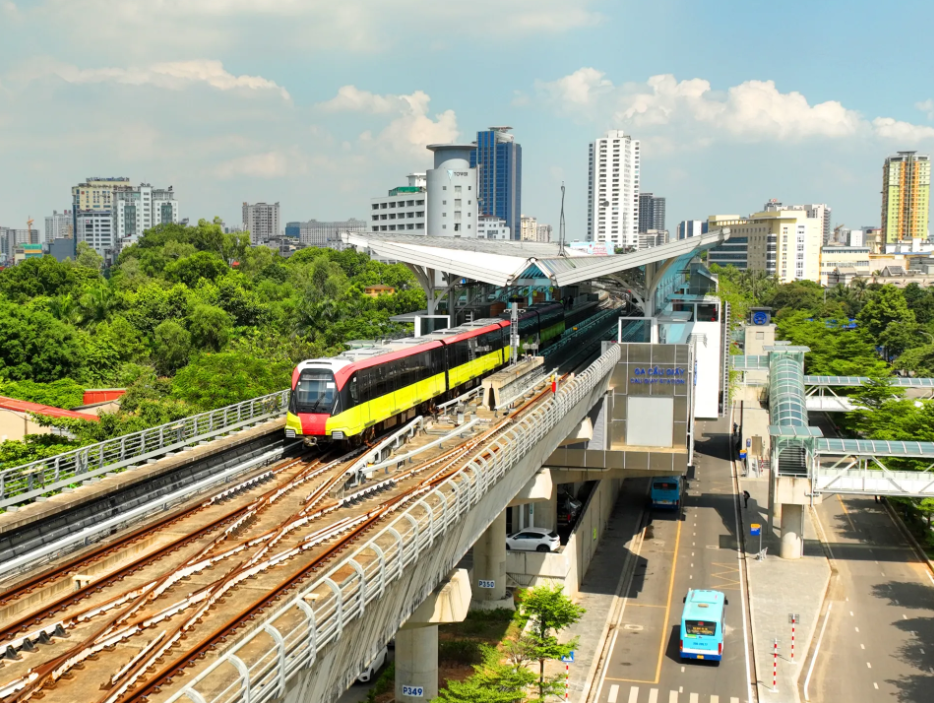
The Nhon - Hanoi Station metro line. Photos: Pham Hung/The Hanoi Times
According to Chairman of the Hanoi People’s Committee Tran Sy Thanh, the city is aiming to complete 14 urban railway lines by 2035, along with Belt Road No. 5 and a second international airport by 2040.
Notably, Hanoi plans to build 20 new traffic routes and 10 eco-urban areas along the Red River, creating new and sustainable development spaces. By 2030, the city targets full smart traffic management in its urban core and aims to cut traffic congestion by 50%.
Professor Le Anh Tuan, Chairman of the University Council at Hanoi University of Science and Technology, noted that in this new phase, Hanoi must prioritize strong investment in transport infrastructure, calling it a “pioneering task,” as the growth of many city areas heavily depends on improved connectivity.
"To meet its development goals, Hanoi needs to accelerate key transport projects, which will serve as new drivers of growth and support its ambition for double-digit economic expansion in the coming years," Tuan told Hanoimoi.
Experts noted that areas like My Duc and Huong Son have unique potential for spiritual and cultural tourism, especially the Huong Pagoda complex, but poor transport access makes travel from central Hanoi longer than to Haiphong, limiting visitor numbers and economic potential.
A striking example is Hanoi’s ambition to attract high-quality human resources to Hoa Lac Hi-Tech Park, positioning it as a key engine for future growth, potentially a "Silicon Valley" for Vietnam or a major tech hub like those in India. To make this vision a reality, many experts urged the city to fast-track investment in public transport systems that link the city center with Hoa Lac.
Dr. Nguyen Viet Chuc, former Vice Chairman of the National Assembly's Committee on Culture and Education, suggested that the city should prioritize the construction of Metro Line 5, which connects Van Cao in Ba Dinh Ward to Hoa Lac in Thach That Commune.
Professor Tran Thanh Hai, Rector of the Hanoi University of Mining and Geology, noted that the rising demand for fossil fuel-powered vehicles is worsening pollution. He emphasized that solutions must be comprehensive and well-thought-out.
For instance, limiting such vehicles in the city center would require adequate parking, alternative transport options, and shuttle services, Hai said.

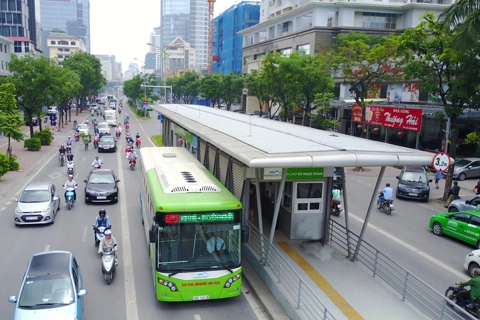
BRT buses operating on Lang Ha Street, Hanoi.
“If Hanoi wants to transition to electric vehicles, the electricity supply must be robust and safe, with high capacity, and the charging infrastructure must be synchronized and available at every residential area. At the same time, there must be clear plans for fire prevention, emergency response, and evacuation procedures in case of incidents," he added.
The 17th Hanoi Party Committee on July 15 released its draft Political Report for the upcoming 18th Party Congress (2025–2030 term) through local media to gather public feedback. The report is slated for presentation at the congress in mid-October and serves as the central document, summarizing the previous term’s achievements and charting directions, tasks, and solutions for the next five years with the goal of driving new breakthroughs for the capital.
|
Assoc. Prof. Dr. Hoang Tung, Rector of Hanoi University of Civil Engineering: Prioritize Transit-Oriented Development in Infrastructure Planning Hanoi currently resembles the expanded Paris model, featuring a dense “central city” (intra-muros) surrounded by a vast peri-urban and rural belt. This model maintains traditional administrative boundaries but introduces a regional-level governance structure with authority over spatial planning, economic development, housing, environment, and transportation. However, Hanoi’s transport infrastructure still lacks strong connectivity between the urban core and outlying areas. Metro coverage remains limited, and newly developed residential zones far from the center rely heavily on private vehicles. Many urban developments are disconnected from public transport networks, contrary to the principles of Transit-Oriented Development (TOD). To address this, Hanoi urgently needs to design infrastructure systems that prioritize TOD. This includes building around metro lines, BRT corridors, and railway stations to form new growth hubs. At the same time, infrastructure investment should follow patterns of urban traffic flows rather than administrative boundaries. Prof. La Ngoc Khue, Former Deputy Minister of Transport: Develop an Integrated Urban Transit Network I believe that with the right strategies, Hanoi has the potential to operate an urban transport system where public transit accounts for 50% of travel by 2030. Achieving this would help lift the capital out of its current status as one of the most congested and polluted cities globally. The first priority should be to complete key transport projects that form the backbone of the public transit network by 2027. Following that, the city should utilize existing infrastructure to build and launch Metro Line 6, which would connect Van Dien to Ha Dong, An Khanh, Co Nhue, Thang Long Bridge, Bac Hong Station, and extend an additional 3 kilometers to reach Noi Bai International Airport. Hanoi must also establish a comprehensive bus network covering the entire city, including the eastern extension of Ring Road No. 4 on the left bank of the Red River. The goal is to ensure that every resident in the central area is within 500 meters of a bus stop. Most urgently, construction must begin on Metro Line 1, linking Yen Vien with Ngoc Hoi. |