Hanoi kicks off work on Ninh So-Phase 2 industrial cluster
Establishing industrial clusters is expected to meet the high demand for manufacturing space in localities while solving environmental problems in the community.
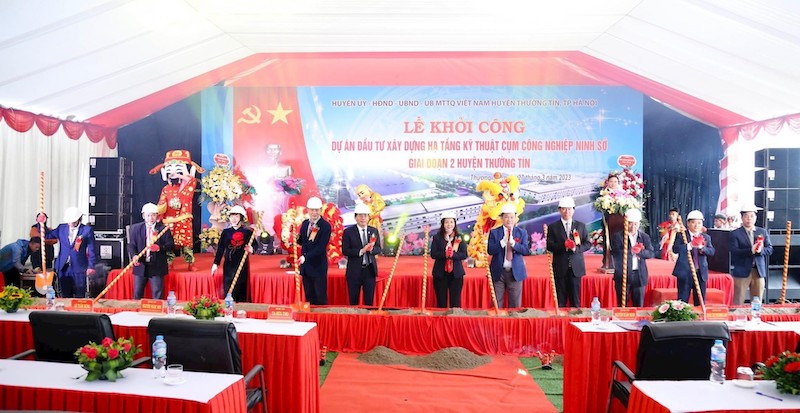
Hanoi authorities started the construction of the Ninh So Phase 2 industrial cluster in Thuong Tin District on March 28.
| The groundbreaking ceremony of the project. Photo: Hanoimoi Newspaper |
The Ninh So industrial cluster has a total area of 76,476 square meters, with an investment capital of VND171 billion ($7.2 million) from Tan Dat Confitech JSC. The need for further expansion of the industrial cluster has increased thanks to local people's growing demand for production space.
Speaking at the event, Mr. Nguyen Xuan Minh, Chairman of the Thuong Tin District People's Committee, said the new industrial cluster, together with the other two [Thang Loi and Tien Phong Phase 2 industrial clusters], would create thousands of jobs and raise people's living standards, contributing to the socio-economic development of the locality and the city.
He added that the locality has 126 handicraft villages, of which 48 are recognized as traditional craft villages, and the rest are business households. Establishing the industrial clusters will solve the high demand for production space in the localities and, at the same time, a way out of environmental pollution.
"Gathering small-scale production facilities into the cluster will help to reduce environmental pollution in residential areas," he said.
Currently, the district has a total of 11 industrial clusters covering more than 195 hectares.
"It would be a breakthrough in the sustainable development of traditional craft villages in the area," he pointed out.
Speaking at the project's groundbreaking ceremony, Acting Director of Hanoi's Department of Industry and Trade Tran Thi Phuong Lan urged the Thuong Tin District to focus on speeding up the construction of the Ninh So Phase 2 Industrial Cluster and other industrial park projects in the area so that they can start operating soon and create jobs.
She said that during the construction process, the investor must strictly comply with regulations on environmental impact assessment and focus on completing the construction of synchronous industrial infrastructure according to the approved design, especially wastewater treatment and industrial solid waste systems while ensuring requirements for fire prevention and extinguishing.
Hanoi has 10 industrial parks covering 1,300 hectares. Nine are operational and almost fully occupied, while the Hanoi South Supporting Industrial Park is under construction. These parks generated $8.1 billion in revenue in 2022, increasing 4.1% compared to the previous year, with combined exports estimated at $5.1 billion and imports valued at $4.3 billion.
The city has planned to establish 5 to 10 industrial clusters this year, part of Plan No. 97 of the City on the Management and Investment of Industrial Clusters in 2023.
Hanoi aims to attract $400 million in foreign direct investment to its industrial parks and production zones in 2023, an increase of 20% compared to the previous year.
The Hanoi Export Processing and Industrial Zones Authority reported that there are 711 valid projects in the industrial parks, of which 307 are from foreign investors with registered capital of $6.3 billion and 404 from domestic sources. The projects are worth VND19 trillion ($803.5 million) and provide jobs for nearly 166,000 people.