Hanoi launches 2030 energy security plan
Hanoi will seek breakthroughs in science and technology, digital transformation and workforce training, while enhancing international cooperation in the energy sector.
THE HANOI TIMES — Hanoi has announced a plan to implement Resolution No. 70 dated August 20, 2025, of the Politburo on ensuring national energy security through 2030 with a vision to 2045.
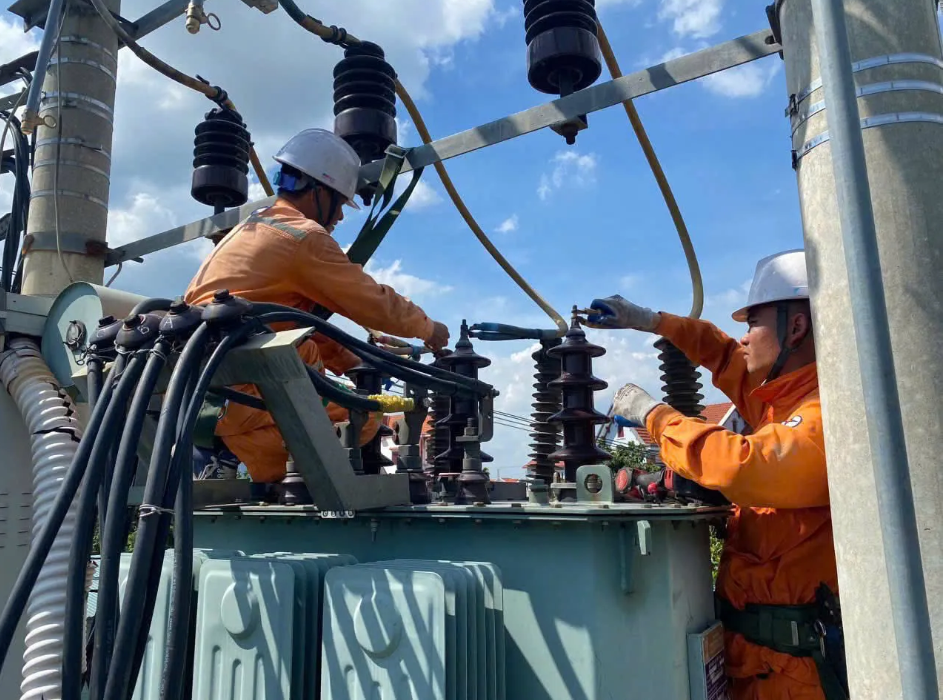
EVNNPC workers inspect electrical equipment during the peak usage period. Photo: Kim Ngan/The Hanoi Times
According to a decision signed on January 1 by Vice Chairman of the Hanoi People’s Committee Nguyen Manh Quyen, the city aims to roll out a coordinated set of solutions to invest in power projects in line with the Capital Master Plan, the implementation plan for the master plan, and the approved power supply network development scheme.
These include power generation projects as well as transmission and distribution grids, alongside a gradual energy transition to meet national development needs.
Under the plan, by 2030, Hanoi targets total commercial electricity consumption of 52,178 million/kWh. Average electricity consumption per capita is expected to reach 5,721 kWh per year, while peak capacity Pmax is projected at 9,400 MW.
Average growth in commercial electricity consumption is designed to support double-digit economic growth.
Renewable energy sources are expected to account for at least 5% of the total primary energy supply.
By 2030, the city aims to develop around 1,500 MW of solar power capacity, while accelerating investment in centralized solar projects and rolling out rooftop solar systems across industrial parks, high-tech zones, industrial clusters, government offices, apartment buildings, high-rise structures, commercial and service complexes and residential housing.
Energy savings are targeted at 8% - 10% of total citywide energy consumption. Hanoi will promote the use of high-efficiency equipment and machinery, expand energy audits, and reduce electricity use and emissions at industrial parks, factories and urban areas.
The city also plans to maintain petroleum reserves equivalent to around 90 days of net imports. At the same time, it will develop infrastructure to meet liquefied natural gas import needs for LNG-fired power generation and other uses, while forming balanced and centralized LNG energy hubs.
Greenhouse gas emissions from energy activities are expected to decline by around 15% - 35% compared with a business-as-usual scenario. These reductions will be aligned with economic growth targets of at least 11% in 2026 and the years that follow.
Hanoi will develop a smart and efficient power grid with safe regional connectivity. Electricity supply reliability will meet the N-1 standard for key load areas and the N-2 standard for especially critical load zones and transmission networks.
Power supply reliability indicators will continue to improve, gradually approaching the levels seen in the capitals of several developed countries in the region.
In parallel, the city will complete the transition to a unified 22 kV voltage level for the medium-voltage grid. The undergrounding rate of medium- and low-voltage power lines in wards, central areas and well-planned urban zones is targeted to reach 100%.
Looking to 2045, Hanoi aims to firmly safeguard national energy security while developing a competitive, transparent and healthy energy and electricity market.
The energy sector is expected to grow in a coordinated and sustainable manner, using resources efficiently, protecting the environment, reducing greenhouse gas emissions and adapting to climate change.
Energy infrastructure will be smart, modern and well-connected across the region, while human resources, science and technology and sector governance capacity are expected to reach levels comparable with those of advanced industrialized countries.
To achieve these goals, the city will strengthen Party leadership, state management and the participation of the entire political system and the public.
It will continue to improve institutions and policies, expand energy supply and infrastructure, promote energy efficiency and environmental protection, mobilize social resources and encourage private sector participation.
Hanoi will also seek breakthroughs in science and technology, digital transformation and workforce training, while enhancing international cooperation in the energy sector.
Source: Document No. 385/KH-UBND of the Hanoi People's Committee on December 31, 2025.