Hanoi outlines people-first, data-driven smart city pillars for sustainable urban development
Hanoi has unveiled a smart city strategy built around people, governance, technology and sustainability, aiming to balance growth with quality of life while advancing data-driven urban management at the Vietnam-Asia Smart City Summit 2025.
THE HANOI TIMES — Hanoi will develop its smart city model around clear guiding pillars to balance growth, governance and social values, said Truong Viet Dung, Vice Chairman of the Hanoi People’s Committee.
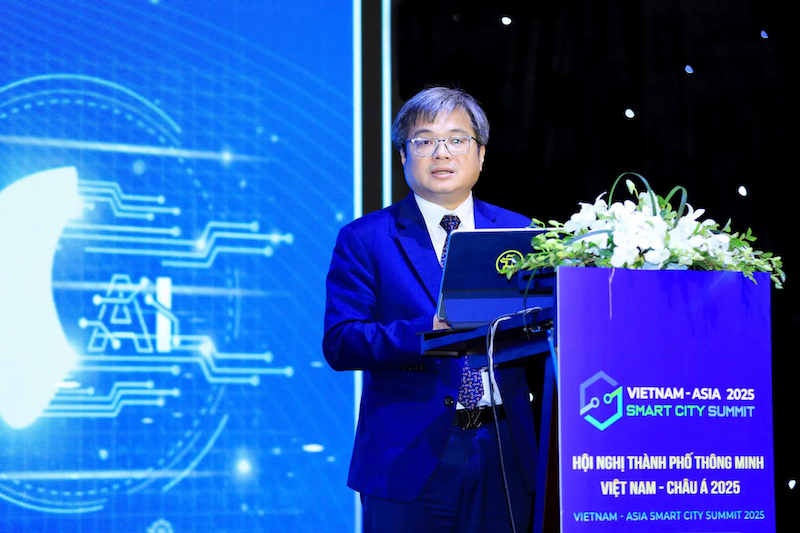
Truong Viet Dung, Vice Chairman of the Hanoi People’s Committee, speaks at the plenary session of the Vietnam-Asia Smart City Summit 2025. Photos: Kinh te & Do thi Newspaper
Speaking at the plenary session of the Vietnam-Asia Smart City Summit 2025, themed “Green and Smart Cities Powered by AI” on December 23, Dung said Hanoi plans to transform into a smart city built on four core pillars.
The first pillar places people, happiness and quality of life at the center, with solutions and technologies designed to improve safety, convenience, daily experiences and overall well-being.
The second pillar focuses on modern urban governance, seeking to reform management methods, strengthen coordination, enable faster decision-making and improve the effectiveness of public administration in a more complex urban environment.
The third pillar emphasizes innovation and technology, positioning science, digital transformation and artificial intelligence as practical tools to support governance, economic development and more efficient public services.
The fourth pillar promotes green and sustainable development while preserving Hanoi’s cultural identity, ensuring modernization aligns with environmental protection, efficient resource use and the protection of historical and cultural values.
Dung said Hanoi prioritizes governance capacity and quality of life, treating technology as a means rather than an end.
“A key shift involves moving from sector-based management to data-driven, integrated urban governance,” he said.
To avoid fragmented investment, the city is piloting smart city models in selected development zones under controlled “sandbox” mechanisms that allow ongoing evaluation, adjustment and long-term sustainability, Dung added.
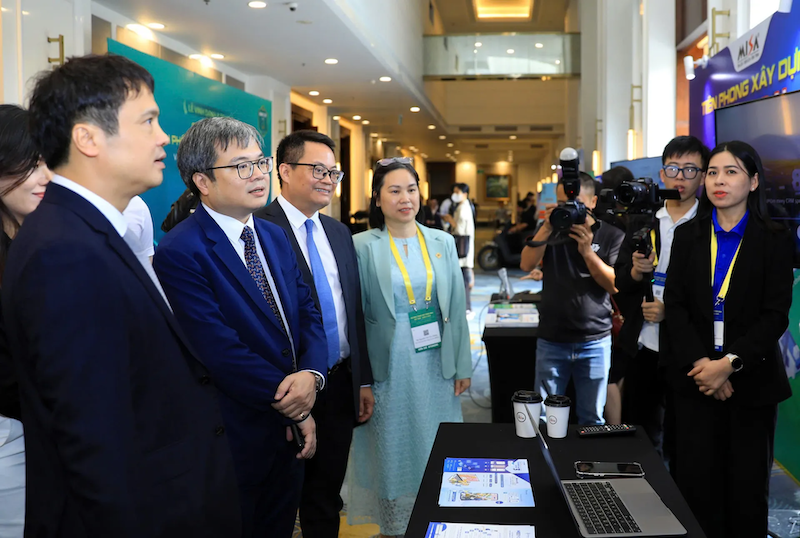
Truong Viet Dung, Vice Chairman of the Hanoi People’s Committee, visits the exhibition on the sidelines of the session.
At the summit, experts stressed the need for practical, people-centered approaches to smart city development, warning that data growth far exceeds the capacity of local governments to manage and use it effectively.
Nguyen Thi Tuyet Nhung, Vice Secretary-General of the National Data Association, highlighted a growing gap between rapid data generation and limited local capacity to harness it.
She said only about 2% of newly created data remains stored into the following year, and just 1% of data generated by Internet of Things systems reaches effective use.
From this reality, Nhung outlined three key lessons for local governments.
First, cities should treat urban data as public infrastructure, supported by clear and transparent governance frameworks, before rolling out technology.
Second, smart city development should prioritize standardization and system interoperability to prevent data silos across agencies and platforms.
Third, investing in people matters more than investing in technology. Public officials need the skills to turn data and digital tools into real value.
“The success of a smart city depends on how effectively it uses data to make better decisions and serve citizens,” she said.
Tran Ngoc Linh from the Urban Development Agency shared the same view, saying smart cities should not operate as standalone technology projects.
Instead, Linh said, they must align closely with digital transformation agendas, digital government development and administrative reform.
She added that smart city initiatives should begin with urgent local challenges such as traffic congestion, environmental pollution, healthcare, education and public security.
Representatives from technology firms, including Viettel, VNPT and FPT, also shared practical solutions to support smart urban development.
|
Vietnam-Asia Smart City Summit 2025 highlights Hanoi as smart, innovative city The Vietnam-Asia Smart City Summit 2025 was jointly organized by the Vietnam Software and IT Services Association (VINASA) and the Hanoi People’s Committee. Hosting the summit highlights Hanoi’s leading role in implementing the amended Capital Law and advancing Politburo Resolution No. 57 on science, technology, innovation and national digital transformation. The event helped promote Hanoi as a smart, innovative and globally connected city, supporting efforts to attract investment, high-quality talent and development capital. Hanoi reaffirmed its goal of becoming a national innovation hub and its commitment to working closely with the Ministry of Science and Technology and related agencies. The summit featured one plenary session and five thematic forums on AI-powered smart city solutions, covering urban governance, digital infrastructure, green energy and smart mobility toward Net Zero 2050, green living technologies, digital business and international cooperation. More than 1,500 delegates attended, alongside an exhibition of 15-20 booths, business-matching activities, partnership signings and the Vietnam-Asia Smart City Awards 2025. |