Hanoi Party Committee sets priorities for 2026
The priorities reflect Hanoi’s ambition to modernize governance, sustain economic momentum and position itself as a dynamic, livable and globally connected capital in the years ahead.
THE HANOI TIMES — Hanoi’s Party Committee has issued its 2026 Work Program, setting out key political, economic and governance priorities as the capital enters a new development phase.
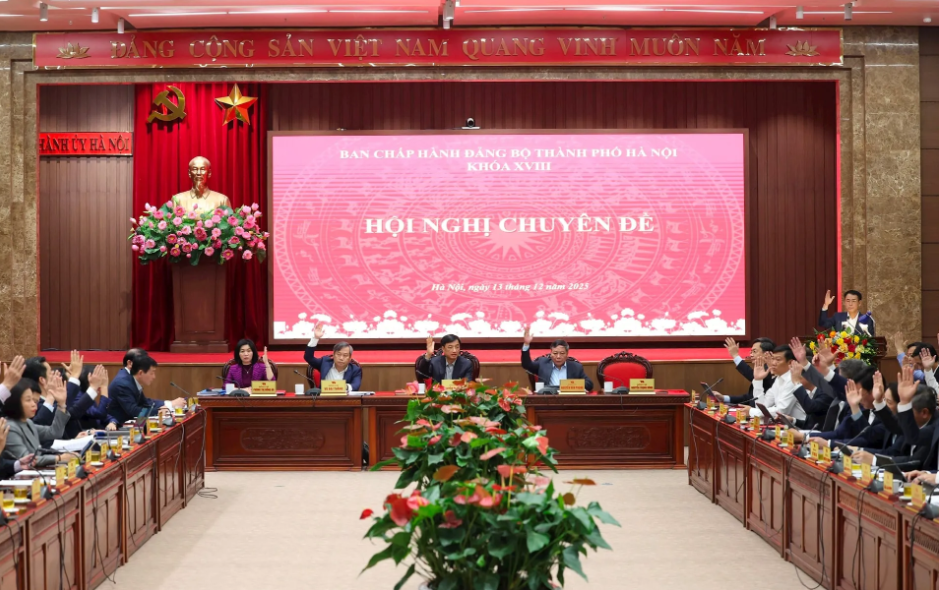
A thematic session of Hanoi People's Committee on December 13. Photo: The Hanoi Times
The program, signed by Secretary of the Hanoi Party Committee Nguyen Duy Ngoc on December 16, places implementation of the resolutions of the 18th Hanoi Party Congress and the 14th National Party Congress at the center of the city’s agenda.
These priorities are translated into concrete action plans aligned with national strategies and the capital’s long-term development goals.
A major focus in 2026 will be preparations for elections to the 16th National Assembly and the 2026–2031 People’s Councils at all levels.
The city aims to ensure a transparent and orderly process while selecting qualified representatives who reflect public aspirations and strengthen democratic governance.
The program also underscores reforms in leadership and administration, with an emphasis on results-based governance and people-centered policies. Hanoi will continue efforts to streamline the two-tier local government model, remove institutional bottlenecks and pursue double-digit economic growth while improving living standards.
Urban development and competitiveness remain central themes. Hanoi plans to mobilize all available resources to advance its three creative pillars of heritage, knowledge and technology, strengthen regional linkages and reinforce its role as the core of the capital region.
Addressing traffic congestion, flooding, environmental pollution, food safety and urban order is identified as an urgent priority.
The city will also accelerate implementation of its five-year plans for socio-economic development, public investment and state budget management. These efforts are anchored in three strategic pillars: the Politburo’s Resolution on Hanoi’s development to 2030 with a vision to 2045, the 2024 Capital Law and the city’s approved master plans.
Digital transformation and innovation feature prominently in the 2026 agenda. Hanoi aims to apply science, technology and data-driven governance more deeply across public administration, urban management and service delivery, in line with the Politburo’s resolution on digital transformation.
The program further emphasizes anti-corruption efforts, administrative discipline, public accountability and stronger inspection and oversight mechanisms. Party building, political education and ethical leadership are highlighted as foundations for effective governance.
In 2026, Hanoi’s Party Committee is expected to hold five regular plenary meetings and several thematic sessions, while the Standing Committee will convene up to 24 meetings to steer implementation and address emerging issues.