Hanoi pilots air quality forecasting and early warning system
The system, called HanoiAir, allows forecast air quality trends over time and across locations to support the local authorities in implementing pollution control measures.
THE HANOI TIMES — Hanoi is piloting an air quality forecasting and early warning system as pollution levels in the capital show signs of continued deterioration, said Vu Xuan Tung, deputy director of the municipal Department of Agriculture and Environment.
The system, known as HanoiAir, is being jointly tested by the department, the National Center for Hydro-Meteorological Forecasting and the University of Engineering and Technology under Vietnam National University Hanoi.
Preliminary data from HanoiAir showed that air quality in several areas of the city reached unhealthy levels on the morning of January 9.
The readings triggered warnings advising residents, particularly the elderly and children, to limit outdoor activities as a precaution against health risks.
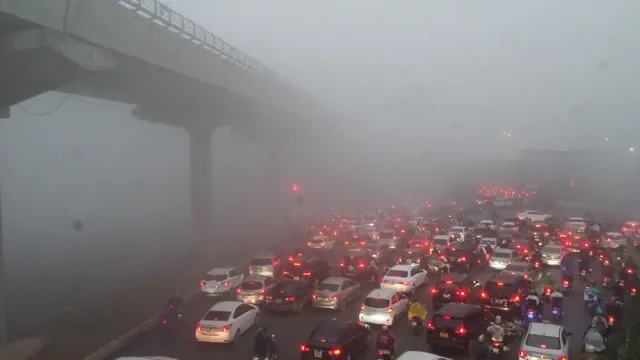
Hanoi is shrouded in smog due to air pollution. Photo: suckhoedoisong.vn
In early January, Hanoi’s air quality has been deteriorating. Forecasts indicate that the city’s average air quality index (AQI) in the next five days (January 10 and 14) will reach poor and very poor levels, with a peak of 114 on January 10 and 139 on January 11, unhealthy for sensitive people.
The southern, southwestern and northwestern areas of the capital city are expected to be the most affected.
These figures show the real risk of worsening air pollution without timely response mechanisms, especially when Hanoi keeps expanding infrastructure and upgrading urban areas.
Tung noted that HanoiAir serves as a crucial tool for practical management and decision-making, a tool to trigger concrete management actions.
"Based on the forecasts, the municipal Department of Agriculture and Environment can issue guidance requesting relevant agencies and localities to apply urgent measures to curb pollution sources," said the official.
When the system warns that pollution risk increases, measures to control dust at construction sites, tighten material transportation and limit outdoor emission sources must be implemented immediately.
"We must not wait until the AQI exceeds the unhealthy threshold before taking action," said Tung.
Winter and spring air pollution will develop rapidly and are strongly influenced by adverse weather conditions. Without early forecasts, authorities risk being reactive, reducing the effectiveness of pollution control measures."
HanoiAir is an important solution for the capital city in ensuring continuous and sustained actions rather than short-term measures.
Hanoi has affirmed its commitment not to trade environmental protection for economic growth. It has also planned to establish low-emission zones (LEZs) as a core measure to control emissions and promote green, sustainable urban development.