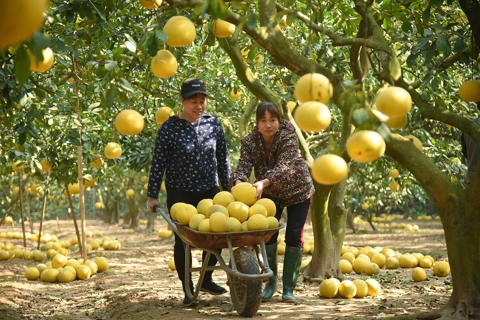
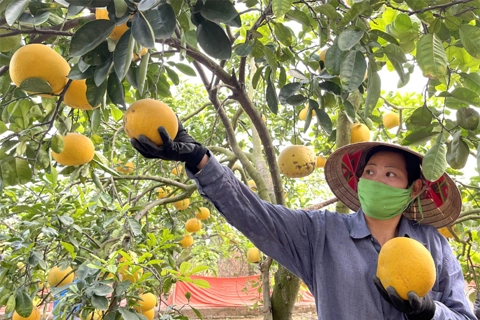
Hanoi replicates world-class pomelo plantations
Pomelo is one of Hanoi's most important agricultural exports, which has been prioritized to improve its economic efficiency.
Hanoi's agribusinesses have been at the forefront of developing high-quality pomelo using world-standard technology.
Le Huu Dien, Director of the Duc Hau - Luu Quang Clean Agricultural Cooperative in Hanoi's Chuong My District, told The Hanoi Times that the cooperative has nearly three hectares of VietGAP (Good Agricultural Practices) certified pomelo.
"The VietGAP pomelo has a cool sweet taste and a beautiful shiny yellow skin. The longer you keep it, the sweeter it gets. Furthermore, it has a production of 30,000 to 40,000 fruits per year and is ordered by companies for distribution through modern trade channels," Dien said.
Phuc Tho is planned to be a green agricultural production area in Hanoi. The district is focusing on introducing brands of 'Tam Van grapefruit' for marketing and increasing economic value for local people.
A Tam Van pomelo tree is capable of producing between 200 and 500 fruits in a single harvest. Photo: Cao Van Ngan |
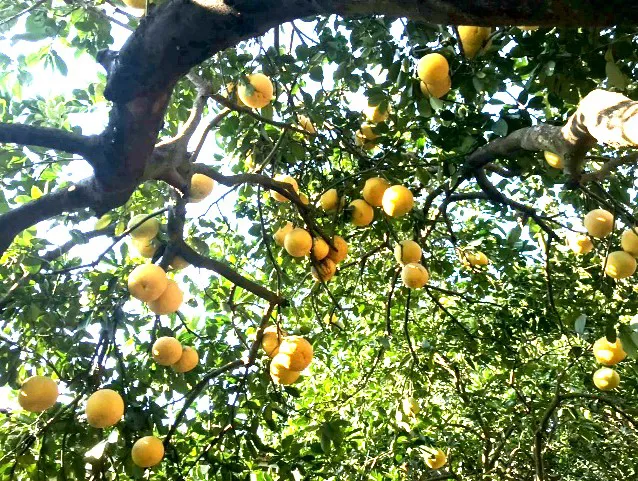
"After more than 10 years of planting 400 pomelo trees, my family earns VND600-800 million (US$23,600-31,400) per year from the harvest. We are very proud of the Tam Van pomelo brand, which has been officially recognized by the Department of Intellectual Property - the Ministry of Science and Technology," Cao Van Ngan, a long-time Tam Van pomelo farmer in Phuc Tho District, told The Hanoi Times.
To ensure high productivity and yield of grapefruit trees, the district coordinates with research centers and institutes to organize training courses for farmers on tending techniques and disease prevention. "At present, we are actively applying science and technology in line with VietGAP and organic processes to ensure sustainability and competitiveness in the market," said Ngan.
Dien pomelo, grown for many years by the people of Dan Phuong, has geographical indications and traceability labels. Nguyen Khac Ky, a farmer in Dan Phuong district, said his family has been planting Dien pomelo trees in an area of more than 3,000 square meters for more than 20 years.
"With 140 pomelo trees, we harvest over 10,000 fruits every year, which generates a substantial income. To develop a sustainable grapefruit orchard, we use only organic herbal products to care for the fruit and create safe products. With the support of the district's farmers' association, our pomelo has been sold in grocery chains in Hanoi," Ky said.
As part of the VietGap program, Dien pomelo is carefully tended to meet standards for entry into supermarkets and high-value agricultural supply chains. Photo: Thoi Nguyen/The Hanoi Times |
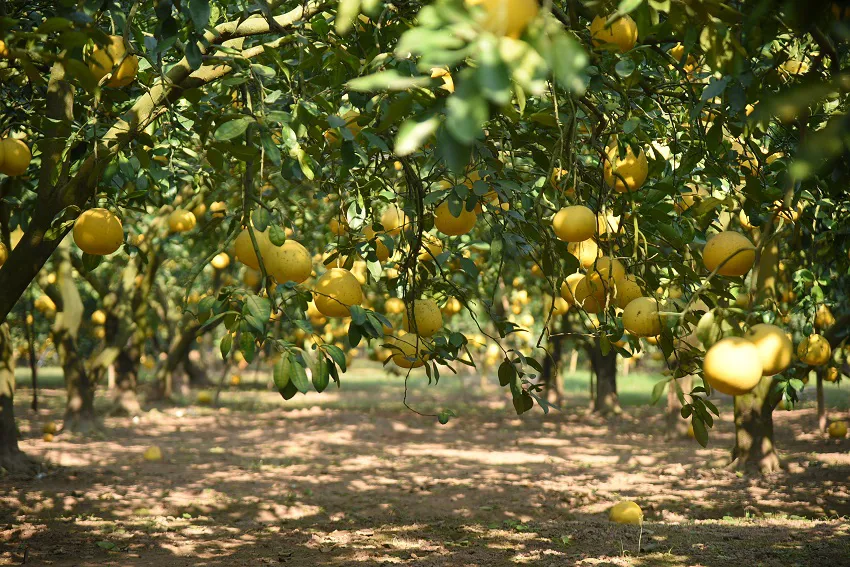
Ta Nhu Dinh, owner of a four-hectare pomelo farm in Thuong Mo Commune, Dan Phuong District, told The Hanoi Times that his family has been growing pomelo for over 30 years. In 2023, they harvested a total of about 100,000 fruits, an increase of about 10-15% from the previous year.
"We grow pomelo under the VietGap organic program. The crops are mainly fertilized with soya beans and ash, so the fruit has a nice aspect, bright and very sweet. Many supermarkets in Hanoi accept our products on their shelves," said Dinh.
Thieu Van Son, Chairman of the Dan Phuong District Farmers' Association, said the association regularly organizes seminars to train farmers on herbal biological products used on crops to produce safe crops.
"Dan Phuong District has nearly 300 hectares of pomelo plantations. The farmers' association has selected quality pomelo orchards to use an electronic traceability system, QR codes, and to sell the products in supermarkets and convenience stores. The association is also introducing farmers to promotional and trade programs so that more and more people know about Dan Phuong pomelo and help to add value to the product," said Son.
For many years, the Hanoi Agricultural Development Center has worked with Hoai Duc District to develop VietGAP models for La Tinh pomelo. "The district is planning stable pomelo growing areas, which will be combined with agro-tourism to improve economic efficiency," said Nguyen Trung Thuan, Vice Chairman of the Hoai Duc District People's Committee.
To replicate VietGAP pomelo, Nguyen Nhu Hao, Director of Que Duong Safe Pomelo Production Cooperative in Hoai Duc District, said that the municipal authorities should organize regular training classes for farmers.
"Applying high technology in large-scale production, building brands and geographical indications for pomelo specialties of each locality so that the products can be put into modern distribution channels," Hao added.
Scientific farming
Nguyen Manh Phuong, Deputy Director of the city's Department of Agriculture and Rural Development (DARD), said that over the years, the city's agriculture sector has held training courses and transferred scientific and technical advances in crop renovation according to VietGAP standards.
"Hanoi has nearly 10,000 hectares of pomelo plantations, mainly in Dan Phuong, Chuong My, Phuc Tho, Phu Xuyen, and Quoc Oai districts. The main varieties, such as Dien grapefruit, Tan Lac red pomelo, and Cat Que pomelo, bring high economic value to the city, generating annual revenues of VND500-800 million ($19,600-34,110) per hectare," Phuong told The Hanoi Times.
In the experience of pomelo growers, the older the tree, the sweeter the fruit. The skin of the fruit turns dark yellow when being ripe. Photo: Bich Hoi/The Hanoi Times |
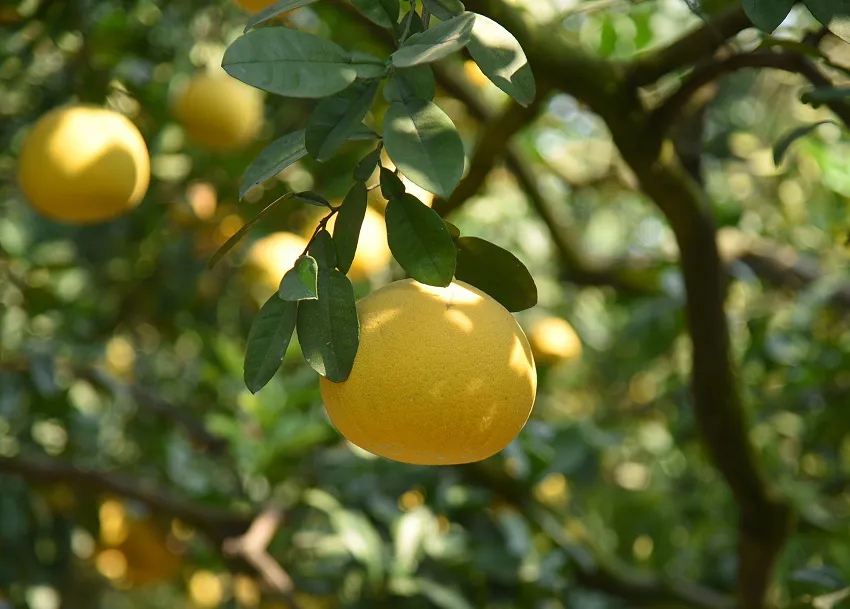
"Recently, many production households have actively invested in automatic irrigation systems and renovation of planting areas to improve their economic efficiency. Meanwhile, the local government has encouraged farmers to choose high-quality seedlings suited to each region's climatic and soil conditions and to master the technical process," Phuong said.
Pomelo has grown securely and organically in the city thanks to years of hard work by the agricultural sector, according to Vu Thi Huong, head of the Hanoi Agricultural Extension Centre under DARD.
"The city has developed two pomelo plantation areas that meet organic standards, opening up opportunities for Vietnam to penetrate demanding markets such as the United States and the European Union. The US Department of Agriculture has given the pomelo varieties high marks for quality and taste," Huong told The Hanoi Times.
She added that after learning the US’s import regulations, the Hanoi Agricultural Extension Center will coordinate with localities to review and re-evaluate the concentrated production areas eligible for export and then register the pomelo growing area code in the coming period.
Huong emphasized that pomelo is one of Hanoi's most important agricultural exports, which has been prioritized to improve its economic efficiency.