Hanoi revives polluted rivers to build a greener and more livable capital
Hanoi is embarking on an ambitious plan to restore its inner-city rivers, starting with the To Lich, as part of a broader effort to build a greener and more livable capital.
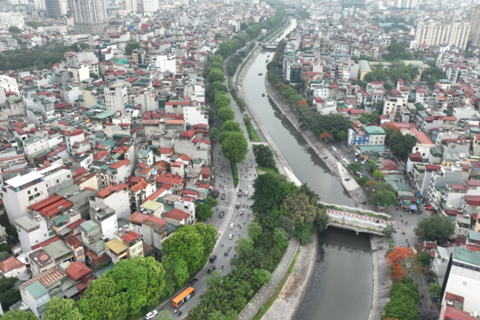
THE HANOI TIMES — Once written off as a dead river, Hanoi’s To Lich is now flowing back to life, turning from a decades-old pollution hotspot into a symbol of the capital’s determination to build a greener and more livable city.
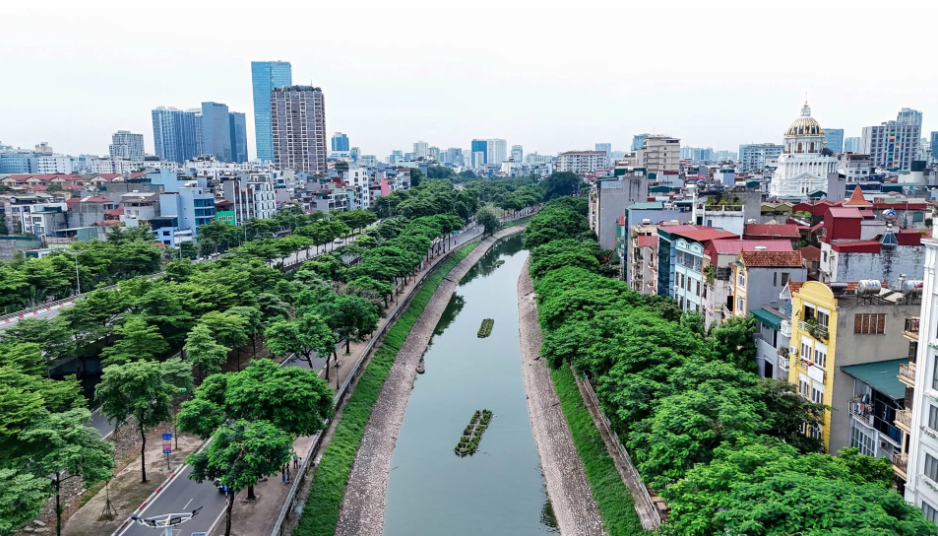
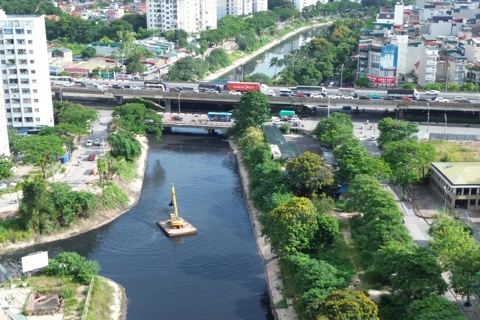
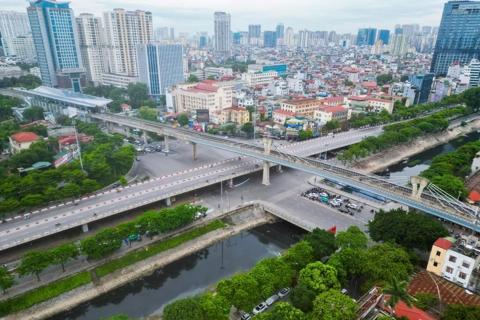
To Lich River banks after water pollution cleanup. Photo: Pham Hung/The Hanoi Times
For years, the river was synonymous with pollution, forcing nearby residents to keep their windows shut to escape the stench. Today, it is writing a story of renewal.
Its early progress is the result of quick fixes and a comprehensive approach that tackles problems at their source.
The most crucial step was cutting off pollution at its origin. At the heart of this effort is the Yen Xa Wastewater Treatment Plant with a capacity of 270,000 cubic meters per day.
Every day, roughly 150,000 cubic meters of domestic wastewater that used to pour directly into the river through hundreds of drains are now collected and treated through an enclosed pipeline system. This marks the end of the “death sentence” the river had endured for decades.
Once the pollution source was contained, the next challenge was restoring the river’s lifeblood - its flow. By channeling clean water from West Lake and treated water from the Yen Xa plant, the To Lich is no longer stagnant. The water level is kept consistently high and stable, creating a continuous flow that circulates and cleans itself.
“I’ve lived here for more than 60 years and never thought I would see the day when I could open my window to welcome the river breeze without that awful smell. The water is clearer now and no longer thick,” said Hoang Giang, a longtime resident on Lang Street.
The transformation is more than visual. Signs of life have returned. Locals can be seen fishing again and flocks of birds have come back to feed along the riverbanks. Water quality indicators, particularly dissolved oxygen (DO) levels, have improved markedly, showing that aquatic ecosystems are recovering.
More importantly, the project has sparked a wave of social awareness. People have begun to view the river as part of their living environment, taking responsibility to keep it clean and appreciate its renewed value.
Expectations and challenges
With To Lich chosen as a pilot model, many wonder if the same approach can be extended to other inner-city rivers such as Set, Lu and Kim Nguu.
The approved plan already includes all four rivers under the same green urban restoration strategy which focuses on wastewater collection and treatment, pollution removal, water replenishment and landscape renewal.
However, environmental experts warn that if resources are concentrated only on To Lich without integrating wastewater management across the entire basin, the effort may become more of a publicity project than a long-term solution. Uneven treatment among river sections could cause progress gaps and undermine the overall outcome.
Experiences from cities like Seoul with its Cheonggyecheon restoration and London’s Thames revival show that technology, financing and governance must work seamlessly together. Otherwise, results can quickly fade.
Cheonggyecheon brought public spaces, cooler city temperatures and higher property values but its annual maintenance cost remains substantial. The Thames restoration took decades of wastewater treatment upgrades and drainage system improvements.
If Hanoi treats To Lich as a mere visual showcase without maintaining waste management governance, pollution could easily return.
Another challenge lies in the treatment technology itself. While methods such as nano-bioreactors can locally clean the water, the results are unsustainable if pollution keeps entering the river.
What matters most is managing pollution at the source, preventing discharge before it reaches the river and not relying solely on end-of-pipe solutions.
Expanding the To Lich model also calls for stronger citizen participation. Residents along the river should be invited to help monitor odors, take photos and record data to complement official tracking systems, adding transparency and accountability for polluters.
Integrating green infrastructure such as wetlands and retention ponds could also help prevent flooding, maintain flow and naturally filter surface water.
A less-discussed but critical factor in the project’s success is financial sustainability. Experts note that operating the treatment system, maintaining the landscape and sustaining the river flow all require stable funding. Without it, early achievements could fade.
Establishing a river conservation fund through a mix of public and private financing or transparent build-transfer (BT) and public-private partnership (PPP) models is therefore essential.
A clear, sustainable and transparent financing mechanism will be key to realizing Hanoi’s river revival ambitions. The model should combine national and local budgets with external resources.
Private sector and community investment can provide the necessary capital while reducing the burden on public funds. This inclusive approach creates shared benefits as businesses gain economic returns while citizens enjoy a cleaner, greener environment.
Vietnam is not short of committed and capable enterprises ready to take part in green projects that generate both economic value and social good. Their involvement ensures that the rivers’ rebirth is not just a government initiative but a collective movement toward sustainability.
The sweeping urban renewal to bring life back to the city’s rivers is an investment in the future on a century-scale. What is happening with the To Lich River is only the promising first chapter of Hanoi’s grand narrative of renewal.
In the near future, residents and visitors alike will remember not only Hoan Kiem and West Lake but also stroll leisurely along a revitalized To Lich listening to the rhythm of a capital that is growing stronger and more harmonious, balancing heritage with sustainable progress.
|
The Hanoi People’s Committee has submitted a proposal to the municipal People’s Council for consideration and approval of the investment policy for the project to renovate, upgrade and redevelop parks along both banks of the To Lich River at the 26th session of the 16th City People’s Council. The project carried out by Sun Group Joint Stock Company will run along the To Lich River through the wards of Ngoc Ha, Nghia Do, Lang, Giang Vo, Cau Giay, Yen Hoa, Thanh Xuan, Dong Da, Khuong Dinh, Dinh Cong, Thanh Liet and Hoang Liet, covering nearly 738,000 square meters. Key components of the project include roads, sidewalks, squares, retaining walls, riverwalks, tree planters, parking areas, sports grounds, playgrounds, pedestrian paths, service facilities, landmark structures, and auxiliary works. The project will also feature green spaces and additional public amenities. The total estimated investment is about VND4.67 trillion (US$185 million) and it will be carried out under a build-transfer (BT) contract. Construction is expected to take place from the third quarter of 2025 to the third quarter of 2027. Once completed, the project will create a new urban landscape described as a “green ribbon” running through the heart of the capital. |