In celebration of the 18th Hanoi Party Congress (2025–2030):
Hanoi sets sights on globally connected city by 2045
The 18th Party Congress of the Hanoi Party Committee has unveiled a bold roadmap for the capital’s next chapter, focusing on innovation, urban connectivity and people-centered development to turn Hanoi into a modern, livable and globally linked city.
THE HANOI TIMES — Hanoi has laid the groundwork for an ambitious transformation, setting its sights on becoming a “globally connected city” by 2045, following a decade of steady growth, improved living standards and major infrastructure breakthroughs.
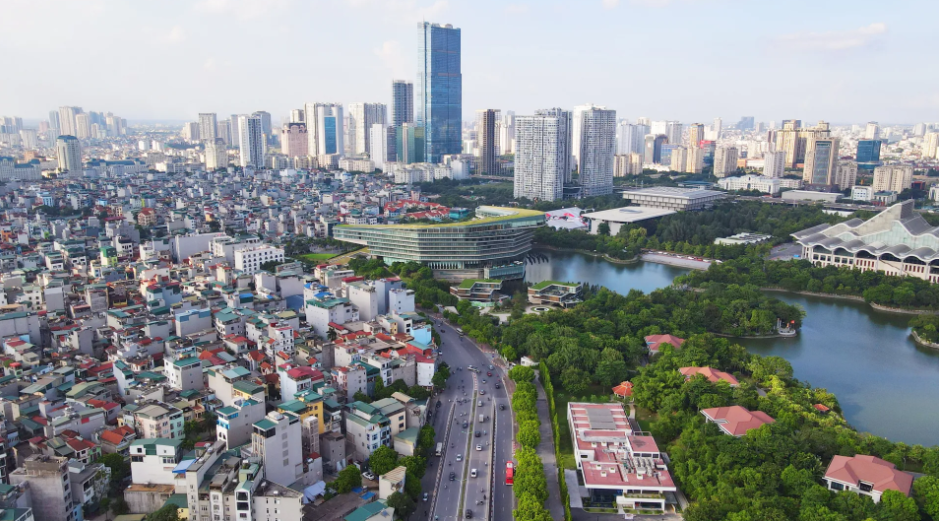
Hanoi from above. Photo: Pham Hung/The Hanoi Times
The vision is among the key priorities outlined in the draft political resolution of the 18th Party Congress of the Hanoi Party Committee for the 2025–2030 term, which opened this morning [October 18] to define the city’s development orientation for the new period.
According to the political report presented at the Congress, Hanoi achieved or exceeded most of the targets set by the 17th Party Congress, despite the severe impacts of the Covid-19 pandemic and global economic fluctuations.
The city’s economy grew at an average annual rate of 6.57%, higher than the national average. Its gross regional domestic product (GRDP) reached about VND1,600 trillion (US$63 billion), and GRDP per capita rose to $7,200.
State budget revenue totaled approximately VND2,200 trillion ($87 billion), 1.8 times higher than in the previous term, while total social investment capital reached VND2,480 trillion ($98 billion).
Living standards improved significantly, with the poverty rate dropping to 0.52%. Major investments were made in social, transport, education and healthcare infrastructure. Key projects such as Ring Road No. 4, metro lines and satellite urban areas are being implemented, marking important progress in regional connectivity and urban development.
However, city leaders acknowledged that Hanoi’s economy still lags behind many regional capitals in productivity, growth rate and investment scale.
Urban planning, land management, environmental protection and infrastructure development remain inconsistent.
In the next term, Hanoi aims to fully leverage its potential and mobilize both domestic and foreign resources to strengthen its position as the national political-administrative center and a leading hub for the economy, culture, education, science, technology and international integration.
By 2030, the city aspires to reach the development level of advanced regional capitals and become a “livable city” with a green, smart environment and happy residents.
According to Secretary of the Hanoi Party Committee Bui Thi Minh Hoai, by 2045, the capital aims to become a “globally connected city” with a high quality of life and comprehensive economic, cultural and social development.
GRDP per capita is expected to exceed $36,000. During the 2026–2030 period, Hanoi targets an average annual GRDP growth rate above 11%, per capita GRDP over $12,000, a digital economy contributing 40% of GRDP, cultural industries around 8%, a Human Development Index (HDI) of 0.88, and a happiness index of 9 out of 10.
The political report outlines ten major tasks and solutions, emphasizing three key breakthroughs: building a streamlined and effective government; developing high-quality human resources and attracting talent; and investing in modern, smart and well-connected infrastructure.
Hoai stressed that Hanoi must “take the lead in institutional reform, innovate its growth model, and build a government that truly serves the people.”
“Every step forward by Hanoi spreads confidence across the nation, affirming Vietnam’s position, courage and intellect on the global stage,” she said in a recent article published on local media.
These directions align with Resolution 15 of the Politburo on the capital’s development toward 2045, with a vision to 2065.
Hanoi is currently adjusting its master plan to expand development space through a multi-polar model with five satellite cities. The city is also investing in completing Ring Road No. 4, urban rail systems, digital infrastructure and the Hoa Lac Innovation Center, while promoting cultural industries, tourism, logistics and high-quality financial services.
"Hanoi is striving not only to remain Vietnam’s economic powerhouse but also to become a regional center for innovation and cultural exchange, contributing to Vietnam’s goal of becoming a high-income, developed nation by 2045," said Hoai.