In celebration of the 18th Hanoi Party Congress (2025–2030):
Hanoi advances high-tech farming with over 400 digital agriculture models
Hanoi views digital technology as a key driver for building transparent, traceable value chains that meet the rising demands of domestic and international markets, forming one of the city’s core solutions to achieve breakthrough development in the 2025–2030 period.
THE HANOI TIMES — As Hanoi gears up for the 18th Hanoi Party Congress (2025–2030) this week, the capital is making its mark with more than 400 high-tech farming models, proof of its pioneering effort to merge technology with agriculture and advance sustainable development over the past five years.
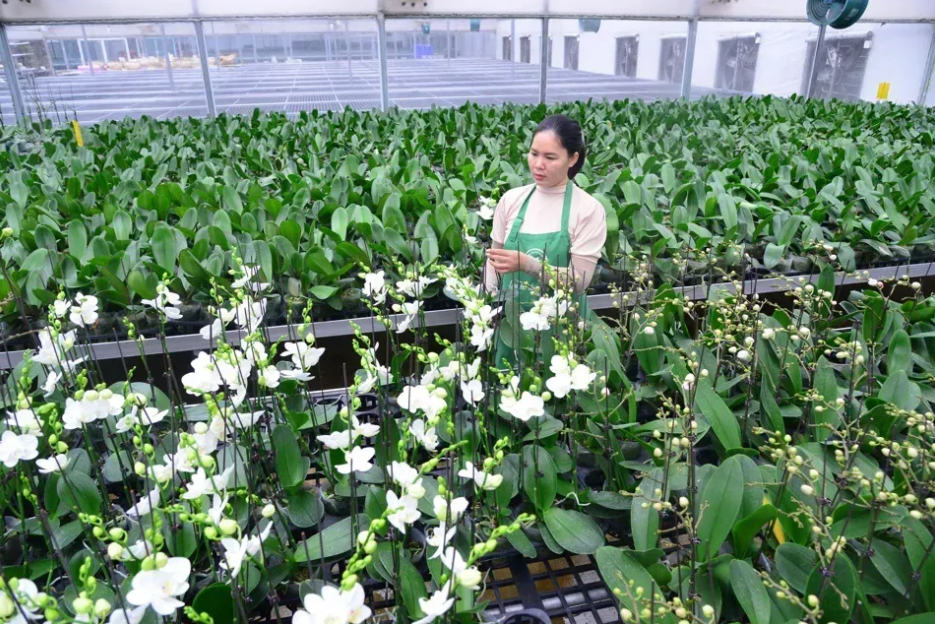
High-tech orchid farming model in Me Linh Commune, Hanoi. Photo: Pham Hung/The Hanoi Times
From hi-tech application…
As one of Hanoi’s leading units in safe agricultural production, the Van Duc Agricultural Service Cooperative in Bat Trang Commune has taken the lead in applying science and technology to farming across 230 hectares of specialized safe vegetable cultivation, including 30 hectares certified under VietGAP standards.
The cooperative has introduced a semi-automatic irrigation system on over 30 hectares of VietGAP-standard vegetable fields, reducing labor costs, ensuring strict water quality control, improving food safety and increasing productivity.
Nguyen Van Minh, Director of the Van Duc Agricultural Service Cooperative, said the cooperative is digitalizing its entire production process, from crop recording and care routines to trading activities.
“This helps make management more transparent, accurate and efficient,” said Minh.
The application of information technology not only strengthens internal governance but also lays the foundation for establishing traceable agricultural value chains that meet the strict demands of domestic and international markets, he continued.
Beyond crop production, high-tech livestock farming is also expanding in Hanoi. As a pioneer in this field, Ngoc Mung Poultry Breeding Joint Stock Company in Thu Lam Commune has developed a modern, fully automated closed-farm system.
According to the company’s Director, Hoang Manh Ngoc, the five-hectare farm raises 200,000 parent chickens and operates 100 modern incubators. Every stage, from temperature and humidity monitoring in barns and hatcheries to automated feeding and watering, is managed through Industry 4.0 technologies.
“The automation of key processes has improved productivity, reduced disease risks, and ensured consistent, healthy flocks,” said Ngoc.
Each month, the company supplies about 600,000 breeding chickens to the market, generating annual revenues of several tens of billions of dong (VND10 billion = US$392,000).”
Under Program No. 07-CTr/TU dated March 17, 2021, issued by the Hanoi Party Committee to promote science, technology, and innovation for the 2021–2025 period, the city has introduced a range of policies to encourage and support businesses, cooperatives, farms and households to invest in high-tech agriculture.
To date, Hanoi has established 406 high-tech agricultural production models and 68 cooperatives applying advanced technologies under VietGAP and GlobalGAP standards, many of which are linking production and consumption through value chains to build brands and improve product quality.
About 20 enterprises have also begun investing in high-tech agriculture, focusing on seed production, agricultural materials, automation and deep processing.
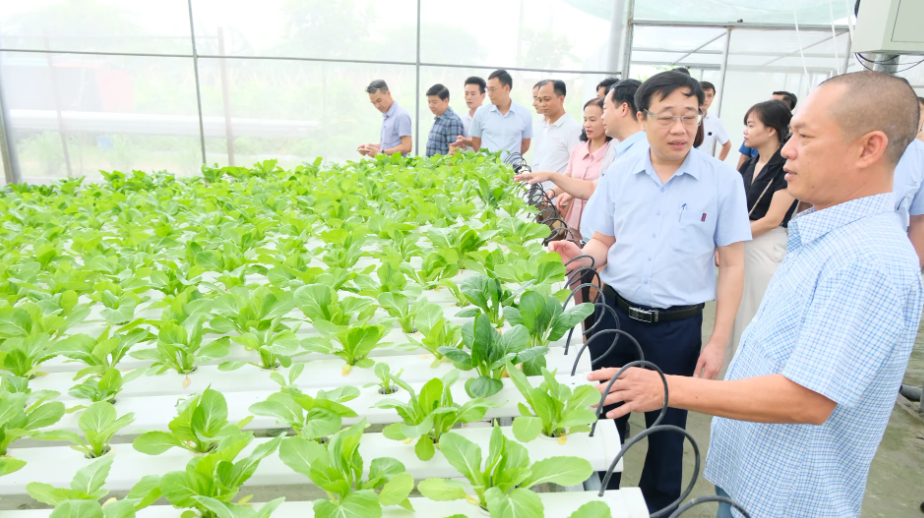
High-tech agricultural model in Soc Son, Hanoi. Photo: Tung Nguyen/The Hanoi Times
…to smart village model
Hanoi’s “smart village” model refers to rural areas that use digital technologies and modern solutions to boost socio-economic development and improve residents’ quality of life.
Several localities have adopted this model effectively, including Hong Van Commune in Gia Lam Commune, where digital tools are used for smart farming, product traceability, tourism promotion and digital skills training for officials and residents.
Pham Tien Dung, Secretary of the Party Committee and Chairman of the People’s Council of Hong Van Commune, said that under Decision No. 06/QD-TTg dated January 6, 2022, approving the national plan for developing a population database and digital identification system for 2022–2025 with a vision to 2030, the commune has widely implemented digital platforms such as VNeID, iHaNoi, and Zalo official account in its administration.
These platforms facilitate communication between local authorities and residents, promote cashless payments, enable QR codes for public services and trade and contribute to building digital governance and society in rural areas.
Economically, Hong Van is gradually transitioning to a rural digital economy through practical initiatives, Dung said.
The commune promotes OCOP (one commune, one product) program and traditional craft village products on e-commerce platforms such as Tiki, Shopee, and Postmart, as well as on social networks like TikTok, Facebook and YouTube.
"We also expand product traceability systems and uses QR codes for agricultural and handicraft products to enhance transparency, ensure quality and widen market access," said Dung.
According to Nguyen Xuan Dai, Director of Hanoi’s Department of Agriculture and Environment, the department will continue to focus on developing digital infrastructure, building specialized databases, implementing digital platforms, streamlining administrative procedures, fostering innovation and enhancing management capacity to further advance smart agriculture.
He added that the department is finalizing major databases on land, environment, crops, livestock, and aquaculture, which will be connected to Hanoi’s and the national data systems to enable efficient access, management and analysis.
It is also deploying the city’s digital document management system across the sector and developing platforms for environmental monitoring, disaster and disease warning, agricultural material management and product traceability.
“These digital systems form a crucial technological foundation that ensures transparent and efficient state management while driving the creation of a modern, sustainable and smart agricultural sector,” said Dai.