Hanoi sets up Steering Committee for Ring road No.4 project
The committee is tasked with ensuring the project’s completion on time and to a high standard.
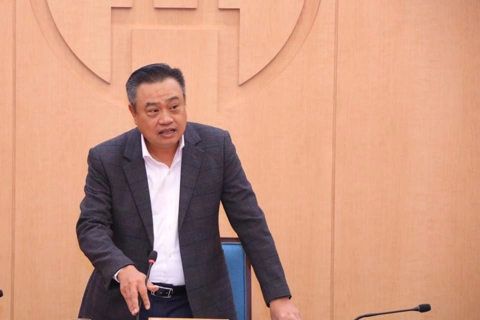
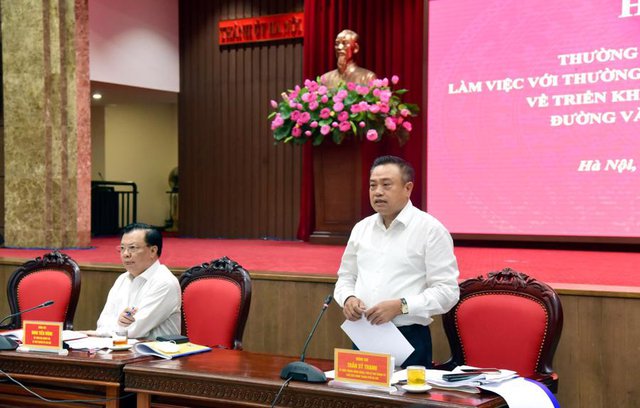
Hanoi has set up a Steering Committee headed by the city's mayor, Tran Sy Thanh, to oversee Ring Road No.4 project, construction of which is scheduled to begin in June.
| Chairman of the Hanoi People's Committee Tran Sy Thanh at a meeting about Ring road No.4. Photo: Gia Huy |
Two deputy chairmen of the municipal People's Committee, Nguyen Trong Dong and Duong Duc Tuan would be the vice chairmen of the Steering Committee, whose members would be senior officials from agencies and districts in the project area: Ha Dong, Soc Son, Me Linh, Dan Phuong, Hoai Duc, Thanh Oai, and Thuong Tin.
The Steering Committee has the responsibility of leading the construction of Ring Road 4 in Hanoi, making certain that the project adheres to the standards set forth in Decree No. 56/2022/QH15 of the National Assembly on approving the investment policy for the project, as well as other relevant laws and government directives.
It must also ensure that the project is on schedule and meets quality requirements.
In addition, it also is tasked with serving as the coordinator for central agencies and other provinces/cities involved in the project.
The Ring Road 4 project involves the construction of a 112.8-kilometer highway, spanning across a total area of 1,341 hectares and passing through the cities of Hanoi (58.2 kilometers), Hung Yen (19.3 kilometers), and Bac Ninh (25.6 kilometers). The road will start at the Noi Bai - Lao Cai highway in Thanh Xuan Commune, Soc Son District, and end at the Noi Bai - Ha Long highway in Que Vo District, Bac Ninh.
The total cost of the Ring Road 4 project is estimated at VND86 trillion (US$3.64 billion), with the implementation set to be divided into seven parts. These include three components for compensating and providing support to households that will be relocated during the construction, three for constructing urban roads as part of the Ring Road (funded by public funds), and one for building an expressway through a public-private partnership.
Once completed and opened to traffic in early 2027, Ring Road 4 is expected to enhance connectivity between Hanoi and other northern provinces in the capital region, promoting socio-economic development in the entire northern area, with Hanoi serving as the main driving force for growth.
The project is expected to cost a total of VND85.8 trillion ($3.7 billion), with the state budget providing VND41.8 trillion ($1.8 billion) over the next five years from 2021 to 2025. Hanoi, Hung Yen, and Bac Ninh will also contribute from their local budgets, with Hanoi contributing VND22.47 trillion ($967.2 million), Hung Yen providing VND1 trillion ($43 million), and Bac Ninh contributing VND2 trillion ($86 million). Additionally, the project will receive additional funding of VND14.5 trillion ($624.2 million) over the next five years, with Hanoi contributing VND4 trillion ($172 million), Hung Yen providing VND505 billion ($21.7 million), and Bac Ninh contributing VND1.16 trillion ($50 million). Lastly, the private sector is expected to provide VND29.4 trillion ($1.26 billion) in funding for the project.