Hanoi steps up efforts to address flooding
Accelerating the progress of drainage projects is a key long-term solution for the city.
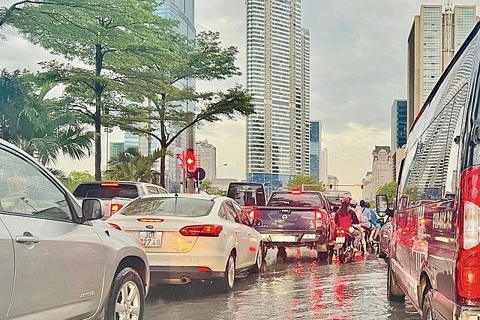
Hanoi has 30 areas that are prone to flooding when it rains, causing traffic congestion and disrupting residents' daily lives. Authorities have proposed several solutions to address both immediate and long-term drainage challenges.
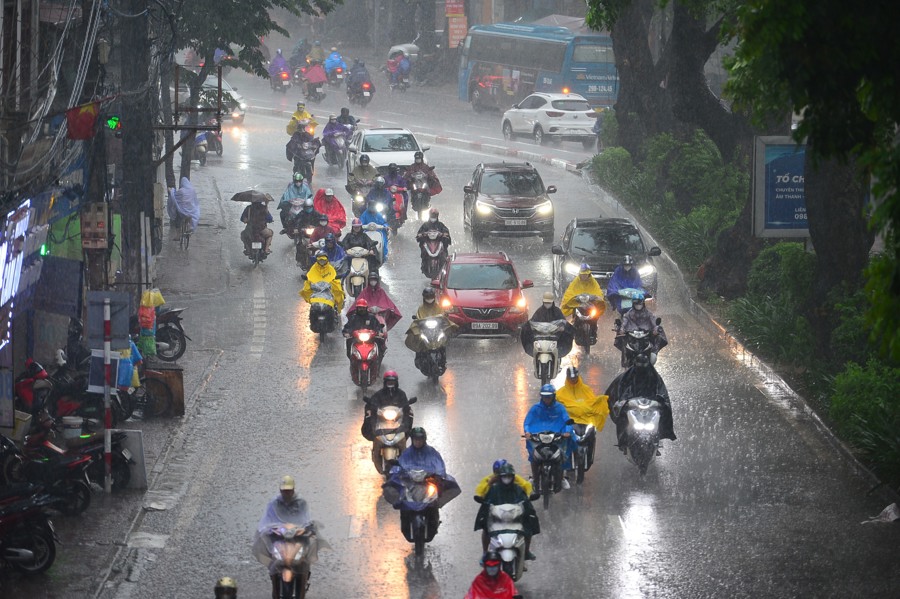
| Hanoi has been experiencing heavy rainfall over the past few days. Photo: Duy Khanh/The Hanoi Times |
Putting in place an underground water reservoir
Due to unusually heavy rainfall this summer, the Hanoi Sewerage and Drainage Company (HSDC) reported that the city experienced flooding at 11 locations during precipitation of 50-70mm/hour, and 19 additional locations during heavier rainfall of over 70mm/hour.
Hoang Thai Ha, Head of Drainage System Operations at the HSDC, explained that these flood-prone areas are often low-lying and are far from discharge points, making them vulnerable to moderate rainfall.
Some inundated areas on Thang Long Boulevard, the intersections of Le Trong Tan and the tunnels at km9+656, An Khanh interchange, lack primary pump stations and drainage systems, he noted. In Long Bien District, despite having a planned drainage system, some areas on Ngoc Lam Street and Hoang Nhu Tiep Street remain flooded due to the absence of major pumping stations at Cu Khoi and Gia Thuong.
Since 2019, the HSDC has proposed to build three underground rainwater collection tanks at Nguyen Khuyen Street, Duong Thanh intersection (near Hang Da Market), and Ly Thuong Kiet - Phan Boi Chau intersection. So far, only the tank on Nguyen Khuyen Street has been completed, reducing flooding by 70%.
To continue these efforts, the city has approved the construction of a second underground cistern at the Duong Thanh - Bat Dan - Nha Hoa - Phung Hung intersection. Professor Tran Duc Ha, former Director of the Institute of Water Supply, Drainage, and Environment Research, stated that underground water tanks are a reasonable solution to reduce localized flooding, especially in densely built areas.
“These tanks are also used to store water for irrigation and groundwater replenishment,” said Ha, but noted that this is a temporary measure for urgent needs, not a long-term solution.
Trinh Ngoc Son, Deputy General Director of Hanoi Drainage Company, said that the management and maintenance of the drainage system are being put out to tender. The system is divided into multiple contracts managed by various stakeholders, which means that completed projects have not yet been handed over for operational use, limiting their effectiveness. Accelerating drainage projects is therefore a long-term solution being implemented by the city.
Completing water drainage projects
For areas without comprehensive drainage systems, such as the left and right banks of the Nhue River (including districts like Cau Giay, Thanh Xuan, Hoang Mai, Tay Ho, Bac Tu Liem, Nam Tu Liem, Ha Dong) and Long Bien District, the city plans to invest in new drainage systems using public funds. The Hanoi Urban Infrastructure Development and Agricultural Project Management Board, along with relevant departments and localities, are tasked with preparing and expediting these projects to improve urban drainage.
The city is currently implementing several projects, such as the Vinh Thanh Pumping Station and drainage system, upgrading the Phuong Trach Pumping Station in Dong Anh District, and improving drainage at the Yen Nghia Pumping Station in Ha Dong District.
Additionally, upcoming investments include drainage systems for the left bank of the Nhue River, drainage systems in Ha Dong District, the Gia Thượng Pumping Station, the Thượng Thanh canal and reservoir in Long Bien District, and flood prevention projects for inner-city districts and suburban areas.
Three drainage projects in Long Bien District managed by the district's People's Committee include the Viet Hung - Cau Bay canal and Cu Khoi reservoir, the Cu Khoi Pumping Station and outflow canal, and the Long Bien - Cu Khoi drainage system. These have been approved and are being fast-tracked.
As the primary manager of about 80% of the drainage system, HSDC focuses on maintaining and optimizing existing systems to ensure efficient drainage during significant rainfall events.
With these immediate and long-term measures, the city aims to progressively address and adapt to the drainage challenges and unpredictable weather changes.