Hanoi intensifies measures to mitigate flooding ahead of rainy season
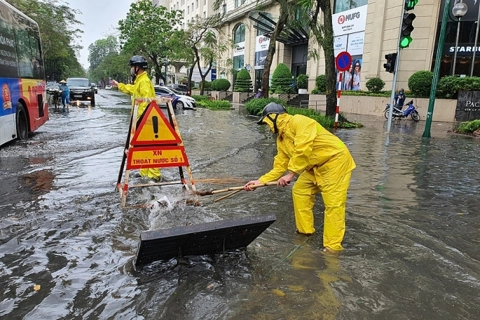
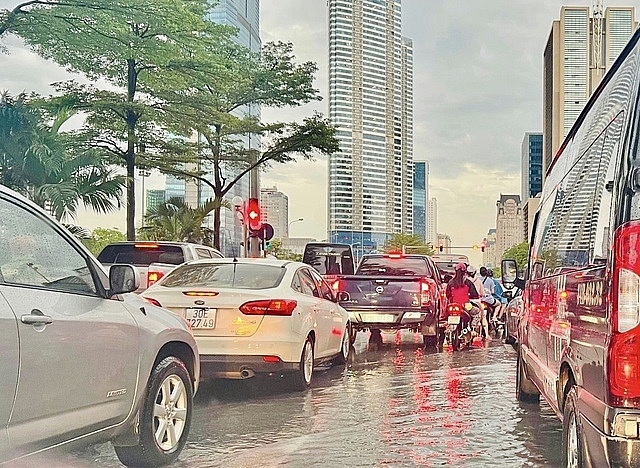
Hanoi is in the throes of the 2023 rainy season, marked by heavy rains and recurrent flooding of many of the capital's streets.
Hanoi is taking drastic measures to reduce the risk of flooding during the rainy season, said Vo Nguyen Phong, Director of Hanoi's Department of Construction.
Phong said Hanoi had entered the rainy season of 2023, characterized by heavy rainfall, resulting in recurrent flooding of numerous streets in the capital.
"This urgent situation underscores the need for a thorough and immediate review of the drainage strategy. Accelerated completion of long-standing flood prevention projects is also imperative," Phong said.
"The presence of incomplete infrastructure according to the intended plan is one of the main reasons for the lack of security in Hanoi's surface water drainage system, resulting in localized flooding whenever there is unusually heavy rainfall," Phong said.
| Hanoi streets flooded during heavy rains. Photo: The Hanoi Times |
According to the Hanoi Capital Drainage Planning up to 2030, with a Vision to 2050, issued on May 10, 2013, the rainwater drainage system within the city center is divided into four different basins: To Lich, Left Nhue River, Right Nhue River and Long Bien.
Over the course of a decade, especially after Hanoi's administrative boundaries were expanded in 2008, only the 77.5 km2 area of the To Lich River basin has been properly invested according to the established plan. It includes eight districts: Ba Dinh, Hoan Kiem, Dong Da, Hai Ba Trung, Hoang Mai and Tay Ho.
On the other hand, the remaining 62 km2 of the Long Bien region, 47 km2 of the right Nhue region, and 58 km2 of the left Nhue region, including the districts of Ha Dong, Bac Tu Liem, Nam Tu Liem, Cau Giay, Thanh Xuan, Hoang Mai, and part of Tay Ho district, as well as Thanh Tri district, have not received synchronized investment and construction according to the proposed plan.
Yen Nghia Pumping Station, with a capacity of 120 m3/s, cannot operate at full capacity due to the ongoing construction of the La Khe water canal system, which limits the flow to the station. In addition, the Yen Xa wastewater treatment plant, with a capacity of 270,000 m3/day, and the associated wastewater collection system remain incomplete.
Similarly, there has been no major investment in the Long Bien area. As a result, drainage capacity relies heavily on the Cau Bay River and the Bac Hung Hai irrigation system, which was initially designed solely for agricultural irrigation and drainage purposes.
Taking drastic action
Dr. Dao Ngoc Nghiem, Vice Chairman of the Vietnam Association for Urban Planning and Development, emphasized that addressing the escalating impacts of climate change requires a comprehensive approach beyond isolated flood-prone areas.
"A comprehensive review and adjustment of the complicated drainage planning is needed to formulate a more contemporary and pragmatic plan to fundamentally curb flooding," Nghiem said.
Hanoi's drainage strategy is divided into two phases, initially designed to deal with rainfall of about 160 mm over two days (Phase 1), which was later revised to handle up to 310 mm over the same period (Phase 2).
In practice, torrential rain has exceeded 160mm in as little as 2 hours, exceeding the capacity of the drainage plan. In this context, Nghiem stressed the urgency of reviewing and improving Hanoi's drainage planning to withstand the expected intensification of climate change impacts effectively.
Nguyen Hong Tien, former Director of the Department of Technical Infrastructure under the Ministry of Construction, stressed the need for Hanoi to quickly evaluate the implementation of planning and construction investments in line with the original design. Despite the establishment of several networks and facilities according to the drainage plan, tangible progress has been limited over the past decade.
"This warrants a comprehensive assessment to devise a pragmatic development strategy that accurately reflects actual conditions. In particular, drainage and wastewater treatment projects require substantial resources, often making it difficult to attract investors. Therefore, the city government should be a proactive initiator and take the lead in construction investment rather than relying solely on mobilizing the private sector," Tien added.
According to Phong of the Department of Construction, the city will conduct a comprehensive assessment in the coming period to strengthen the capacity of its surface water drainage treatment system.
This effort will prioritize investment in upgrading and establishing a reservoir regulation system in line with the existing plan, thereby maximizing the efficiency of drainage pumping projects. An illustrative case is the Yen Nghia Pumping Station project, which includes a 60-hectare regulation lake that is yet to be constructed and will be synchronized as part of the process.
Experts have stressed the need for Hanoi to urgently implement construction projects according to the established plan. In particular, they advocate the rapid implementation of seven water drainage projects in the 2021-2025 timeframe, including initiatives such as the construction of a stormwater drainage system in the left basin of the Nhue River, the construction of the Yen Nghia pumping station, and the creation of a comprehensive canal network for water management in the right basin of the Nhue River.
Nguyen Hong Tien, former Director of the Department of Technical Infrastructure of the Ministry of Construction, emphasized that the ongoing process of drafting Hanoi's Capital Plan for the 2021-2030 period would provide an opportunity for Hanoi to reassess and modify its drainage planning that has remained in place over the past decade, allowing for a contemporary direction that is in line with development practices and seamlessly integrated into the Capital Plan.