Hanoi students question if AI helps or hinders creativity
At Hanoi’s 2025 Children’s Forum, students questioned whether artificial intelligence is helping or harming creativity, while experts urged balance, cultural pride and kindness in the digital age.
A question that made the room fall silent
“Should children use artificial intelligence?” When 13-year-old Nguyen Kim Thai Linh asked this question at Hanoi’s 2025 Children’s Forum, making the room where filled with 250 young delegates, teachers and policymakers, grew quiet.
It was the kind of question that revealed both excitement and unease about growing up in a world shaped by algorithms and virtual companions.

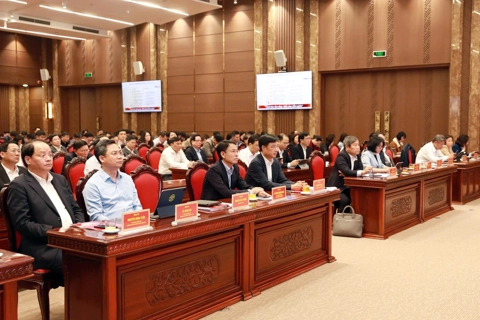
The workshop is attended by many experts and children from various schools in Hanoi.
The forum, themed “Kind words, good deeds, civilized behavior – building beautiful friendships and saying no to school violence,” was organized on November 1 by the Hanoi Youth Union and the Hanoi's Ho Chi Minh Young Pioneer Organization's Council. It brought together outstanding students from 126 communes and wards to discuss how to live smart, learn creatively and act responsibly in the age of technology.
For many children, the day was not just about AI. It was also about courage to speak out against bullying.
“How can we prevent school violence?” asked Tran Thi Dan Chau, a student from Nghia Tan Secondary School. Her question resonated across the auditorium, where others nodded in agreement.
In response, Dang Hoa Nam, Vice President of the Vietnam Association for the Protection of Children’s Rights, said Hanoi’s education sector is rolling out a more comprehensive approach to prevent and handle school violence. That includes ethics education from early grades, counseling networks in schools, and collaboration with mental health professionals.
“Many acts that seem small, mocking a classmate or spreading rumors online, can leave deep scars if not corrected early. Timely guidance and empathy are key to shaping a child’s values and emotional health,” said Nam.

A student raises question at the workshop.
Kieu Cao Trinh, from the Hanoi Department of Education and Training, added that the city is strengthening school-based psychological support. Teachers are being trained to identify signs of stress or isolation among students, while schools are partnering with hospitals and mental health centers to provide counseling.
One student shared “Sometimes it’s not the teachers or lessons that scare us, but it’s being left out, being laughed at, or being gossiped about for getting a bad grade.”
Experts at the forum agreed that breaking the silence is crucial. “When children dare to speak, society must listen,” said an expert. “That’s how we build a safer, kinder learning environment.”
Beyond emotional safety, students also wondered how to stay connected to their roots while embracing modernity.
“How can we preserve our cultural identity in this digital era?” asked Dang Kim Thien Kim from Le Ngoc Han Secondary School.

Speakers discuss and response to issues raised by children.
For Dao Duc Viet, Deputy Secretary of the Hanoi Youth Union, the question reflected something profound: “In an age of AI and globalization, knowing who you are and where you come from gives you strength. Preserving culture is not about rejecting technology but carrying your values with you into the future.”
He encouraged children to begin with simple acts like speaking Vietnamese politely, learning about local traditions and showing respect for teachers and elders. “These are the small roots that keep us grounded in a fast-changing world,” he said.
AI - helper or creativity trap?
Then came the topic that captured everyone’s imagination: artificial intelligence.
Thai Linh, the student who asked the opening question, voiced what many have wondered: “AI can help us study better, but I’ve heard it can also make us lazy or less creative. Should children like us use it at all?”
To this, Vice President of the Vietnam Association for the Protection of Children’s Rights Dang Hoa Nam offered a balanced view. “AI is like a new friend. If you use it wisely, it can help you learn faster. But if you depend on it too much, it might slowly take away your ability to think independently.”
He likened overreliance on AI to a trend among young people jokingly called “brain rot”, a warning against letting machines think for humans. “Children should treat AI as a tool, not a substitute, using it to summarize lessons or explain difficult ideas, but keep the creativity and emotions their own.”
“Always verify what AI says. Not everything it tells you is true. And talk to your parents or teachers before sharing personal information online,” said Nam.

A student speaks at the workshop.
The discussion turned to online behavior, where many young people express themselves, learn and sometimes lose their way.
Students and experts noted a troubling trend of the normalization of inappropriate content and idol culture. Some young people admire social media figures with controversial pasts or illegal actions, blurring the line between right and wrong.
Le Van Ba, from the Hanoi Police’s Mobile Force Unit, urged students to develop a “three-step filter” before posting or reacting online: “Ask yourself. Is it legal? Is it moral? What are the consequences?”
He reminded them that digital bravery is not about being loud online, but about sharing kindness and reporting harm. “Spread good stories, not scandals. Let beauty defeat ugliness,” he told the audience.
By the end of the forum, what began as a discussion about AI had turned into something bigger, a reflection on what it means to grow up human in a digital world.
For Hanoi’s young generation, technology is both a challenge and a chance. As one teacher summarized, “AI can teach facts, but it can’t teach empathy. That’s something we must protect and pass on.”
|
Before the forum, the Hanoi Youth Union and the Hanoi's Ho Chi Minh Young Pioneer Organization's Council gathered opinions from children in all communes and wards across the capital on three topics, including preventing school violence and ensuring a safe environment for children; promoting healthy and creative online interaction; and preventing accidents, abuse and violence against children. Nearly 1,000 responses were collected. According to Dao Duc Viet, Deputy Secretary of the Hanoi Youth Union and Chairman of he Hanoi's Ho Chi Minh Young Pioneer Organization's Council, after the forum, local Team Councils and school units will continue gathering children’s opinions and forwarding them to the city level to help develop practical solutions addressing issues affecting young people. |
The story was compiled from reports by tuoitrethudo.vn