Hanoi urged to adopt proactive waste reduction
A modern capital should not be defined by how quickly it is cleaned after waste appears, but by how little cleaning is needed because the community maintains shared spaces, treatment systems are modern and management relies on digital data and circular-economy principles.
THE HANOI TIMES — Hanoi is urged to move beyond the cycle of sweeping collecting and hauling toward a prevention-first approach that reduces waste at the source instead of reacting to rising volumes.
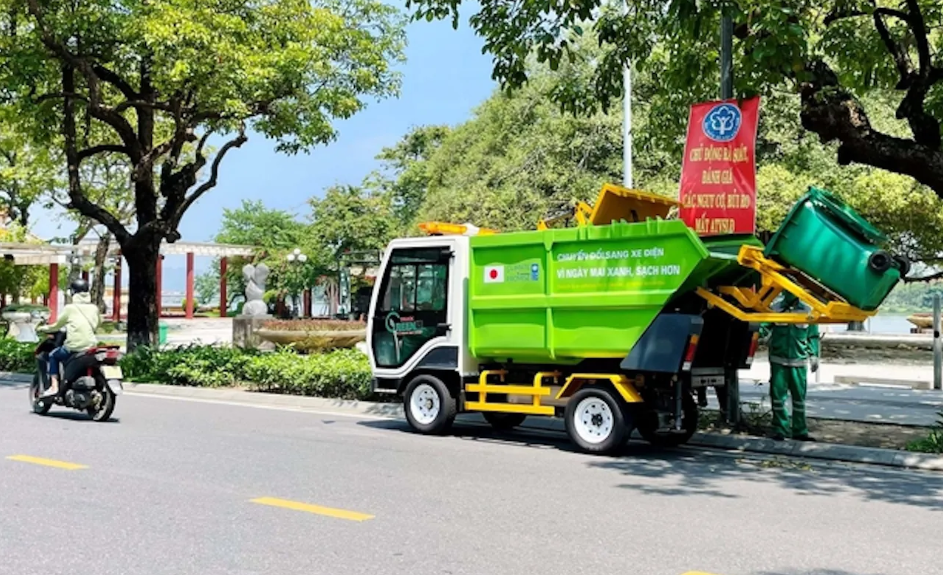
Waste collection in Hanoi. Photo: The Hanoi Times
According to Nguyen Van Quy, Head of the Solid Waste Management Division of the Hanoi Department of Agriculture and Environment, the capital’s sanitation efforts must go beyond keeping streets clean and orderly.
“With a large and growing population, Hanoi needs a comprehensive and proactive approach that moves from short-term responses to long-term prevention and investment.” Said Quy.
He added that a modern and sustainable city must meet three requirements at the same time, including a smart and closed-loop waste management system, a shift in perception so waste is treated as a secondary resource rather than something to discard and a clear effort to reduce landfill use.
In this regard, Quy expected science and technology to be applied widely through digital tools and real-time data, including digitalizing collection routes, monitoring waste-transport vehicles, using sensors at gathering points and installing cameras to detect violations.
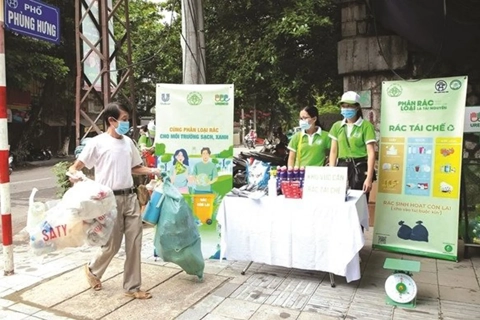
He said the system must involve community participation rather than relying only on sanitation workers.
“We cannot continue the old cycle of sweeping, collecting and hauling, which only deals with the surface. Hanoi needs a new management mindset that focuses on prevention and active measures to cut waste at the source instead of chasing the growing volume,” he said.
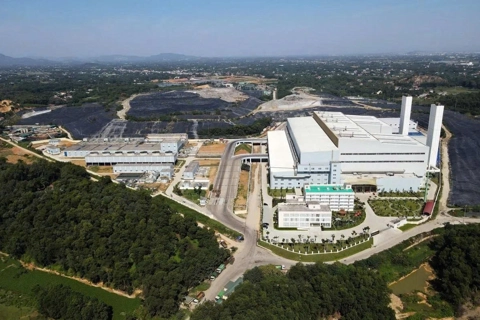
Experts and officials shared this view, noting that urban and rural planning must be aligned with waste-treatment infrastructure to avoid the pattern of rising population and rising waste. Treatment facilities must receive consistent investment to prevent delays and gaps in capacity.
A modern capital should not be seen as a place that becomes clean only after cleanup, but as a place that rarely needs to be cleaned because the community maintains it well, treatment infrastructure is modern and management is based on digital data and circular-economy practices.
This is the direction Hanoi must commit to if it aims to become a sustainable city under the pressure of climate change and population growth.
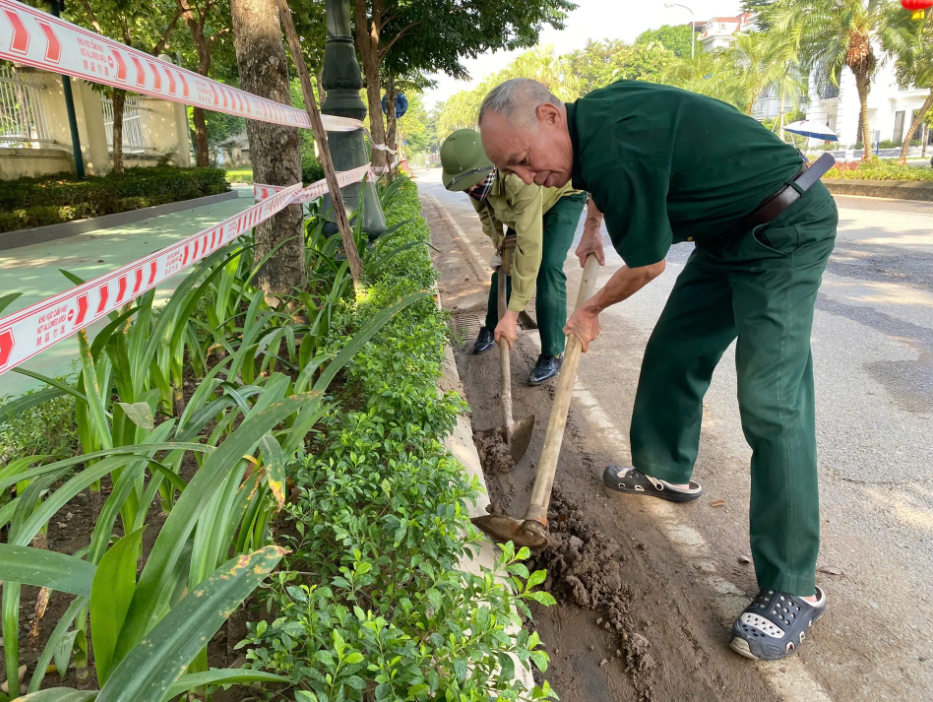
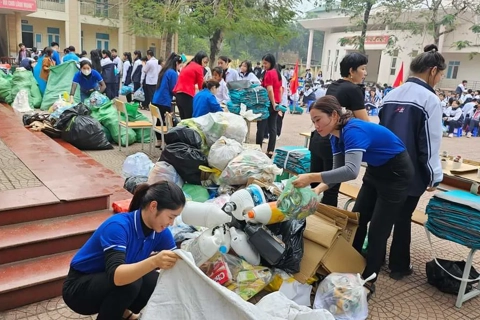
Residents of Phu Thuong Ward take part in environmental cleanup efforts.
Strategy for environmental protection required
The draft Political Report for the 18th Congress of the Hanoi Party Committee identifies environmental protection and pollution control as one of five priority areas for the 2025–2030 term.
Le Thanh Thuy, Deputy Head of the Environmental Management Division of the Hanoi Department of Agriculture and Environment, said this orientation is timely and appropriate.
“It shows a clear shift from reactive problem-solving to long-term prevention and investment in environmental management,” Thuy said.
She said this shift will encourage social resources, modern technology and stronger engagement from the entire political system and the community, from rural areas to urban centers.
“Identifying the environment as a strategic priority not only reflects the city’s commitment, but also opens opportunities for Hanoi to move toward becoming a green, livable and sustainable capital,” she added.
Deputy Director of the Hanoi Department of Agriculture and Environment Nguyen Minh Tan said the draft Political Report for the 18th Party Congress of Hanoi includes a key task to study and develop a strategic program or master plan for environmental protection and green development with a vision of at least 15 to 20 years.
He said this is a necessary step that reflects Hanoi’s long-term vision, as the capital faces challenges such as air pollution, solid waste overload, declining water resources and rapid urbanization.
“Without a comprehensive strategy, current measures will remain fragmented and inconsistent, making it difficult to achieve lasting results. We hope the city will soon finalize this master plan for environmental protection and green development,” he said.
|
With the goal of building a clean capital, Hanoi’s agencies have worked to raise the urban waste collection and treatment rate to nearly 100%. In rural areas, the rate has also reached 95% - 99%. Each day, about 6,829 tons of household waste are collected and treated in line with required standards. To address several pollution hotspots across the city, Hanoi is increasing the use of technology, installing surveillance cameras and assigning clear individual responsibility, especially for ward and commune chairpersons if violations occur. Environmental sanitation performance has even been added to the criteria used to evaluate local agencies. |