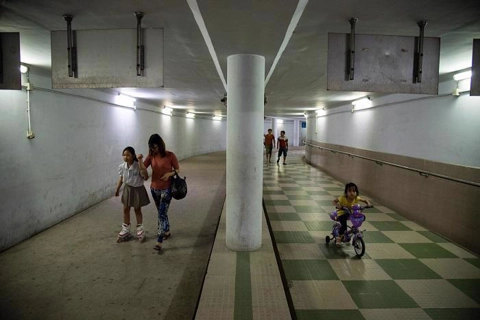
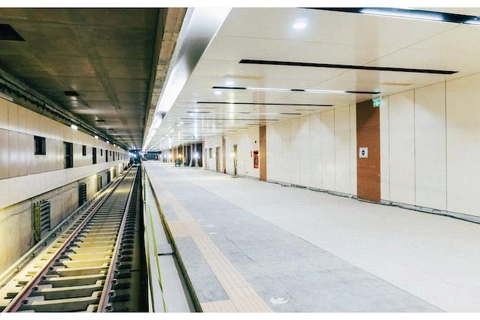
Hanoi urged to soon realize underground planning
The planning would open up a new phase in urban construction and development, helping the city better utilize the land resources for socio-economic growth.
Experts called for Hanoi, the first city in Vietnam to have released an underground master plan until 2030, with a vision of 2050, to soon put it into motion.
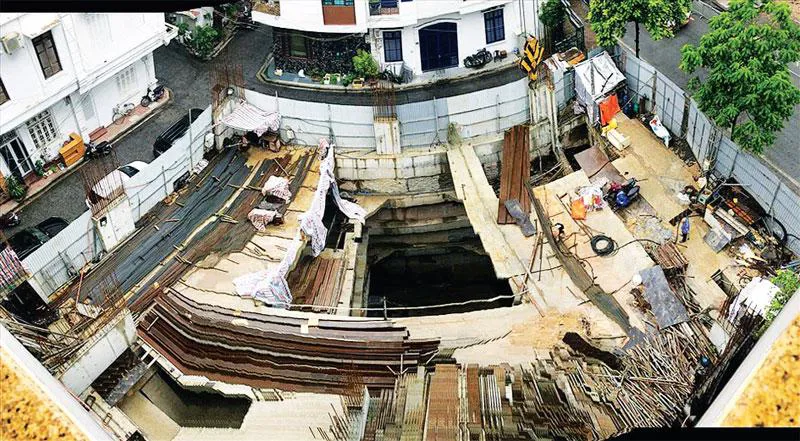
| A private building at Son Tay Street, Ba Dinh District was given a license to build four underground storeys. Photo: Cuong Ngo |
The planning of the technical and social infrastructure of both elevated and underground spaces was issued in Politburo's Resolution No.06 dated January 24, 2022 on the planning and sustainable urban management in Vietnam until 2030, with a vision to 2045.
The draft Capital Law has also included incentives to encourage investment and utilization of the city’s underground space.
In March 2022, the Hanoi People’s Committee issued the planning of urban underground space in the downtown areas until 2030, with a vision for 2050.
Director of the Hanoi Urban Planning Institute Luu Quang Huy expected the planning would enhance state management in the construction and use of underground facilities in the city’s downtown, at the same time forming a linkage between different underground spaces.
“There has been an inconsistency in the management of underground spaces in the city, resulting in the lack of update and oversight of different underground works, including technical, energy, telecommunication and security-defense,” Huy told The Hanoi Times.
According to Huy, the fact that Hanoi is the first city in Vietnam to have underground planning shows the efforts of the local authorities and experts.
“The planning would open up a new phase in urban construction and development, helping the city better utilize the land resources for socio-economic growth,” he continued.
However, the Former Director of the Infrastructure Department under the Ministry of Construction Nguyen Hong Tien called for the city to soon map out an action plan with a clear timeline to realize the planning.
Tien also noted the construction and operation of underground works would require sophisticated technologies and equipment, resulting in higher costs compared to above-ground structures.
“Hanoi would need more incentives to encourage the participation of the private sector, as well as the public-private-partnership (PPP) in the construction of underground spaces,” Tien told The Hanoi Times, adding the priority would be to build underground stations, financed by the state, and in cooperation with investors in other public and services facilities in the surrounding areas.
Tien also noted the city’s major public transport hubs, including the urban railway or metro, would be the core of the development of underground spaces, as the city is pushing for the transport-oriented development (TOD) model.
Huy from the Hanoi Urban Planning Institute noted the city is currently working on detailed planning for the formation of underground spaces, subject to the approval of the city’s leaders in the near future.
A key part of the city’s planning of underground space is a network of underground transport systems, including six metro lines with a total length of 86.5 kilometers at a depth of 20 meters, along with 81 underground stations.
In addition, Hanoi also plans 78 underground parking lots for a combined area of 104 hectares, concentrated in the four core districts.
Hanoi has identified 39 underground public spaces in the downtown areas with 954 hectares, including those for services, trade, and entertainment which will be connected with urban railway stations, and proposed the construction of an addition of 65 underground public spaces in the North and South of the Red River with 2,171 hectares.
| The planning of the underground pace would help enhance efficiency in the utilization of urban land resources, preserving the cultural and historical landscape, developing green spaces and the urban ecosystem toward modernity and sustainability, said Former Director of the Infrastructure Department under the Ministry of Construction Nguyen Hong Tien. |