Policies required to promote urban underground construction in Vietnam
It's necessary to have legal frameworks for underground construction that is booming in Vietnam.
Given the booming development of underground spaces in Vietnam’s cities, legal frameworks regulating the matter need to be refined, local experts suggested.
| The second-floor underground terminal linking Nguyen Hue and Dong Khoi streets of Ho Chi Minh City's first metro line. Photo: Ho Chi Minh City's authority |

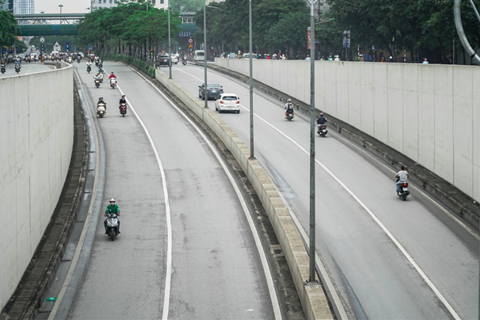
The regulations become more necessary amid the growing development of underground construction in big cities that is attributed to the construction of traffic works below the surface such as metro lines, subway stations in Hanoi, Ho Chi Minh City; underpasses (Hanoi, Ho Chi Minh City, Danang); river crossing tunnels (Ho Chi Minh City); pedestrian tunnels (Hanoi), and parking lots.
Besides, the Hanoi's technical infrastructure works including underground lines and cables in cable culverts, pipes with a diameter of over 3,000mm are being buried together with a number of public works, and basements in high-rise apartment buildings (Times City and Royal City) are contributing to the expansion of underground space.
The aforementioned issue was discussed at a seminar on March 12 with the participation of leading construction experts. Sharing at the event, Phan Huu Duy Quoc, thế former Deputy Chief Representative of Japan’s Shimizu Corporation, emphasized: “It is necessary to have appropriate policies to make full use of urban underground space in Vietnam, especially for public works, in which, it is necessary to clarify the ownership of underground space.”
Echoing Quoc, Nguyen Hong Tien, the former Director of the Technical Infrastructure Agency under the Ministry of Construction, said a set of legal documents on underground space management are needed such as the Law on Underground Space Management; the addition of underground space planning in the Law on Urban Planning and its guidelines; the amendment of underground land use management in the Land Law; Civil Law relating to property ownership; Railway Law regarding the safety corridors.
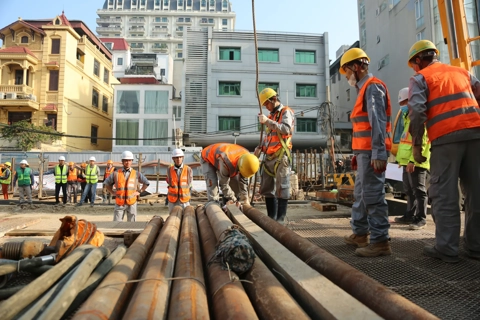
These ideas came from the problems that have arisen during the construction of underground works and the use of underground space in Vietnam over the years. “Lack of specific regulations on the use of land for underground works and space has led to court litigation, such as the construction of a five-story basement house in Ba Dinh, Hanoi has threatened the safety of neighboring construction,” Tien said.
Many related issues have not been legalized yet, including economic and technical norms, unit prices and technical processes for underground works funded by the State; compensation for owners of properties affected by the construction of underground works; obligation in ensuring the safety of adjacent works; policies on mobilizing the private sector in underground construction, he added.
Under the current regulations, there is a combination of ground and underground planning, but it is not being fully enforced, according to Tien.
He pointed out that an exemplary urban area must have a system of offices, shops and traffic system located entirely underground while ground space for parks, trees, plants, and entertainment venues. It should be an inevitable trend for Vietnam's big cities in the face that the world's urban construction is associated with the use of underground space.
“Underground space is a precious resource that needs proper policies on planning, construction and management,” he said.
| Hanoi is home to 615 construction works with underground space, mainly concentrated in the urbanized area south of the Red River (accounting for 94% of the total), according to the Hanoi Planning and Architecture Department. |