Hanoi Vice Chairman explores Web3 hub to drive digital transformation
The hub incorporates digital and green transformation objectives, using a carbon credit platform to convert green concepts into financial value.
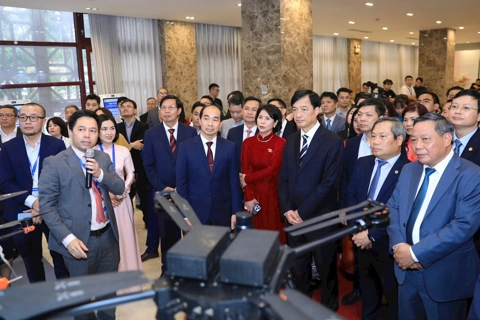
THE HANOI TIMES — Hanoi People’s Committee Vice Chairman Truong Viet Dung praised CT Innovation Hub 4.0 as a practical, effective, and widely welcomed next-generation innovation model during a recent working visit to CT Group.
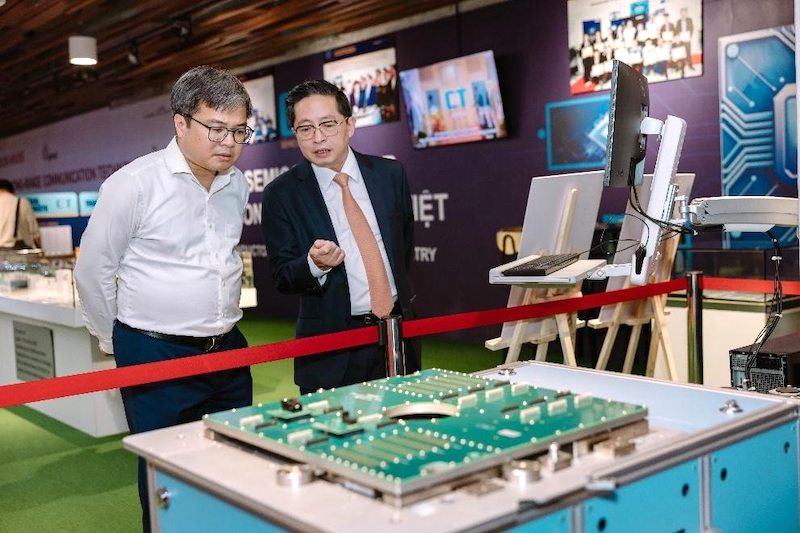
Truong Viet Dung, Vice Chairman of the Hanoi People’s Committee (left), visits the model of CT Innovation Hub 4.0. Photo: Dai doan ket Newspaper
Dung, leading a delegation from the municipal People’s Committee and the Hanoi Department of Science and Technology, said that Hanoi remains concerned about the relatively modest performance of its innovation and science-technology activities.
CT Innovation Hub 4.0 aims to become a Web3-based “Super Innovation University,” where learning is tied to real-world value creation to inspire strong motivation among learners.
CT Group Chairman Tran Kim Chung noted that, unlike previous-generation hubs which relied on traditional models and Web2 platforms, CT’s Innovation Hub 4.0 is fully powered by Web3 and artificial intelligence (AI).
Built on a blockchain foundation, the hub ensures the uniqueness and intellectual property protection of submitted ideas.
It operates with nine core technologies and one orchestration system that strategically channels innovative concepts into market-ready products.
The visit to CT Group comes as Hanoi intensifies its push for innovation and digital transformation. As part of this plan, the city is drafting six major resolutions to foster scientific research, encourage tech startups, and develop a robust digital economy.
Vice Chairman Truong Viet Dung’s endorsement of the CT Innovation Hub 4.0 aligns with Hanoi’s strategic goal of building next-generation innovation ecosystems powered by emerging technologies like Web3 and artificial intelligence.
Hanoi draft six plans to boost innovation
To realize the national and municipal strategies for science and technology development, Hanoi is drafting six key plans aimed at creating breakthroughs in innovation, scientific research, and digital transformation.
These plans are part of the city’s roadmap to implement the amended Capital Law, the Politburo’s guidelines, and the latest policies issued by the National Assembly and Government to boost science, technology, and innovation.
The city is striving to refine its institutional framework by localizing central directives while designing its own bold and tailored mechanisms to unlock resources and accelerate progress in line with international standards.
Four of the plans are being developed by the Hanoi Department of Science and Technology. One focuses on establishing special policies to support innovation and technology advancement. Another proposes mechanisms to promote investment and strengthen the innovation and startup ecosystem.
A third sets the groundwork for the creation of the Hanoi Technology Exchange to facilitate technology commercialization. Meanwhile, the fourth outlines a controlled environment for trial operations, allowing new solutions to be tested in a sandbox model to assess market readiness and associated risks.
The Department of Finance is drafting a plan on establishing a venture capital fund to finance high-risk, high-potential innovations.
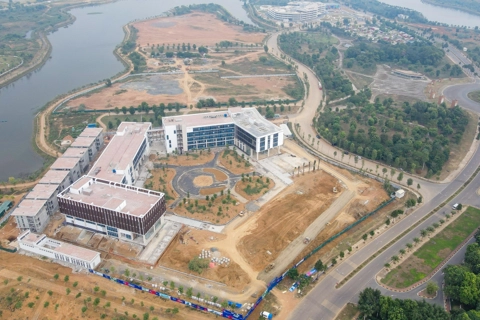
Meanwhile, the city’s Management Board of Hi-tech and Industrial Parks is developing a plan to turn the Hoa Lac Hi-Tech Park into a world-class innovation hub, modeled on Silicon Valley, with service infrastructure and housing to attract elite professionals.
With these plans, Hanoi reaffirms its ambition to lead the country in innovation, scientific research, and digital transformation.