Hanoian needs $8,000 monthly on average to buy home: analysis
A middle-income family earning around US$1,200 a month will struggle to afford a new home in Hanoi.
A household in Hanoi needs a minimum monthly income of VND45-210 million (US$1,770-$8,270) to afford a house, according to research by the Vietnam Association of Realtors (VARS).
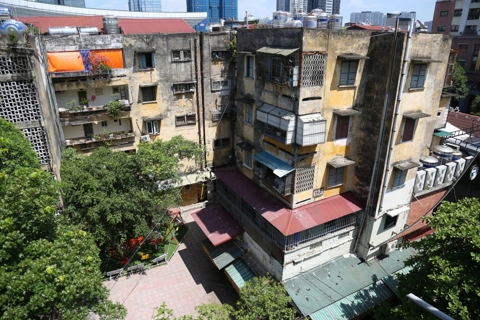
| An apartment building in Hanoi. Photo: Linh Trang/kinhtedothi.vn |

Compared to the average household income in Hanoi, these figures are about 2.3 to 10 times higher.
According to the General Statistics Office, a household of four in Hanoi with two people of working age has an average total income of about VND21.4 million ($843) per month.
This income level makes it difficult for households to purchase a home in Hanoi, especially when the average primary market apartment price in 2024 has reached VND70 million ($2,757) per square meter, and newly launched units are priced from VND60 million ($2,363) per square meter.
The gap between the minimum annual salary required for mortgage payments and the average household income amounts to tens of millions of dongs when buying a home in central districts, VARS reported.
To buy a house in Hoan Kiem, Ba Dinh, Hai Ba Trung, Dong Da, and Tay Ho Districts in central Hanoi, an individual or household must have a minimum annual income of VND1 billion ($39,400). This figure is 3.7 to 8 times higher than the standard household income.
In Cau Giay and Thanh Xuan districts, this gap is 3 to 3.5 times. In more distant districts such as Ha Dong, Bac Tu Liem, and Long Bien, housing prices are more accessible, but an individual or household still needs a monthly income of at least VND40-60 million ($1,575-2,363).
Le Van Vinh, a 37-year-old from Thai Binh, has lived in Hanoi for 10 years. His family, with a combined household income of VND30 million ($1,182) per month, currently rents a 30-square-meter apartment in Cau Giay District.
After years of saving, they now want to buy a house. But it seems impossible, as their income has remained flat for years, but housing prices in Hanoi have skyrocketed in a short period of time.
With their current savings and the amount they can put aside each month after expenses, buying a house in Hanoi's suburbs remains challenging, Vinh said.
Hanoi people have expressed that the rapid increase in housing prices has made the dream of owning a home in Hanoi even more out of reach, even for those with about VND1 billion ($39,400) in cash.
In the Kim Van-Kim Lu neighborhood, about ten kilometers from downtown, apartment prices have skyrocketed from VND15 million ($591) per square meter in 2011 to VND60 million ($2,363) per square meter today.
For many people, buying property is seen as an investment, as real estate prices in major cities such as Hanoi tend to rise rapidly, offering higher returns than some other investment channels, said Pham Thi Mien, Deputy Head of VARS's Market Research and Investment Promotion Department.
This investment trend is driving up housing prices, especially for newly launched units, putting them beyond the reach of middle-income buyers, she said.
Some buyers choose to cut back on living expenses, accept financial risks and take out mortgages to buy a home, while others choose to wait or continue to rent, Mien added.
Housing prices in Hanoi are already high, and the current rate of increase is less likely to continue," she said. Buyers' salaries could fall due to the economic crisis, and home loans would become more expensive due to fluctuating interest rates, Mien added.
Households or individuals with average incomes should have at least 30% of the property's value in cash before considering a mortgage, Mien said.
"Buyers must be willing to relocate to more affordable areas, such as the outskirts or satellite towns around Hanoi," she said.
Improving transportation infrastructure will enhance urban mobility and encourage people to consider homes further from the city center, she added.
To attract buyers, developers need to offer prices that are in line with market demand and affordability, creating homeownership opportunities for a broader segment of the population, she said.
When will home ownership dream come true?
Do Thu Hang, Senior Director of Research & Consulting at Savills Hanoi, said the gap between household income and housing prices is widening.
With an average household income of around VND250 million ($9,846) per year and an average housing price of around VND4billion ($157,500), it would take a household 18 years to afford a house without spending on anything else, she said.
"While average incomes are growing at only 6% per year, secondary market home prices have increased at an average of 17-20% per year, posing significant barriers to homeownership," Hang said.
Given the continuous increase in housing prices, buyers with a minimum income of VND30 million ($1,182) would be hard-pressed to buy a house in Hanoi.
Currently, the minimum price for an apartment or house in Hanoi is around VND2-2.5 billion ($78,770-98,464). If buyers take out a mortgage for 50-70% of the value of the property, they will have to repay VND17 million ($670) per month in both principal and interest.
"With a median income of VND30 million ($1,182) per month, buying an apartment in Hanoi is almost impossible without additional financial support or the willingness to live further away from the city center," said Do Van Thach, CEO of Dova Land.
To afford an apartment at the current average market price, a buyer needs to earn at least VND60-70 million ($2,363-2,757) per month, he said.
To make home buying affordable, policies offering financial and tax incentives for first-time home buyers, as well as preferential loan packages from banks, are essential, Thach said.
Developing satellite neighborhoods and encouraging investment in affordable housing projects, including social housing and low-cost commercial housing, will help ease the housing affordability crisis, he added.