Hanoi’s latest proposal on Ring road No.4 project to save US$380 million
The project, estimated to be around VND87.1 trillion (US$3.81 billion), would be divided into seven sub-components and carried out under the combination of private-public partnership (PPP) and public investment mechanisms.
The Hanoi People’s Committee has submitted the third proposal on the construction of the Ring road No.4 to the Government, with the cost estimated to be around VND87.1 trillion (US$3.81 billion), down VND8.7 trillion ($381 million) from the previous estimate in January.
Under the proposal, Hanoi suggested that Ring road No.4 have a total length of 112.8 kilometers, including 103.1-kilometer of the ring road and 9.7 kilometers of an access road in the direction of the Noi Bai – Ha Long expressway.
| The design of Ring road No.4. |
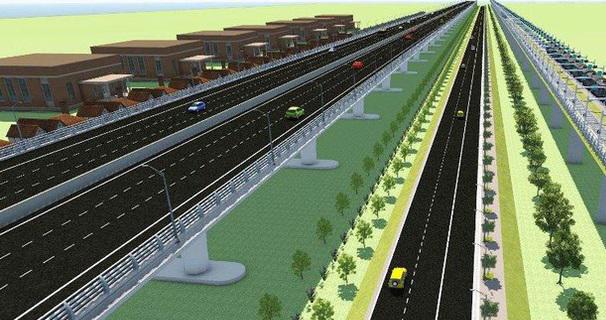
The project, set to cover an area of 1,341 hectares, would be divided into seven sub-components and carried out under the combination of private-public partnership (PPP) and public investment mechanisms.
Once completed, Ring road No.4 would consist of four lanes with 17-meter-wide for an average speed of 80 kilometers per hour.
The city also proposes a parallel two-lane road alongside the Ring road with a width of 12 meters.
| Ring road No.4 is estimated to cost over $3.8 billion. |
Hanoi expects the ring road to be completed in 2027, one year earlier compared to the previous proposal.
According to the city, a total of VND32.5 trillion ($1.42 billion) would be mobilized from the state budget during the 2021-2025 period for the project, including VND14.2 trillion ($621.5 million) from the central budget and the remaining from three provinces under the capital area, namely, Hanoi, Hung Yen, and Bac Ninh.
For the 2026-2030 period, the state budget would allocate an addition of VND24.2 trillion ($1.05 billion) for the project, and the investors would finance the cost of VND27.5 trillion ($1.2 billion) or 48% of the estimate for components under the PPP scheme and 32% of the total project cost.
The Hanoi People’s Committee called for special mechanisms for the projects that are similar to those applied to the Eastern North-South expressway for the 2021-2025 period, to ensure the completion as scheduled in 2027.
For other components, including consulting packages, site clearance, and resettlement, as well as those financed by the public funds, the authorities suggested a no-bid contracting mechanism to speed up the contractor selection process.
To cover part of the project’s finance, Hanoi plans to borrow funds via Government bonds during the 2021-2025 period, which would later be paid by the sale of lands along with Ring road No.4.
In addition, Hanoi asked for a credit package with a preferential interest rate for the project to better attract investors, as the funds are set to be mobilized from local and foreign banks.
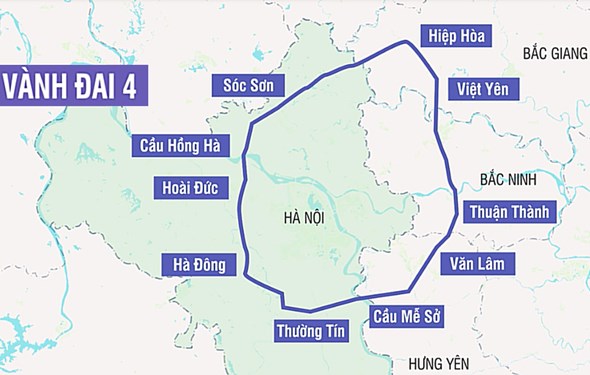
| Ring road No.4 would connect 14 districts from three northern cities/provinces of Hanoi, Hung Yen, and Bac Ninh. The construction of the project would not only address traffic congestion, but also open up room for further economic linkage and trade cooperation among Hanoi and other cities/provinces of Hung Yen, Bac Ninh, Vinh Phuc, or Bac Giang. |