Massive urban rail push set to transform Hanoi mobility
Despite the large upfront cost, the long-term gains are evident, from cutting the billions of dollars lost to congestion each year to boosting productivity as travel times fall.
THE HANOI TIMES — A focused investment push into urban rail is emerging as Hanoi’s most decisive solution to tackle chronic congestion and reshape the capital’s transport landscape over the next decade, according to city planners and finance officials.
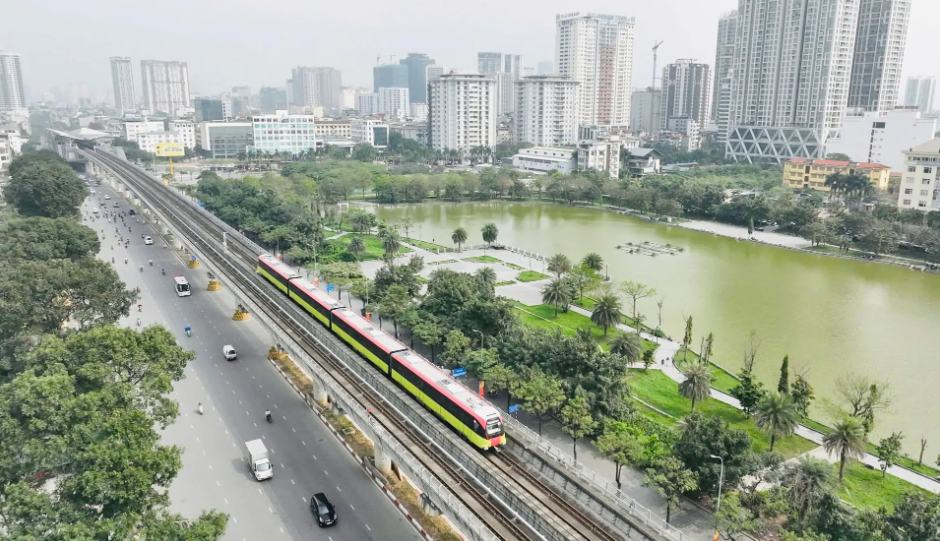
Cat Linh - Ha Dong metro line from above. Photos: The Hanoi Times
Hanoi’s urban rail network still far behind targets
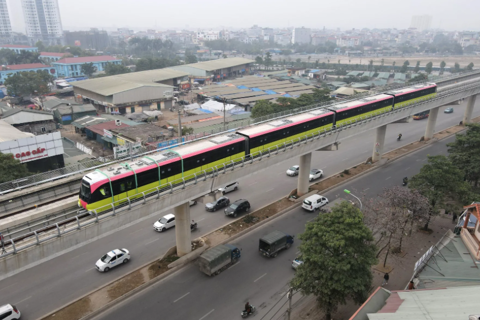
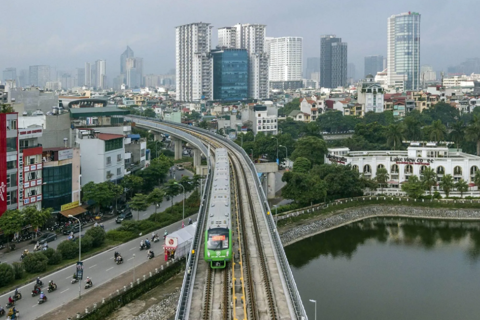
As of today, Hanoi has put into operation only two urban rail segments with a combined length of 21.5 km, including Line 2A Cat Linh to Ha Dong and the elevated section of Line 3.1 Nhon to Hanoi Station, accounting for 3.5% of the planned 14-line network with a total length of about 619 km.
A representative of the Hanoi Metropolitan Railway Management Board said the city aims to build a modern and interconnected rail system capable of meeting fast-growing public transport needs. To achieve this, Hanoi has submitted a comprehensive master plan for the development of its entire urban railway network.
In phase one, running through 2030, the city targets completion of 96.8 km across three key routes: Line 2 Nam Thang Long-Tran Hung Dao, Line 3.1 Nhon-Hanoi Station, and Line 5 Van Cao-Hoa Lac. At the same time, it will prepare investment for 301 km of routes including Line 1, the extended Line 2A to Xuan Mai, Lines 4, 6, 7, 8, and the satellite corridor from Son Tay-Hoa Lac-Xuan Mai.
From 2030 to 2035, Hanoi plans to bring online another 301 km of new lines, followed by 200.7 km in the 2036–2045 period.
To advance these targets, Hanoi broke ground on Line 2 Nam Thang Long-Tran Hung Dao on October 9, 2025. The project has a total investment of VND35.6 trillion (US$1.4 billion) and covers nearly 11 km, including 1.94 km elevated and 9 km underground, served by 10 stations.
This is Hanoi’s first project designed under the transit-oriented development (TOD) model. The Xuan Dinh depot will double as a passenger interchange and a mixed-use commercial-residential complex.
On December 19, 2025, the city is scheduled to launch Line 5 Van Cao-Ho Tay, which will connect the downtown core with the Hoa Lac Hi-Tech Park and surrounding satellite towns. Stretching 39.6 km, the line includes 6.5 km underground, 2 km elevated and more than 30 km at ground level, with a total investment of VND61.9 trillion (US$2.4 billion).
Investment priorities
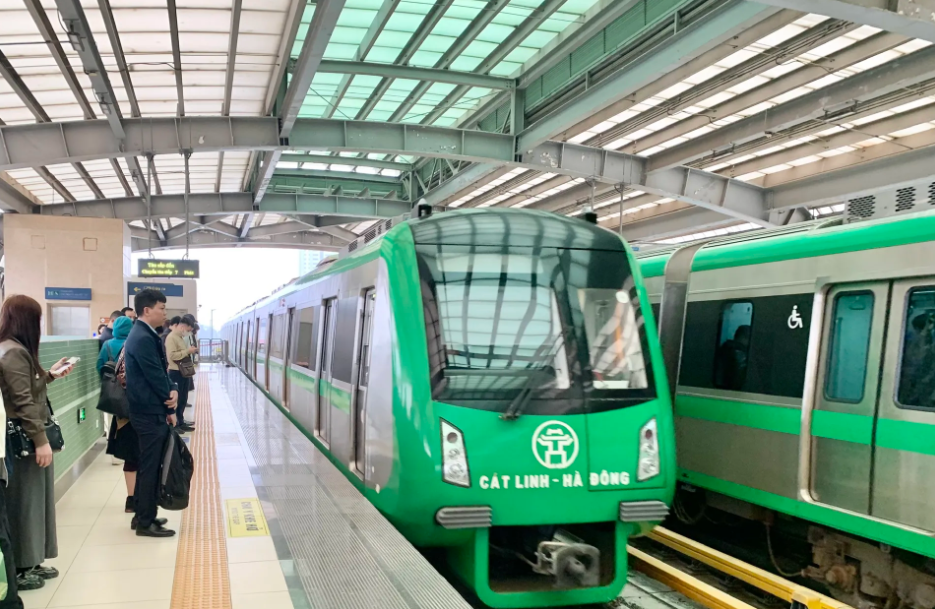
Passengers waiting to board on the metro.
Investment priorities shift decisively toward rail In its draft plan to reduce traffic congestion from 2025 to 2030 and beyond, Hanoi is preparing to allocate nearly VND1,400 trillion (US$53 billion) to curb gridlock, a problem that has persisted for decades and increasingly affects economic competitiveness.
Deputy Director of the Department of Finance Le Trung Hieu said choosing to prioritize rail is not simply a technical matter but “a strategic decision that will determine the city’s future.”
“Although upfront investment is high, long-term benefits are undeniable-Hanoi currently loses billions of dollars each year due to congestion. Urban rail will cut travel time, boost productivity and ease pressure on roads,” said Hieu.
He added that an expanded rail network will significantly improve the investment climate and enhance Hanoi’s attractiveness to global businesses.
To prepare for the next phase of construction, Hieu recommended that the city select international consulting firms for the 2026–2030 investment cycle, covering route planning, station design and major interchange architecture.
He also stressed the need to identify true TOD zones where land values can increase and contribute revenue back into the rail system. Such areas, he said, will become new urban growth hubs.
Shaping the future urban form Regarding long-term planning, Hieu suggested Hanoi adopt a multi-centered urban structure anchored around major metro stations and interchanges, allowing public transport to shape city development rather than the other way around.
To keep construction on schedule, he said Hanoi must define land-clearance requirements early and prepare resettlement areas in advance to ensure affected residents have immediate housing options, a step that has often slowed past infrastructure projects.
A new political commitment Reaffirming political determination to accelerate the rail program, Hanoi established the Steering Committee for Railway Projects on October 20, 2025. The committee is tasked with coordinating planning, addressing implementation bottlenecks and serving as a focal point between the city and national ministries.
The mechanism is expected to speed up decision-making, ensure contractor coordination and secure necessary approvals to keep projects on track.
With congestion worsening and road expansion reaching its limits, Hanoi’s shift toward sustained, high-intensity investment in urban rail marks a decisive change. If funding, planning and implementation advance together, the capital may finally achieve the integrated rail system long envisioned in its urban plans.