Hanoi shifts from road-based growth to rail corridors
It's proved that cities where 40% to 50% of residents use public transport save billions of dollars annually by reducing congestion, fuel consumption and environmental pollution while improving labor productivity.
THE HANOI TIMES — Hanoi is redefining its urban future by shifting its development model from road-based expansion to growth centered around rail corridors, with the urban railway system now seen as a strategic and indispensable foundation for the city’s transformation.
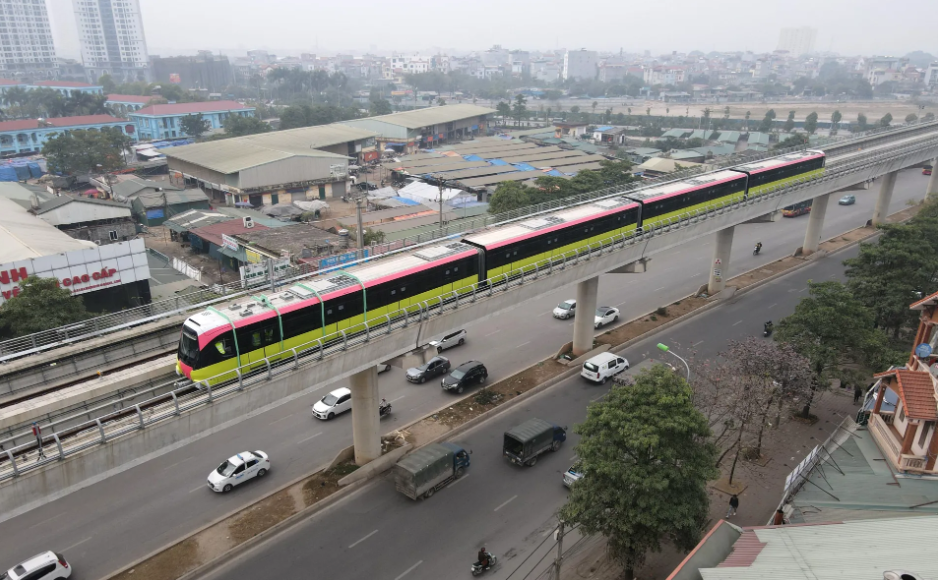
Nhon - Hanoi station metro line. Photo: Hai Linh/The Hanoi Times
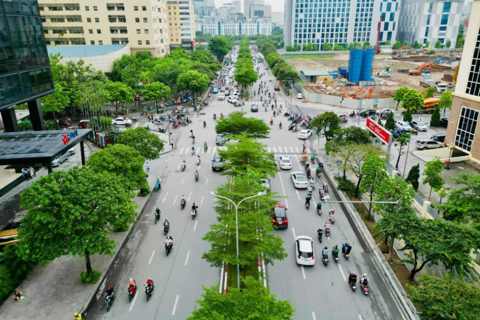
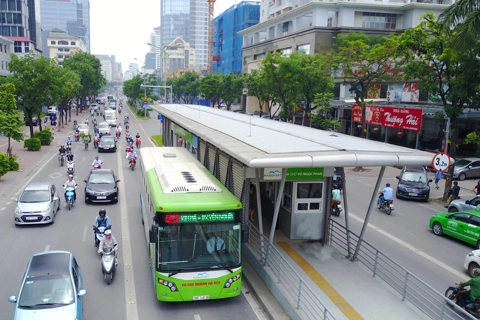
With over 8.5 million residents and nearly eight million motor vehicles, Hanoi’s transport system has exceeded its capacity.
Studies by the Japan International Cooperation Agency and the Transport Development and Strategy Institute estimate that congestion costs the city US$1.2–$1.5 billion each year, or 3%–5% of its GRDP.
The warning is clear: without a major shift, Hanoi could face systemic gridlock within a decade, even with localized road expansion.
In major global cities, no mode rivals urban rail in capacity, reliability and space efficiency.
A single metro line can move 40,000–60,000 passengers per hour in each direction, far surpassing buses or private cars.
If Hanoi completes its plan for 14 metro lines spanning more than 400 kilometers, the system could carry at least 45% of all urban trips, a turning point that would ease road congestion and change mobility habits.
Metro development is costly, ranging from $150–$200 million per kilometer for underground lines and $80–$120 million per kilometer for elevated ones, including trains and equipment.
Yet the long-term benefits are substantial. Cities where 40%–50% of residents use public transport save billions annually through reduced congestion, fuel use and pollution, while improving productivity.
Metro infrastructure delivers the highest social return on investment among transport projects, boosting land value and economic connectivity.
For Hanoi, the metro is not just a transit solution but the backbone of its future urban structure.
Each line and station can anchor new growth corridors, supporting urban areas, commercial districts, administrative centers and modern services. This underpins Hanoi’s shift to a multi-center model like Tokyo, Seoul or Paris, reducing pressure on the historic core.
When complete, the network will guide Hanoi into a new phase of multi-centered development, with growth clusters along corridors such as Tay Ho Tay–Cau Giay–Ha Dong, Dong Anh–Long Bien–Gia Lam and Hoa Lac–Xuan Mai.
This approach allows expansion without overloading existing infrastructure. Over time, metro-led planning combined with transit-oriented development (TOD) will support a “15-minute city” where residents can reach essential services quickly and efficiently.
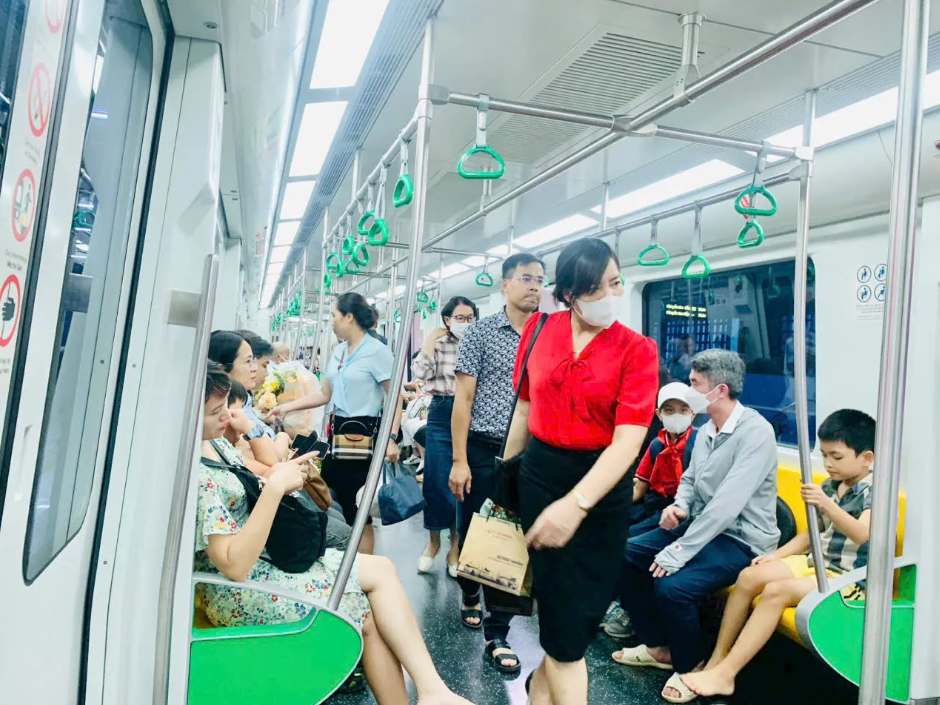
More residents are choosing public transportation for their daily commute. Photo: Pham Hung/The Hanoi Times
Urban restructuring
Turning the 14-line metro plan into reality faces major internal challenges, particularly financing and project management.
First, heavy reliance on official development assistance (ODA) creates complex procedures that must meet domestic law and donor rules. Pilot projects Cat Linh–Ha Dong and Nhon–Hanoi Station exposed costly overruns and schedule slippages.
Root causes included rigid counterpart funding mechanisms limited experience with EPC contractors and weak capacity in contract negotiation and dispute resolution. Hanoi needs more flexible financing, less dependence on ODA and stronger private-sector participation.
Second, technology integration and operations remain a hurdle. Metro systems combine track rolling stock and signaling into a single complex system, yet shortages of skilled engineers professional operators and internationally trained managers have slowed technology transfer and delayed commissioning.
Third, land clearance in dense central districts is a persistent bottleneck. New land valuation methods that balance resident and state interests are essential. Clearance delays stall projects and raise costs through accrued interest on ODA loans and higher compensation.
Maximizing the metro’s impact requires TOD that clusters housing, commerce and services around stations, shifting Hanoi from suburban sprawl to compact, energy-efficient communities along metro corridors.
TOD zones is minimum 10 hectares in urban areas and 20 hectares in suburban areas tailored to local conditions.
Hanoi must put in place a clear legal framework flexible land valuation and innovative finance that captures land value uplift rather than relying solely on auctions. Recovering part of the increased land value near 10–15 key stations could help fund 20%–30% of initial investment for some lines.
Finally, metro investment must be covered in a broader strategy of traffic management vehicle control connectivity and digital operations.
These measures should proceed in parallel with efforts to raise public transport quality and strengthen multimodal links around stations.