Mekong-US Partnership policy dialogue series for 2021-2023 launched
The dialogues convene experts from different stakeholders to support sustainable prosperity and autonomy among Mekong countries.
The first discussion of the flagship initiative of the Mekong-US Partnership (MUSP) Track 1.5 Policy Dialogue series for 2021-2023 has been launched with a focus on key policy and sustainability challenges facing Thailand, Laos, Cambodia, and Vietnam.
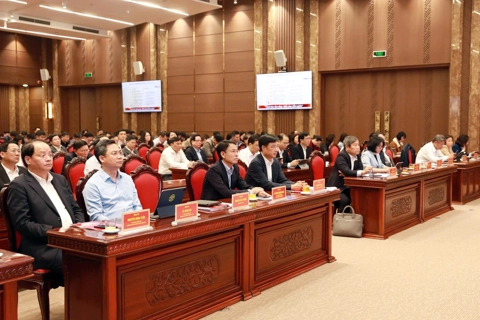
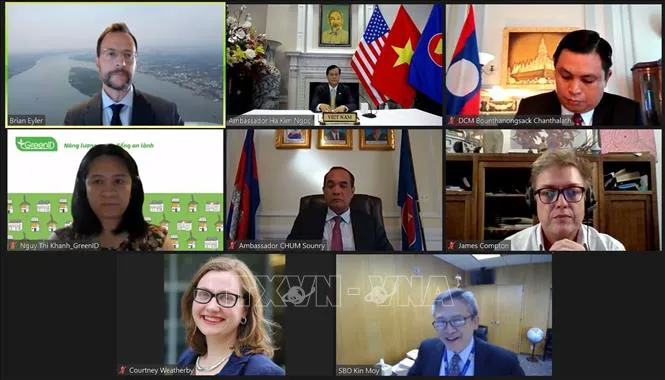
| Representatives at the event on Sept 15. Photo: VNA |
The series includes six virtual and in-person dialogues that explored opportunities for concrete collaboration on issues, including energy and infrastructure, non-traditional security, human resources, water governance, connectivity, and nature-based solutions.
Participants include Kin W. Moy, Bureau of East Asian and Pacific Affairs, US Department of State, Cambodia’s Ambassador to the US Chum Sounry, Bounthanongsack Chanthalath, Deputy Head of Mission of the Embassy of Laos to the US, Ambassador of Vietnam to the US Ha Kim Ngoc, Brian Eyler, Director Southeast Asia Program and the Energy, Water, and Sustainability Program, Stimson Center, Nguy Thi Khanh, Executive Director of Green ID Vietnam, and other representatives from some organizations.
Vietnam’s expectations
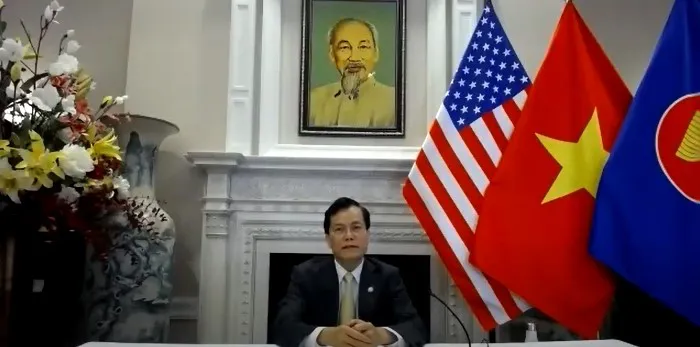
Speaking at the event, Ambassador of Vietnam to the US Ha Kim Ngoc said: “We believe that a strong resilient and prosperous Mekong Sub-region will greatly benefit ASEAN and the region as a whole.”
Given the fact that many areas along the Mekong River are underdeveloped, Vietnam, as ASEAN Chair in 2020, worked closely with other ASEAN member states, partners, and friends to promote cooperation for narrowing the development gap and the Mekong Sub-region’s sustainable development in ASEAN agenda.
Ngoc stated that ASEAN needs to integrate Mekong priorities into the broader community-building agenda towards an exclusive, people-oriented, people-centered ASEAN community that leaves no one behind.
He said there is much-untapped potential for cooperation in infrastructure development, digital economy, clean and renewable energy, and the region welcomes the US International Development Finance Corporation (DFC) to invest and catalyze more financing in Mekong infrastructure.
He hoped the US private sector will engage and invest more in the region via the public-private partnership (PPP).
The US investment in the region’s infrastructure and renewable energy will “solidify US commitment and presence in the region,” Ngoc added.
The ambassador’s second point is the importance of water data sharing in a “timely, transparent, and reliable manner.” Regarding this issue, Ngoc highly appreciated the Mekong Dam Monitor Project, an open-source online platform for near-real-time monitoring of dams and environmental impacts in the Mekong Basin, developed by the Stimson Center with Brian Eyler as the project lead.
In addition, Ngoc highlighted the synergy between the MUSP and other Mekong frameworks including the Mekong-Japan, Mekong-Republic of Korea, Mekong-Ganga, and the Mekong-Lancang Cooperation. The move would help avoid overlapping and maximize benefits to the people in which the MUSP is expected to be the leading role in this regard.
| Ambassador of Vietnam to the US Ha Kim Ngoc. Photo: Minh Vu |
Nguy Thi Khanh, executive director and founder of the Green Innovation and Development Center (GreenID) in Vietnam, stressed the importance of civil society and scientists in the policymaking and the joint efforts of regional stakeholders in addressing the common challenges.
Her work to advocate for green energy and sustainable development in Vietnam and the region and discussion of important environment tradeoffs is a perfect example of civil society at work in the region and an example of how civil society can interact with ministries and government stakeholders in Vietnam and throughout the rest of the region to drive change.
Bill Flens, director of the Office of Multilateral Affairs at the Bureau of East Asian and Pacific Affairs, the US Department of State, said the MUSP is a testament to the commitment of the US to the Mekong spanning two presidential administrations. Last month, US State Secretary Antony Blinken chaired two Mekong ministerial meetings, one being the Mekong-US Partnership Ministerial and the second being the Friends of the Mekong.
James Compton, Project Lead on USAID Wildlife TRAPS, TRAFFIC stressed the need to have multiple responses between the Mekong countries and the US. “There are threats to national security from transnational organized crime and illegal activities. But more importantly, sometimes the issues of environmental security whether that’s about forests or freshwater or marine resources get overlooked and those are interlinked with health security and medicinal security.”
Compton emphasized that “good natural resource management can be part of a post-Covid economic and societal recovery.”
Both technical and financial resources are “really necessary to manage and to nurture natural capital as an asset in the Mekong countries,” he noted.
The dialogue is the first anniversary of the Mekong-US Partnership. It was upgraded from the Lower Mekong Initiative.
The MUSP includes cooperation on economic connectivity, energy and climate security, human capital development, transboundary water, and natural resources management, and non-traditional security.
In addition, the non-traditional security sector comprises collaboration on emerging threats such as health security capacity-building and pandemic response; countering transnational crime; cyber security; and countering trafficking in persons, illicit drugs, timber, and wildlife.