New Housing Law to lift legal barriers to renovating old apartments in Hanoi
The 2023 Housing Law introduces several important changes to address these issues.
In a month and a half, the Housing Law of 2023 will officially take effect (August 1, 2024), with many new provisions expected to address challenges in housing development, particularly the efforts to renovate and rebuild old apartment buildings in Hanoi.
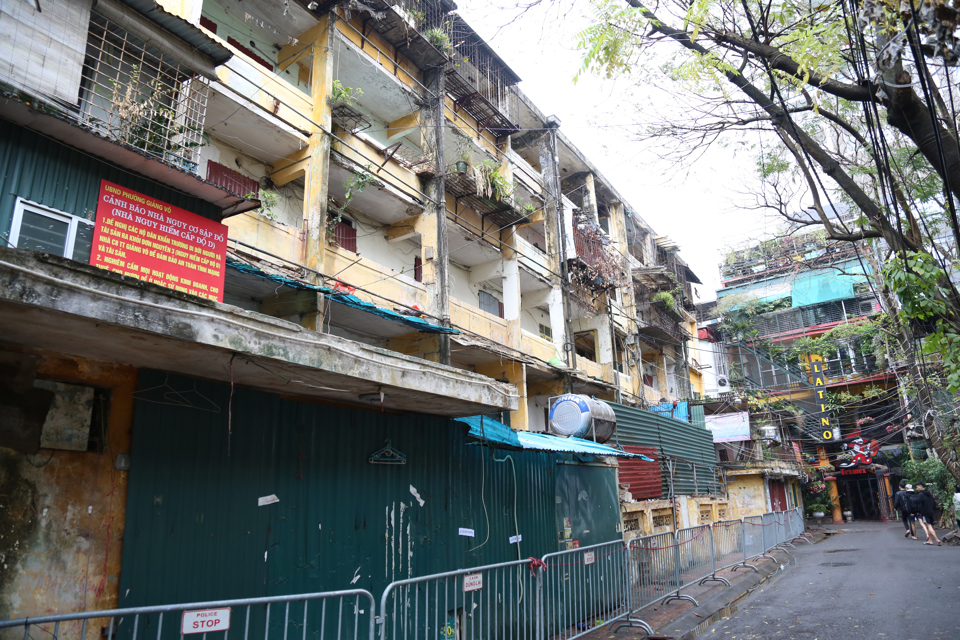
| The C8 Giang Vo apartment is posing safety risks for locals. Photo: Thanh Hai/The Hanoi Times |
For over 20 years, although the renovation and reconstruction of old apartment buildings have been a major concern of government authorities at both the central and local levels, thousands of households are still living in deteriorating and unsafe buildings with constant threats to their lives and property.
According to the Ministry of Construction, there are more than 2,500 old apartment complexes nationwide, with Hanoi having the largest share of 1,579 complexes, followed by Ho Chi Minh City. These buildings, mostly constructed between the 1960s and 1990s, have a structural lifespan of 50-70 years and were built with outdated construction technology.
Many buildings have severely deteriorated over time, exacerbated by residents expanding their living spaces, increasing the load on already unsafe structures. Despite being aware of the risks, financial constraints force many families to continue living in these buildings, putting their lives at risk. Meanwhile, renovation efforts have been sluggish.
In Hanoi alone, out of 1,579 old apartment complexes, dozens are in critical condition, including six classified as level D (the most dangerous) that must be demolished and rebuilt. These include buildings like C8 Giang Vo, G6A Thanh Cong, and A Ngoc Khanh.
By the end of 2023, the renovation and reconstruction of old apartment buildings in Hanoi had only achieved 1.14% of the plan, with 19 complexes under renovation. Despite approvals for many projects, such as those in Nghia Do, Nguyen Cong Tru, and Lieu Giai, progress has been stalled due to regulatory obstacles in the 2014 Housing Law and its guiding decrees.
Vice Director of the Hanoi Department of Construction Mac Dinh Minh said one major hurdle was Decree 101/2015/ND-CP, which allowed residents and businesses to negotiate compensation and resettlement independently but lacked specific guidelines on compensation rates.
“This led to disagreements and delays in renovation projects,” said Minh.
Clearing legal hurdles
In response, the 2023 Housing Law introduces several important changes to address these issues. One notable update is the new consensus requirement: instead of 100% of homeowners agreeing, only 75% of the 70% of homeowners consulted will be sufficient for a project to proceed. The new law also provides clearer guidelines on the compensation ratio (K coefficient) for land valuation and rental prices after redevelopment. Local authorities can adjust the K coefficient based on the location and value of the old apartment sites, potentially increasing it by 1-2 times.
Urban planning expert Architect Tran Tuan Anh noted another significant change is the "consolidation" of individual houses into one high-rise building, allowing more space for amenities such as green areas and playgrounds.
“This is expected to encourage both local authorities and developers to participate in the renovation process, benefiting residents who can stay in their familiar neighborhoods with better infrastructure,” said Tuan Anh.
Additionally, the 2023 Housing Law empowers provincial People's Committees to handle compensation, resettlement planning, investment approvals, and demolition decisions. It also requires homeowners to contribute financially to the reconstruction of buildings constructed after 1994, ensuring a balance of interests among owners, the state, and investors, and supporting urban renewal goals.
| "We highly appreciate the new provisions in the 2023 Housing Law regarding the renovation of old apartment buildings and collective housing. These stipulations are practical, detailed, and clear, and fill gaps or deficiencies in the current legislation. They ensure a balance of interests between the state, residents, and businesses, thereby accelerating the renovation and reconstruction of old housing and enhancing the urban landscape to meet the demands of integration and development," Dr. Nguyen Van Dinh, Vice Chairman of the Vietnam Real Estate Association |