Presence of China vessels in Whitsun Reef: Critical hype
The mass incursion of Chinese vessels in the South China Sea's Whitsun Reef, where the Philippines and Vietnam have territorial claims, since early March has triggered an international chorus of concern over a possible logjam in the world’s politics.
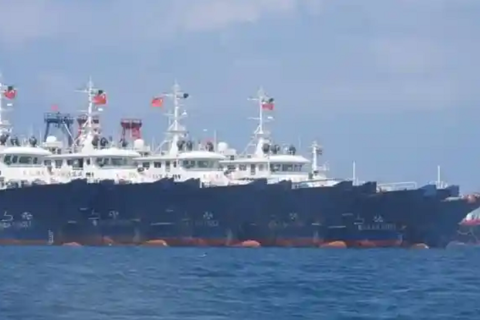
| An overview of fishing vessels spotted in the Julian Felipe Reef on March 23. The Philippine Coast Guard spotted about 220 Chinese fishing vessels in the area sometimes. Satellite images: Maxar Technologies via Reuters |

Mooring of more than 200 fishing boats in the Whitsun Reef, which Manila calls Julian Felipe Reef implicates the recurrence perpetrated by Beijing in the South China Sea (called East Sea by Vietnam).
Politicians and pundits around the world have expressed concern about rising tensions and destabilization of the situation.
Shortly after the deployment, the Philippine Foreign Ministry lodged a diplomatic protest, calling Beijing’s move “swarming and threatening presence” that creates “an atmosphere of instability.”
Philippines Defense Secretary Delfin Lorenzana called the presence of militia vessels a “clear provocative action of militarizing the area” and urged China to withdraw them.
On March 25, Spokesperson Le Thi Thu Hang of Vietnamese Ministry of Foreign Affairs demanded China to stop the violations and respect Vietnam’s waters after the vessels moved to Whitsun Reef, a part of the Vietnam's Grierson Reef (Sinh Ton Dong in Vietnamese) in Spratly Islands.
But what really set the situation on edge was a conclusion by Andrew Erickson, a noted authority on China’s maritime militia, that the vessels are indeed “maritime militia,” according to Asia Times.
Andrew Erickson, professor of strategy at the US Naval War College’s China Maritime Studies Institute, said the ships photographed look and act very much like the 84 large steel-hulled vessels purpose-built at multiple shipyards.
Such vessels reportedly have weapons lockers, and official PRC [People’s Republic of China] photos depict exercises in which they are loaded with ‘light arms, he told Radio Free Asia (RFA).
Jay Batongbacal, director of the University of the Philippines Institute for Maritime Affairs and Law of the Sea, said Satellite photos also show that the decks of these vessels are very clean. It's as if they're brand new.
Andrew Erickson speculated that they are “trolling for territory” and warned that if not countered at Whitsun Reef, or elsewhere, the China’s People’s Armed Forces Maritime Militia (PAFMM) vessels could support further territorial seizure akin to what China achieved at Scarborough Shoal in 2012.
Concerning development
According to the Taiwanese think tank Institute for National Defense and Security Research (INDSR), China’s maritime militia is part of their “grey zone” tactics, which are used to wage conflict against China’s neighbors without crossing the threshold into conventional war, Andrew Erickson said.
The maritime militia is a particularly useful gray zone force because Chinese authorities can deny or claim affiliation with its members depending on context. China can send its militia to harass foreign vessels in contested areas, but publicly assert that the vessels are independent from government control, thus avoiding escalation with other states.
Recent improvements also potentially make militia vessels more threatening during at-sea confrontations, raising the risk of unintended escalations with foreign militaries, said Andrew Erickson.
The maritime militia is believed to be behind a number of incidents in the South China Sea where high powered lasers were pointed at the cockpits of aircraft. This includes an attack against a Royal Australian Navy helicopter, he noted.
In 2019, the United States issued a warning to China over aggressive and unsafe action by their Coast Guard and maritime militia.
Gregory B. Poling, director of the Asia Maritime Transparency Initiative (AMTI) at the US-based think tank Center for Strategic and International Studies (CSIS) called the deployment suspicious, saying that the boats, tied up “with military precision” beside each other, “are not fishing,” reported National Public Radio (NPR).
Poling says to assert its vast claim, Beijing increasingly uses its fishing fleet as a maritime militia.
“But most dangerously, they are used as a coercive element. So you put a whole bunch of them in an area where you want to bully one of the neighbors without actually shooting anybody.”
“One big worry, of course, is that they might be preparing to occupy the reef... in order to construct another artificial island,” NPR quoted Batongbacal as saying. “We’ve seen it happen before,” he added.
Poling said “China’s goal is to control the water, the seabed, the airspace. And so they don’t really need an eighth outpost to do that. What they need is an overwhelming dominance when it comes to the number of vessels in the Spratlys.”
“Once China moves in, it doesn't leave. It might decrease the number. It might play nice for a little while, maybe it ratchets down the tension for short term political gain, but it is unlikely to vacate this reef,” Poling stressed.