Prime Minister urges acceleration of social housing projects
Hanoi focuses on expediting housing projects, overcoming administrative hurdles, and promoting collaboration between public and private sectors to meet the increasing demand for affordable housing.
Prime Minister Pham Minh Chinh has asked related ministries, agencies, and local authorities to promptly resolve challenges and expedite the implementation of social housing projects, as outlined in a directive dated December 10, 2024.
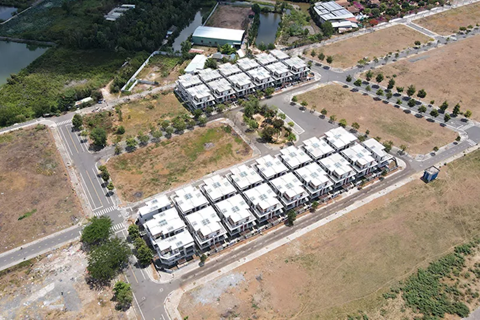
| Thanh Lam - Dai Thinh Social Housing Project in Me Linh District, Hanoi. Photo: Hai Linh |
.jpg)
Under the request, ministries and provincial leaders must enhance oversight, streamline administrative processes, and accelerate land allocation, investment approvals, and construction permits.
Meanwhile, it requires localilities’ actions which include sufficient land for social housing and ensuring clean land availability.
At the same time, related agencies must expedite investment approvals and construction progress to facilitate access to a VND-120 trillion (US$4.72 billion) credit package for social housing development. Beneficiaries will get subsidized housing loans through the Social Policy Bank.
The implementation requires the participation of different ministries, including the Ministry of Construction which ensures legal compliance, conducts training, enforces regulations, and oversees project implementation.
Meanwhile, the Ministry of Natural Resources and Environment will assist with land planning and ensure proper land use for housing projects. The State Bank of Vietnam is responsible for accelerating loan disbursement for housing projects.
Deputy Prime Minister Tran Hong Ha will oversee implementation, address any issues, and report unresolved matters to the prime minister while the Government Office monitors and coordinates progress among relevant ministries and local authorities.
Hanoi’s social housing development progress
The Hanoi Department of Construction has announced 19 social housing projects, comprising approximately 15,540 apartments, expected to be completed in the 2021-2025 period.
Currently, the city has 69 social housing projects in various stages of development. The completed ones have provided about 640,000 square meters of social housing floor space, totaling over 10,270 apartments. An additional 5,923 apartments from 11 projects are expected to be completed between 2024 and 2025.
In its future plans for the 2026-2030 period, there are 50 social housing projects under development, projected to deliver about 57,170 apartments. The Hanoi People’s Committee is currently assessing investment proposals for selecting developers for four out of five standalone social housing zones, concentrated in Dong Anh, Gia Lam, and Me Linh districts. These zones cover over 200 hectares and are expected to provide more than 12,000 apartments.
The specific projects include two in Tien Duong Commune in Dong Anh District; a centralized social housing area in Co Bi Commune, Gia Lam District; and social housing zones in Dai Mach Commune, Dong Anh District, and Tien Phong Commune in Me Linh District.
In addition, Hanoi also plans to convert the student housing complex at the Phap Van - Tu Hiep New Urban Area into rental social housing to further increase supply.
Hanoi is intensifying its social housing development to meet the rising demand for affordable homes among low-income residents, workers, and public service employees. The city prioritizes large-scale project implementation, streamlined investment processes, and secured land reserves for housing construction.
Hanoi's social housing strategy embraces a comprehensive approach that integrates legal, economic, and social dimensions. This balanced framework aims to create a more inclusive and sustainable urban environment by streamlining administrative processes, enhancing investment incentives, and prioritizing land allocation for housing development.
Hanoi's social housing strategy takes a holistic approach by balancing legal, economic, and social factors. This integrated framework aims to promote an inclusive and sustainable urban environment through streamlined regulations, investment incentives, and strategic land use planning. The city's efforts focus on accelerating housing projects, addressing administrative bottlenecks, and fostering public-private partnerships to meet the growing demand for affordable housing.
Hanoi People's Committee Chairman Tran Sy Thanh stressed the need to fast-track social housing development, citing administrative delays as key obstacles. He called on the Hanoi Construction Department and other relevant agencies to promptly address these issues, underscoring the importance of ensuring adequate housing for workers as a critical social responsibility.
Thanh further noted that upcoming amendments to the Capital Law would strengthen Hanoi's legal and financial framework, enabling more effective implementation of social housing projects. This includes introducing tailored financial packages for workers. The city aims to provide dedicated housing in all industrial parks by 2030, aligning with its broader socio-economic development strategy
The revised law introduces innovative mechanisms, preferential policies, and robust investment support, all aimed at accelerating the development of social housing projects. These changes are designed to attract greater investment and streamline processes, ensuring that social housing can be built more efficiently and effectively to meet growing urban needs.