UK's Mine Advisory Group helps eliminate landmine impact in Vietnam
MAG’s ultimate goal in Vietnam is to reduce the risk of unexploded ordnance and make the land safe to support socio-economic development.
Manchester-based Mines Advisory Group (MAG) will help Vietnam improve its capacity in clearing explosive remnants of war.
| Representatives of VNMAC and MAG at the signing ceremony on Oct 7. Photo: VNMAC |
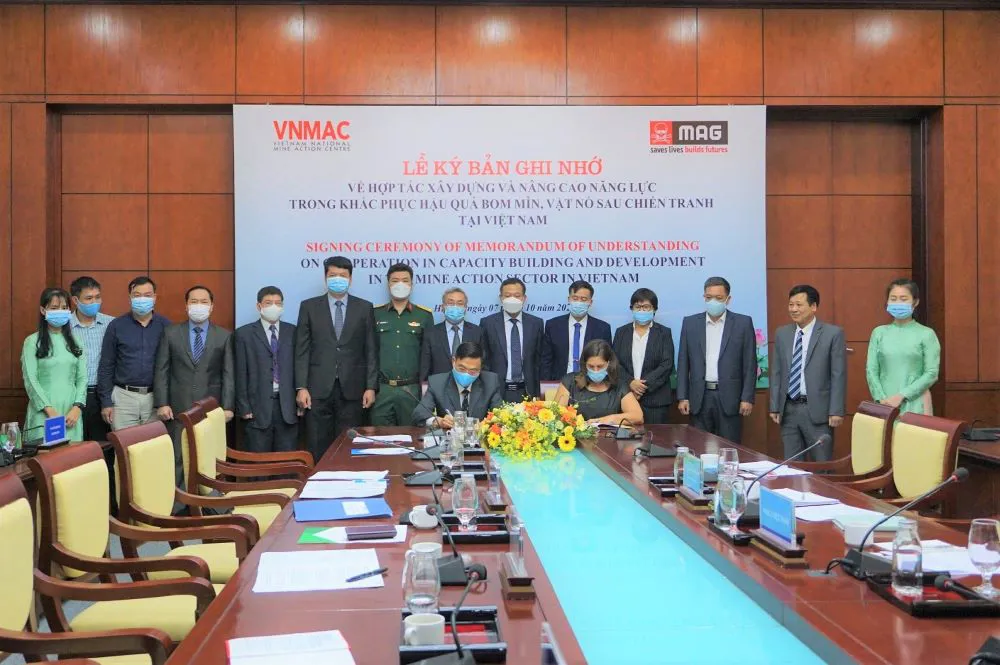
Under the memorandum of understanding (MoU) signed in Hanoi on Oct 7, MAG will share expertise in the field with the Vietnam National Mine Action Center (VNMAC), the host government’s lead for issues related to unexploded ordnance (UXO) and landmines, according to MAG Country Director Vietnam Helene Kuperman.
The signing marks an important step to serve as a foundation and legal basis for further and more effective cooperation, contributing to addressing the legacies of the war in Vietnam and to advancing socio-economic development in war-affected areas, said Major General Tran Trung Hoa, VNMAC general director.
Hoa appreciated MAG activities in Vietnam over the last 20 years, greatly contributing to clearing unexploded ordnance in the central province of Quang Tri since 1999 and Quang Binh since 2003, the two most heavily contaminated provinces in the country.
In 2020–2021, supported by a consortium of operators led by Mines Advisory Group (MAG), and in conjunction with Norwegian People’s Aid (NPA) and Peace Trees Vietnam, the authorities in Quang Binh province have been trained and supported to set up a provincial database and coordination unit, building on the experience gained in Quang Tri.
Over the past 20 years, MAG has cleared almost 170 million square meters of land, destroyed nearly 360,000 dangerous items, directly benefiting over one million Vietnamese people.
MAG’s ultimate goal in Vietnam is to reduce the risk of landmines and unexploded bombs and make land safe to support socio-economic development.
It also conducts risk education sessions during village meetings to ensure that communities infested by unexploded ordnance are briefed on how to stay safe in contaminated areas in Vietnam.
Finding and destroying landmines, cluster munitions, and unexploded bombs in places affected by conflict, MAG has helped over 20 million people in 70 countries rebuild their lives and livelihoods after the war since 1989.
In 1997, MAG-formed the International Campaign to Ban Landmines (ICBL) was jointly awarded the Nobel Peace Prize for “their work for the banning and clearing of anti-personnel mines.”
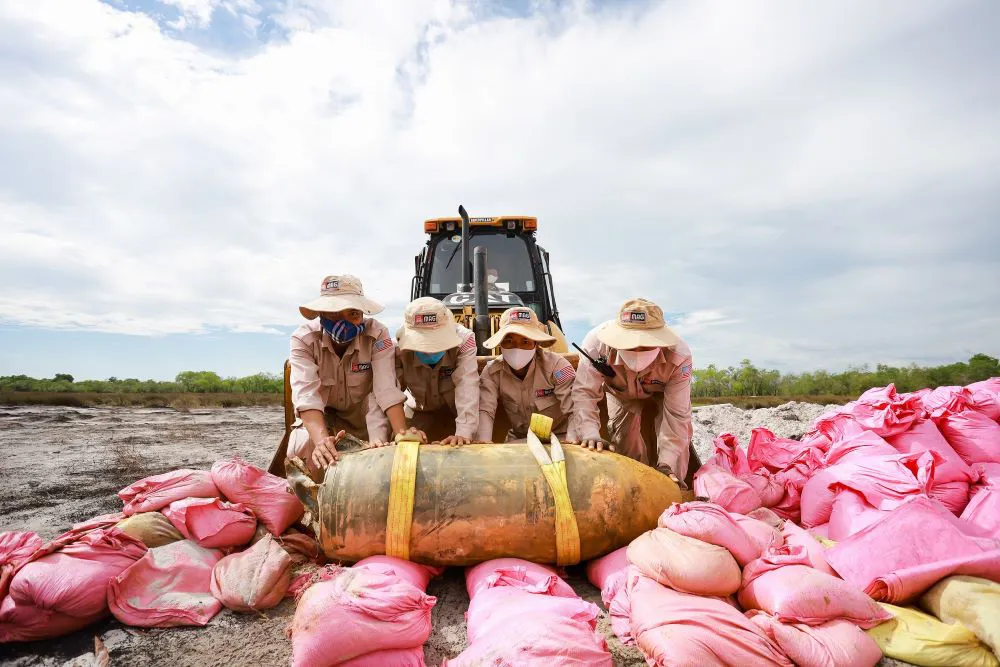
| MAG landmine clearance in Vietnam. Photo: MAG |
International support
According to MAG, Vietnam remains one of the world’s most contaminated countries, with an estimated 800,000 tons of leftovers from the war that ended more than 40 years ago.
Intending to mitigate the consequences of unexploded ordnance, many international organizations have joined hands with Vietnam for more than two decades.
Of them, MAG has conducted risk education as an integrated part of survey activities including risk education in schools; and risk education at Farmers’ Union, Women’ Union, and Youth Union meetings.
Peace Trees Vietnam (PTVN), with operations in the country since 1995, helps organize projects related to risk education through billboards and radio broadcasts, and mobile risk education.
The Norwegian People’s Aid (NPA) has worked in Vietnam since 2008 following the signing of an MoU with Quang Tri to support the development of Project RENEW’s Explosive Ordnance Disposal (EOD) capacity. NPA’s operational footprint now covers all of Quang Tri and Thua Thien-Hue provinces, with an increase of assets to four Battle Area Clearance teams, one Non-Technical Survey team, four EOD teams, and 25 Technical Survey teams.
The Project RENEW was established in 2001 as a joint effort between Quang Tri and interested international NGOs to “restore the environment and neutralize the effects of the war” – with the main focus on the unexploded ordinance.
The Danish Demining Group (DDG) completed its work in Vietnam in January 2020 since its first operations in the country in 2012. It covered risk education for teachers as part of a school program and risk education in communities.
UNDP is in charge of producing risk education videos as part of the Korea-Vietnam Mine Action Project (KVMAP).
The US Golden West Humanitarian Foundation (GWHF), with operations in Vietnam since 2007, developed an integrated research and educational program focused on the use of mechatronics and robotics in humanitarian explosive ordnance disposal (EOD), and mine action.
Meanwhile, the Catholic Relief Services (CRS) is responsible for risk education in primary and secondary schools, and through a risk education app.