Urban rail takes center stage in Hanoi’s US$53-billion plan to ease congestion
Expanding the urban rail network remains the most strategic solution to improve Hanoi’s traffic situation.
THE HANOI TIMES — Hanoi has completed its 2025–2030 Traffic Congestion Reduction Plan with an estimated cost of US$53 billion, mostly for urban rail development that aims to ease the capital’s long-standing traffic congestion.
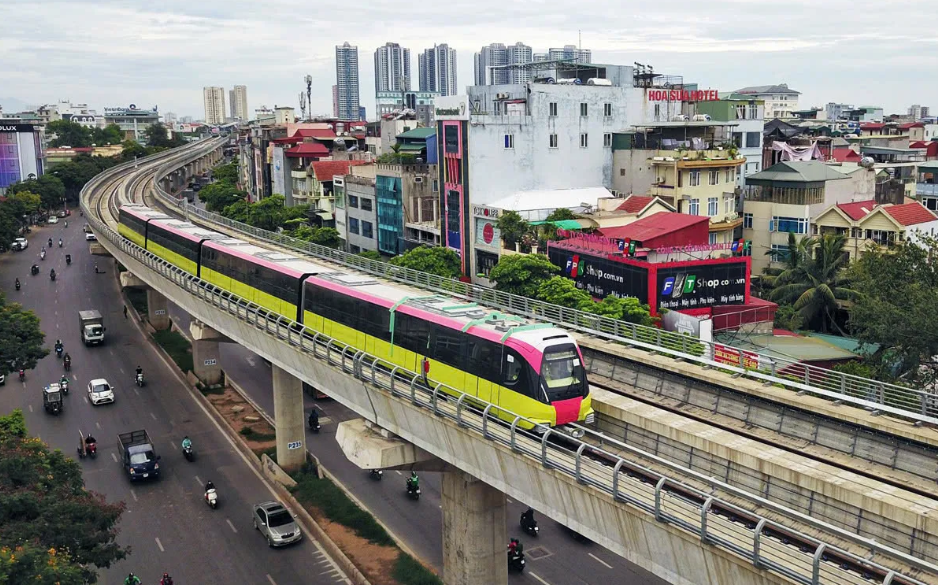
Nhon - Hanoi Station metro line. Photo: Hai Linh/The Hanoi Times
Hanoi is investing heavily in its transport infrastructure with 15 planned urban rail lines, projects that are costly and technically complex but essential to reshaping the city and easing congestion, pollution and private vehicle dependence.
Transport expert Le Trung Hieu warned that congestion threatens sustainable growth and quality of life in the capital, calling metro expansion “the most strategic solution to improve Hanoi’s traffic.”
Hanoi Urban Railway Management Board Chairman Nguyen Cao Minh said public transport is expected to meet 50%–55% of travel demand in central areas by 2030 and 65%–70% after 2030, a target impossible without a modern metro system.
Once completed, the network is projected to serve 3.2 million passengers daily, covering 35%–40% of public transport in central districts and 20% in suburban areas.
The city plans to pursue transit-oriented development (TOD), with urban growth centered on metro corridors. “The metro is indispensable as it not only eases congestion and pollution but also drives economic growth and enhances Hanoi’s competitiveness,” said Minh.
This strategy aligns with national policies, including the Party’s 13th National Congress Resolution, the Politburo’s Resolution No. 30-NQ/TW (2022), and Conclusion No. 49-KL/TW (2023), all designating metro development as a top priority.
The National Assembly and Government have also approved the Comprehensive Urban Railway Investment Plan and a pilot resolution giving Hanoi and Ho Chi Minh City special authority to speed up metro expansion.
Minh noted that the city now needs a network more than originally planned. “The old plan had ten lines, but we now propose fifteen routes integrated with TOD redevelopment.”
Total investment for the 15-line system, planned through 2045, is estimated at VND1.39 quadrillion ($55.44 billion).
One strategy, three phases
Hanoi’s metro expansion follows a “one strategy, three phases” roadmap based on five principles: align investment with funding capacity, maximize efficiency, prioritize central routes already studied in detail, connect key transport hubs such as airports and main stations, and ensure technological consistency and effective execution.
Phase 1 (to 2030) will complete 96.8 km of metro lines (Nos. 2, 3.1 and 5) and prepare 301 km for construction, with an investment of VND406 trillion ($16.21 billion). The system will operate about 680 metro cars, serving 2.2–2.6 million daily trips, or 7%–8% of all public transport.
Phase 2 (2030–2035) will add 301 km with 2,110 metro cars at an estimated cost of VND526 trillion ($20.97 billion). By then, metro services are expected to handle 9.7–11.8 million trips daily, accounting for 35%–40% of urban passenger transport.
Phase 3 (2035–2045) will construct 196.2 km more, costing VND458 trillion ($18.27 billion) and deploying 1,375 metro cars.
By 2045, Hanoi plans to complete over 600 km of tracks and operate 15 lines with 4,165 metro cars, an ambitious yet determined vision for sustainable urban mobility.
To meet the vast funding needs, Conclusion No. 49-KL/TW directs mobilizing all available resources while prioritizing rail development in the national infrastructure strategy.
Domestic capital will remain the foundation, with the state budget playing a key role and external financing providing strategic leverage.
The city will review all public investment sources, including budget allocations, bonds, ODA loans and other lawful channels, to fund this long-term metro program.