Log in
Business

Vietnam aims for export growth of 6-7% in 2021-2030

Vietnam aims for a healthy and sustainable trade partnership with all key partners.

Deputy Prime Minister Le Van Thanh has signed off decision No.493 approving the country’s trade strategy until 2030, which targets export growth of 6-7% during the 2021-2030 period.

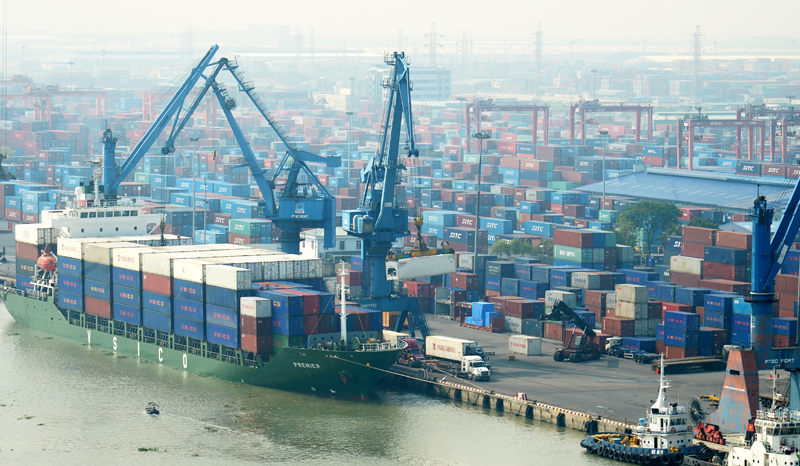
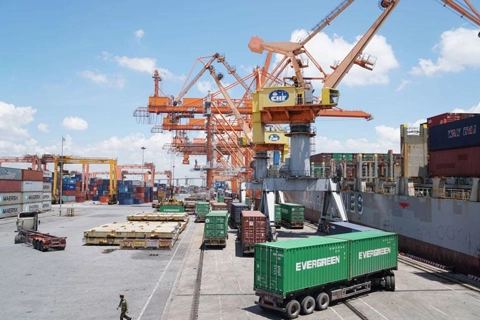
 Cargo handling at Dinh Vu port, Haiphong. Photo: Pham Hung

Under the strategy, Vietnam’s exports are expected to expand by 8-9% in 2021-2025, and 5-6% in 2026-2030.

Meanwhile, the imports growth would average 5-6% in 2021-2030, with around 7-8% in the 2021-2025 period, and 4-5% in 2026-2030.

A key priority in the strategy is to ensure a balanced trade in the next five years, and gradually reach a sustainable surplus in the 2026-2030 period.

“Vietnam aims for a healthy and sustainable trade partnership with all key partners,” it said.

In addition, the Government sets as a goal the contribution of the manufacturing and processing sector at 88% of total exports by 2025 and 90% by 2030, of which mid-tech products would account for 65% in 2025 and 70% in 2030.

It is expected the European market to make up 16-17% of Vietnam’s exports by 2025, and 18-19% by 2030; the American market  32-33% by 2025 and 33-34% by 2030; and the Asian region  49-50% by 2025 and 46-47% by 2030.

To ensure sustainable exports, Vietnam would continue to push for industrialization and modernization, focusing on environmentally-friendly export products with higher added value and technological content.

Vietnam is also expected to shift to a high processing level of agro-forestry-fishery products that are capable of meeting quality, environmental and social standards in foreign markets.

The strategy also stressed the necessity to reduce the country’s dependence on input materials from abroad, while moving away from producing items that may cause environmental pollution and are resource-intensive.

For the 2021-2025 period, Vietnam would focus on key farm produce and promote the local brands in international markets, at the same time raising the added value for products with high competitiveness in the labor-intensive industries, such as garments, and footwear or electronics.

In the subsequent five years, the country is set to develop new products of high added value, and take advantage of Industry 4.0 to focus on mid-to high tech products for exports.

The strategy noted Vietnam would prioritize importing modern machinery, equipment, and production chains from developed countries, especially high technologies, which are seen as a key solution to enhance productivity, quality, and competitiveness of export products.

A key approach is to continue diversifying export-import markets to avoid dependence on a single market while ensuring balanced trade relations for sustainability.

Vietnam aims to deepen economic integration through the utilization of free trade agreements that the country is a part of and penetrate key markets such as the EU, Japan, China, South Korea, and ASEAN.
Reactions:
Share:
Trending
Most Viewed
Related news
Vietnam’s export strength in 2025 builds solid momentum for 2026 growth

Vietnam’s export strength in 2025 builds solid momentum for 2026 growth

With trade turnover nearing the US$900-billion mark, Vietnam enters 2026 with renewed confidence despite global volatility, rising trade barriers and shifting supply chains. Deputy Director of the Import–Export Department Tran Thanh Hai has outlined the drivers of this growth and the priorities for sustaining momentum next year.

Vietnam sets new trade record as import–export turnover nears $840 billion

Vietnam sets new trade record as import–export turnover nears $840 billion

Vietnam recorded its highest-ever trade performance in January-November as import–export turnover surged, driven by strong export growth and a continued trade surplus.

Vietnam accelerates plan to develop new free trade zones nationwide by 2030

Vietnam accelerates plan to develop new free trade zones nationwide by 2030

Vietnam moves to pilot major free trade zones in major cities next year to drive economic growth and boost competitiveness.

Hanoi advances hi-tech industry, with Hoa Lac as its key growth engine

Hanoi advances hi-tech industry, with Hoa Lac as its key growth engine

Hanoi is accelerating its shift toward a modern industrial model built on high technology and innovation, with Hoa Lac emerging as the core destination for investment and high-quality human resources.

Hanoi pushes SME–large enterprise linkages to drive sustainable supply chain growth

Hanoi pushes SME–large enterprise linkages to drive sustainable supply chain growth

Experts have said that the city can strengthen its competitiveness by deepening cooperation among the Government, large enterprises, and small businesses, especially through more effective supply-chain linkages.

Hanoi’s Hi-tech & Industrial Parks: achievements and outlook

Hanoi’s Hi-tech & Industrial Parks: achievements and outlook

Hanoi’s hi-tech and industrial parks are emerging as key drivers of the capital’s economic transformation, attracting high-value investment, advancing innovation and strengthening supply chains as the city sets its sights on becoming a leading regional technology and manufacturing hub.

Vietnam honors 50 transparent listed companies as stock market reaches new milestones

Vietnam honors 50 transparent listed companies as stock market reaches new milestones

Vietnam honored 50 listed companies for excellence in transparency at the 2025 Vietnam Listed Company Awards, which spotlighted standout annual reports, corporate governance and sustainability disclosures amid rising foreign investor interest and growing alignment with international reporting standards.

Vietnam to tighten biometric authentication for new bank cards next year

Vietnam to tighten biometric authentication for new bank cards next year

Bank card issuers must conduct a face-to-face meeting and match the biometric data of individual customers or the legal representative of organizational customers with their identity documents.