Vietnam, China intensify cooperation on green growth, digital economy
The scope of cooperation includes not only investment but also technology transfer, employee training, and the exploration of other markets.
Vietnam and China would further boost investment and connectivity in emerging fields such as green development, renewable energy, and digital economy.
| Delegates at the meeting between Minister Nguyen Chi Dung and Chinese Minister of Commerce Wang Wentao. Source: VGP |
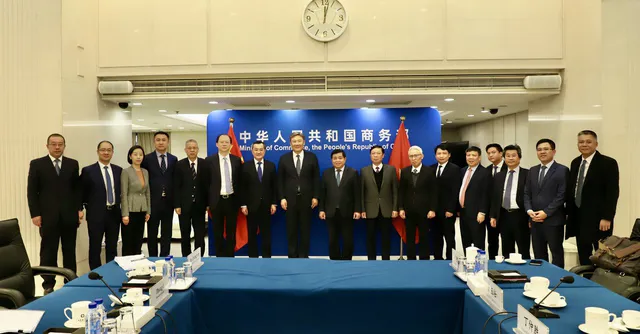
The view was shared during a meeting on March 28 in Beijing between Vietnam’s Minister of Planning and Investment (MPI) Nguyen Chi Dung, who is currently on a working visit to China from 28-30 March, and Chinese Minister of Commerce Wang Wentao.
At the meeting, Dung expressed delight at the steady performance of China's foreign investment in Vietnam. China has been Vietnam's largest trading partner for many years, while Vietnam is China's largest trading partner in ASEAN and the sixth largest in the world.
Currently, both sides have agreed to connect standard gauge railways across the border, including the Lao Cai - Hanoi - Haiphong 1.435m gauge Dong Dang - Hanoi and Mong Cai - Ha Long – Haiphong lines.
“This is an important infrastructure system to promote economic and trade cooperation between Vietnam and China,” Dung said.
Regarding the establishment of free trade zones and duty-free zones, Dung called on China to share its experience with new economic models such as Free Trade Zones, Open Economic Zones, Customs-Free Zones, and related legal incentives.
On investment, Dung emphasized that Vietnam encourages Chinese enterprises to expand investment cooperation in areas of strength such as innovation, renewable energy, smart cities, electronics, technology, and supporting industries.
“The MPI is committed to accompanying, supporting, and creating favorable conditions for Chinese enterprises to successfully and efficiently implement investment projects for the benefit of both sides,” Dung added.
The Chinese Minister of Commerce, Wang Wentao, expressed his pleasure at meeting with Minister Dung in Beijing and his desire to work together in production chains and supply chains in both new and traditional sectors.
The scope of cooperation includes not only investment but also technology transfer, employee training, and exploration of other markets, he added.
Wentao stated that some manufacturing industries, even production chains, have moved from China to Vietnam, such as textiles, household appliances, and wood products. China's investment in Vietnam is rapidly growing, especially in electronics. Many Chinese ancillary enterprises have supplied products to major electronics brands such as Samsung and Apple. China is also increasing investment in new sectors in Vietnam, such as solar energy.
China will increase imports of Vietnamese goods to ensure a better trade balance, he noted.
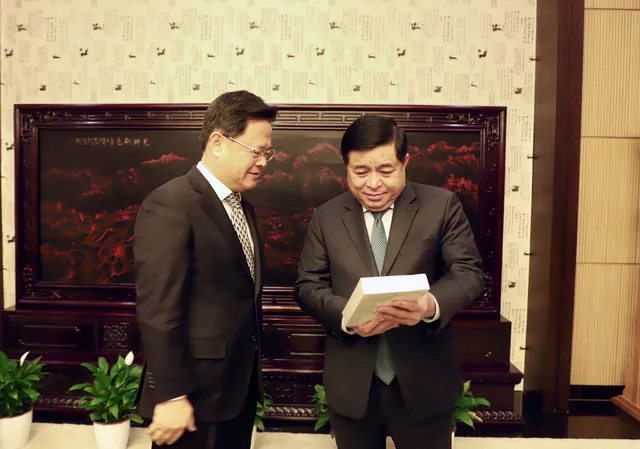
In a meeting with Chairman of the National Development and Reform Commission (NDRC) Zheng Shanjie, Dung urged the NDRC to coordinate the research and drafting of a joint report on expanding cooperation under the "Two Corridors, One Belt" initiative to the Chinese city of Chongqing (cooperation currently covers only Guangxi and Nanning).
| Minister Dung (r) and NDRC's Chairman Zheng Shanjie. |
Regarding infrastructure connectivity, including railways, Dung stated that developing transportation infrastructure is one of Vietnam's three strategic breakthroughs in national development strategy.
Currently, the Vietnamese Government is focusing on investing in the construction of expressways, with the total length of expressways in Vietnam currently reaching about 1,900 km.
It is expected that by 2025, more than 3,000 km of expressways will be built, rising to 5,000 km by 2030.
Meanwhile, China is a leading country in the world in terms of the development of the railway industry. Therefore, Vietnam hopes to learn from China's experience in building and developing the railway industry, especially in terms of technology, engineering, mobilization of financial resources, and management skills, Dung said.
On March 29, the Vietnamese delegation led by Minister Dung visited the Beijing-Shanghai high-speed railway line. Built in 2008 and completed in 2011, the line covers more than 1,300 km with a total investment of over US$33 billion, and trains run at speeds of around 350 km/h.
On March 30, the delegation discussed the issue with the China Railway Rolling Stock Corporation (CRRC). Minister Nguyen Chi Dung, along with leaders from the Ministry of Transport, exchanged experiences with CRRC leaders on developing high-speed rail systems, particularly in the development of the railway industry, manufacturing machinery, rolling stock, cooperative mechanisms, and workforce development.
China owns the world's longest high-speed rail network, consisting of four north-south lines and four east-west lines, ranging from 250 to 350 km/h. The high-speed railway network now spans nearly 50,000 km, reaching 93% of cities with a population of over 500,000.