Vietnam and Cuba launch joint biotechnology network in Hanoi
The network aims to connect resources in research, training, technology transfer, production and commercialization of Cuba’s biotechnology products while leveraging Vietnam’s indigenous resources.
THE HANOI TIMES — Vietnam and Cuba on August 28 launched a joint biotechnology network in Hanoi, marking a new milestone in scientific and technological cooperation between the two countries.
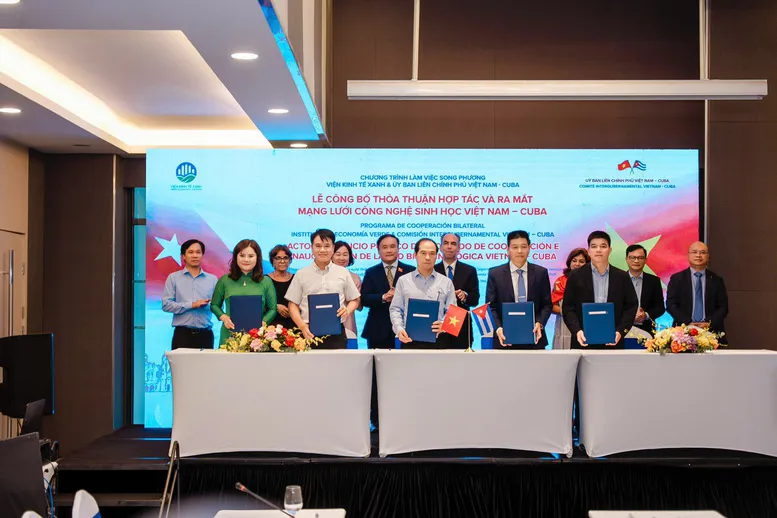
The launch ceremony's overview. Photo: Baochinhphu
The Vietnam - Cuba Biotechnology Network, initiated by the Green Economics Institute, brings together founding members from 20 Vietnamese hospitals, research institutes, universities, and major enterprises.
The initiative is expected to expand Vietnam’s biotechnology sector and accelerate the application of Cuban scientific achievements in healthcare, agriculture, and community development.
According to Duong Thi Bich Diep, Director of the Green Economics Institute, the network will facilitate sustainable cooperation among research institutes, enterprises, universities, and hospitals from both sides.
The Cuba Intergovernmental Committee delegation and Cuban Ambassador to Vietnam Rogelio Polanco Fuentes welcomed the move.
Vietnam and Cuba see biotechnology cooperation as a potential field to strenthen the two countries’ excellent bilateral relations, the ambassador said.
Cuba is highly experienced in this field, while Vietnam's biotech sector has a huge room for further development, he added.
At the event, the Green Economics Institute proposed eight initiatives to boost collaboration between Vietnam and Cuba in the biotech industry.
One of the eight initiative is the potential establishment of a joint venture that combines Cuban technologies and Vietnamese resources to develop new biotech products.
This joint venture will be the foundation for developing an agricultural biotechnology park in the central coast province of Lam Dong, an international healthcare complex in the southern province of Dong Nai, and an e-commerce platform for biotechnology products.
The initiative highlights both nations’ efforts to deepen ties beyond traditional political solidarity, extending cooperation into high-tech sectors.
The launch also featured a symbolic donation from Vietnamese businesses, which contributed 400 tons of rice to Cuba as humanitarian support amid the nation’s food shortages.
In June, the Green Economics Institute inked an agreement with Cuba-based LabioFAM Group and the Center for Genetic Engineering and Biotechnology (CIGB) to study and produce bitoech products for agriculture and natural medicine.
Cuba is internationally recognized for its strength in vaccine research and biotechnology, while Vietnam seeks to expand its biotech capacity as part of broader economic modernization goals.