Vietnam coastline increasingly exposed to natural disasters: WB
Each year, an average of US$852 million – or 0.5% of GDP – and 316,000 jobs in key economic sectors are at risk from riverine and coastal flooding.
The coastline of Vietnam is increasingly exposed to natural disasters, resulting in significant human and economic losses, but current risk management measures prove inadequate, according to the World Bank.
A new resilience development strategy is urgently needed ─ otherwise, additional economic growth over the next decade in the range of billions of dollars could be wiped away by natural shocks, stated the World Bank in its latest report titled “Resilient Shores”.
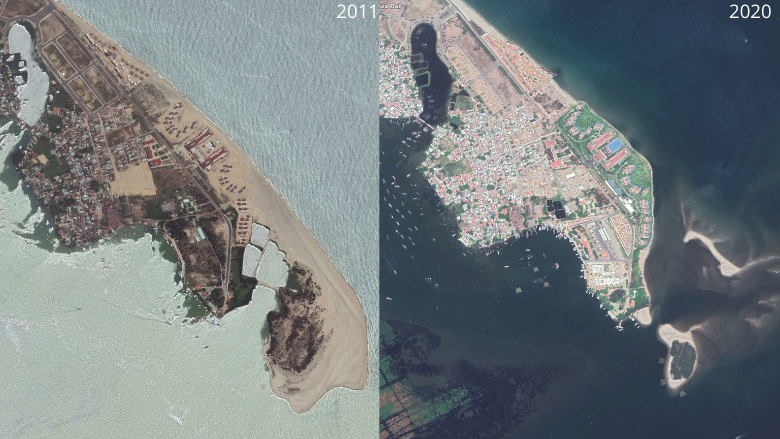
| About 200 meters of beach have disappeared in 10 years in Cua Dai, near Hoi An. Source: Google Earth. |
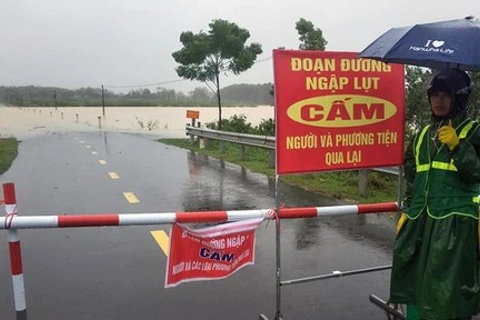
The ongoing devastating storms and floods that battered the central part of Vietnam are the latest evidence of a worrying trend that natural risks, which have already been substantial, are intensifying due to rapid urbanization, economic development, and climate change.
“To ensure the sustainable development of Vietnam’s coastal zones, we cannot ignore the challenges of natural shocks and climate change. To secure prosperity, we must invest in resilience,” said Tran Quang Hoai, director general of the Vietnam Disaster Management Authority, under Vietnam’s Ministry of Agriculture and Rural Development.
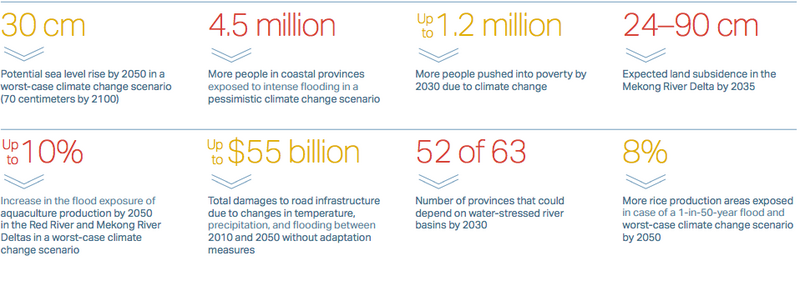
The report estimates that 12 million people in coastal provinces are exposed to the threat of intense flooding and over 35% of settlements are located on eroding coastlines. Each year, an average of US$852 million – or 0.5% of GDP – and 316,000 jobs in key economic sectors are at risk from riverine and coastal flooding.
| Source: Resilient Shores. |
Public facilities and infrastructure are also at risk, which means disruption of service delivery at the time when they are most needed. Severe flooding affects directly 26% of public hospitals and healthcare centers and 11% of schools in the region. More than one-third of Vietnam’s power grid is located in forested areas, at risk of being damaged by storm-induced fallen trees.
Despite much progress over the past decade, Vietnam’s current risk management scheme still faces significant challenges. Major shortcomings the report identifies include fragmented and incomplete risk information and ineffective enforcement of related regulations such as spatial planning, building codes, safety standards and systematic maintenance of infrastructure systems. For instance, the report shows that two-thirds of Vietnam’s sea dike system does not meet the prescribed safety requirements.
“If the current trends of rapid economic development in high-risk areas continue, disaster losses are bound to increase,” said World Bank Country Director for Vietnam Carolyn Turk. “It’s time for a new approach to balance the risks and opportunities so that Vietnam’s coastal regions can continue to be an engine of growth while being resilient to shocks.”
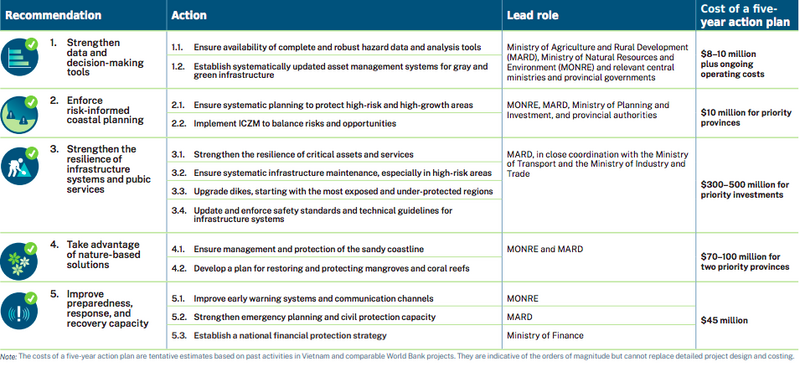
The report presents a concrete action plan in five strategic areas that needs to be rolled out immediately and decisively.
| Source: Resilient Shores. |
Vietnam’s diverse coastline spans over 3,000 kilometers. The coastline’s wealth of natural endowments provides livelihoods for some 47 million people or half of the country’s population. The region also bears the brunt of natural disasters that hit Vietnam regularly.