14TH NATIONAL CONGRESS OF THE COMMUNIST PARTY OF VIETNAM
Log in
Hanoi

Vietnam enhances Hanoi and Gia Binh Airport connectivity

Once completed, Gia Binh Airport is expected to become a 5-star international facility listed among the world’s top 10 most beautiful and modern airports.

THE HANOI TIMES — The government has directed all relevant agencies to use all available resources to develop strategic airport infrastructure and set up a direct route from Gia Binh Airport in the northern province of Bac Ninh to Hanoi.
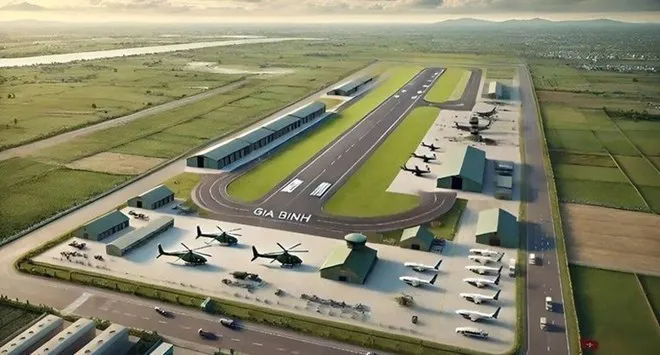
Computer-generated image of Gia Binh Airport. Photo: VGP

This instruction was outlined in Notice No. 304/TB-VPCP issued by the Government Office on June 17, 2025 that summarizes the conclusion of Deputy Prime Minister Tran Hong Ha during a meeting on the special investment mechanism for the road project connecting Gia Binh Airport and Hanoi.

The people’s committees of Hanoi and Bac Ninh are asked to implement investment projects within their jurisdictions to ensure the timely completion of construction.

The deputy prime minister emphasized the need for an urgent and thorough review of applicable legal provisions.

“If special mechanisms are deemed necessary, the rationale for their proposal must be clearly explained, and their potential impact must be assessed to ensure investment effectiveness and prevent corruption, vested interests, losses, waste, and misconduct,” Ha  concluded.

According to the Hanoi People’s Committee's proposal, the road connecting Gia Binh International Airport to Hanoi will begin at the airport and end at the interchange with the road linking the Tu Lien Bridge approach road to Hanoi's Ring Road No. 3, with a total length of approximately 35.43 kilometers.

Within Hanoi’s territory, the route spans 14 kilometers with a cross-sectional width of 120 meters. Of this section, the 7-kilometer stretch from the Bac Ninh–Hanoi border to the Hanoi Ring Road 3 interchange with the Hanoi–Lang Son Expressway will be newly constructed.

The remaining seven kilometers, from the Hanoi Ring Road 3 interchange to the Tu Lien Bridge approach road interchange (overlapping with Ring Road 3), will be upgraded from a 35-meter-wide road to a 120-meter-wide road.

Construction of Gia Binh Airport began in December 2024 in Gia Binh District, Bac Ninh Province, led by the Ministry of Public Security. The 125-hectare airport is scheduled for completion by the end of 2025. It will be designated a Class 3 helipad, a Class 3 military airport, and a Class 3C civil airport.

According to the revised plan approved by the Ministry of Construction for the period from 2021 to 2030, Gia Binh International Airport will be developed to meet ICAO 4E standards (accommodate aircraft with a “Reference Field Length” of 1,800 meters and above and a wingspan up to 65 meters). The airport will have an annual capacity of approximately one million passengers and 250,000 tons of cargo.

By 2050, the airport will retain its 4E classification but increase its capacity to approximately three million passengers and one million tons of cargo per year.
Reactions:
Share:
Trending
Most Viewed
Related news
Hanoi greenlights road linking Gia Binh Airport

Hanoi greenlights road linking Gia Binh Airport

18 Feb, 20:25

The road construction project is in line with the city's general planning guidelines and ensures connectivity with existing transportation networks outlined in approved planning schemes.

Work starts on US$612 million elderly healthcare complex in Hanoi

Work starts on US$612 million elderly healthcare complex in Hanoi

The complex project is designed as a multi-functional center with high-quality medical services, education and clinical training, scientific research and comprehensive elderly care.

Hanoi orders urgent action to tackle environmental pollution

Hanoi orders urgent action to tackle environmental pollution

Hanoi’s Party chief has called for urgent, comprehensive action to tackle environmental pollution, warning that delays are undermining urban sustainability and the city’s tourism appeal.

Huong Pagoda Festival 2026 embraces smart management for modern pilgrimage experience

Huong Pagoda Festival 2026 embraces smart management for modern pilgrimage experience

Blending centuries-old spiritual traditions with modern governance tools, the Huong Pagoda Festival is redefining how major religious events are organized in Hanoi, with technology now playing a central role in management and visitor services.

Hanoi Times Weekly podcast - January 17

Hanoi Times Weekly podcast - January 17

This week, we highlight major developments shaping Hanoi, including Vietnam’s first semiconductor chip plant, expanded global tech cooperation, cultural events, social housing targets, digital public services, innovation investment and job creation priorities across the capital.

Hanoi targets double-digit export growth with focus on high-value goods

Hanoi targets double-digit export growth with focus on high-value goods

As global trade conditions grow more complex, Hanoi is recalibrating its export strategy to move up the value chain, broaden market access and strengthen long-term economic resilience.

Metro ridership target rises as Hanoi pushes safer, smarter urban rail operations

Metro ridership target rises as Hanoi pushes safer, smarter urban rail operations

As Hanoi accelerates public transport reform, the city’s metro operator is setting higher ridership goals while focusing on safety, digital governance and service quality to support long-term urban mobility growth.

Hanoi advances Capital Region linkages through urban cluster model

Hanoi advances Capital Region linkages through urban cluster model

The approach is expected to create new momentum and development space for provinces in the Capital Region and neighboring areas, ease pressure on Hanoi and enable shared growth.

Hanoi honors Palestinian ambassador for decades of service and deep ties to capital

Hanoi honors Palestinian ambassador for decades of service and deep ties to capital

Over four decades of studying, working and living in Vietnam, Palestinian Ambassador Saadi Salama has witnessed Hanoi’s transformation from a struggling capital into a dynamic political, economic and cultural centre that has retained its distinct identity.