Vietnam NA chairman is special guest of Cuba parliament
Addressing the Cuban parliament, Vietnam’s top lawmaker reaffirmed the cooperation in legislation and a wide range of fields while promoting the brotherhood legacy.
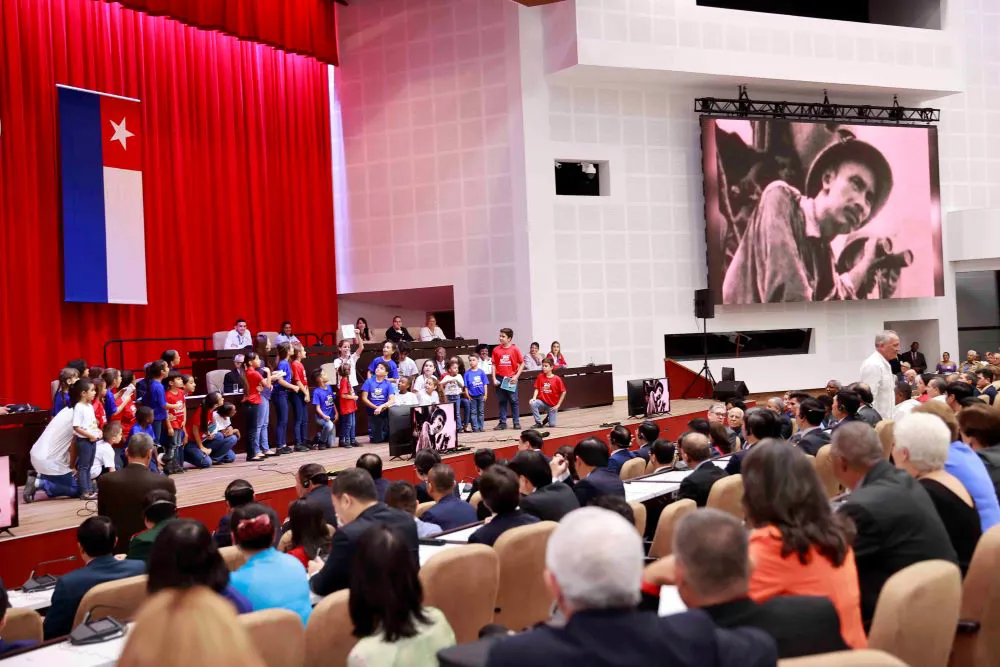
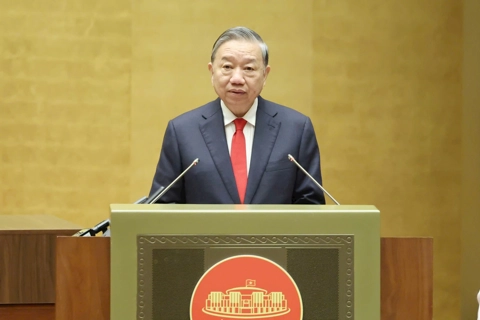
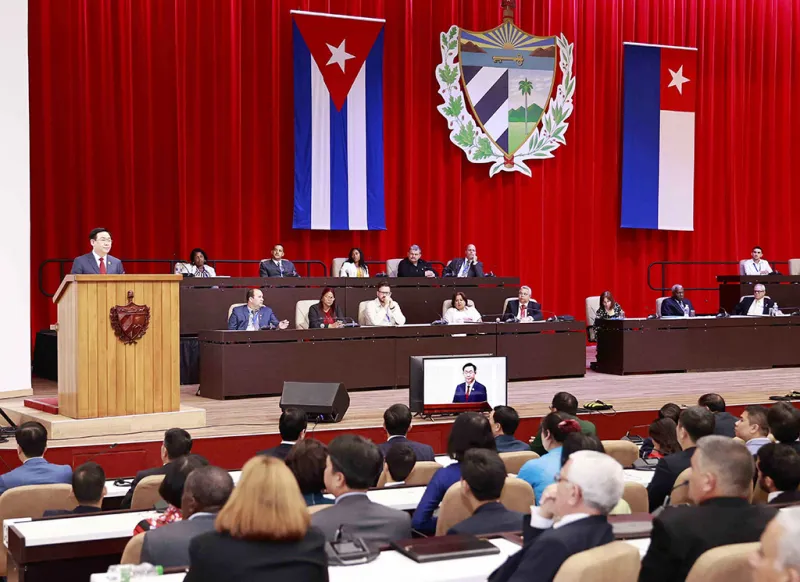
During his current visit to Cuba, Vietnamese top legislator Vuong Dinh Hue was invited by the Cuban National Assembly of People's Power as a special guest to deliver a speech to the assembly.
| Chairman of Vietnam's National Assembly Vuong Dinh Hue (R) meets Cuba's President Miguel Díaz-Canel. Photo: Quochoi |
.jpg)
Chairman Hue congratulated the leadership of the National Assembly of People’s Power and State Council on being elected at the Constituent Session of the 10th Legislature.
He conveyed the congratulations of the Vietnamese leaders of the Communist Party, the State, and the Government to President Miguel Díaz-Canel, Prime Minister Manuel Marrero Cruz, President of the National Assembly of People’s Power of Cuba and the Council of State Esteban Lazo Hernández, for their ratifications in the charges.
In his words to the plenary, he highlighted the brotherly relations that unite the two countries and affirmed that the Vietnamese have always remained faithful and close to the Cuban people. Both countries treasure extraordinary ties, which are a symbol of international relations.
Hue’s visit to Cuba coincided with the 62nd anniversary of the victory at Playa Girón, the 50th anniversary of the visit of the historic leader of the Cuban Revolution Fidel Castro to the Quang Tri liberated zone, the 70th anniversary of the assault on the Moncada and Carlos Manuel de Céspedes barracks, and the 60th anniversary of the establishment of the Cuban Committee of Solidarity with the People of South Vietnam.
He stressed that present and future generations will continue to uphold the legacy of Fidel and Ho Chi Minh. Vietnam always remembers Fidel’s historic phrase “For Vietnam, Cuba is willing to shed its own blood,” which has been the basis of the special relations between the two peoples, he noted.
He said the traditional relationship of solidarity, support, and all-around cooperation between the Vietnamese and Cuban brothers has led to a permanent will to consolidate, promote and develop bilateral ties in all spheres.
The leader of the Vietnamese Parliament referred to the Doi Moi (Renewal) process in Vietnam and stressed that today Vietnam is the main Asian investor in Cuba.
Hue maintained that the people of Vietnam have great admiration for the Cuban people and their capacity for resilience and support to other countries.
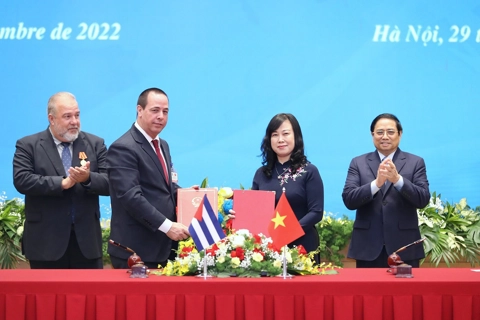
During his stay in Cuba, the parliaments and governments of the two countries signed a series of agreements with the aim of increasing exchange.
Regarding trade, on April 1, 2020, the Bilateral Trade Agreement officially entered into force, with new preferential trade commitments, promoting benefits for companies from both countries and creating favorable conditions for bilateral business and trade of goods.
In his speech, Hue expressed his best wishes for the development of bilateral relations, stressing the message that reads ‘Vietnam and Cuba, together we will win.’
On this occasion, he announced that Vietnam will continue supplying rice to Cuba and supporting projects in corn, soybeans, and aquaculture production.
| Chairman Vuong Dinh Hue speaks at the Cuba parliament. Photo: Quochoi |
Valuable legacy
For his part, the president of the National Assembly of Popular Power and president of the Council of State of Cuba, Esteban Lazo Hernández said during the struggle to defend its sovereignty, Cuba was not alone and never has been thanks to the solidarity and support from all corners of the world, including a country in the antipoles that they feel deeply close: Vietnam.
He cited an example of the close relationship between the two countries. “Let us recall how José Martí, the Apostle of Cuba, described the Annamese in 1889 as a people with an immense heart who transcend generations with their work ethic, bravery, and self-sacrifice,” he noted.
He emphasized that Fidel frequently highlighted the colossal feat of the Vietnamese resistance, which should serve as an example for Cubans and how he summed up Cuba’s internationalist commitment in one sentence: “For Vietnam Cuba willing to even shed its own blood!”
The president of the Cuban Parliament recalled Fidel Castro’s trip to the liberated zone in Quang Tri province on September 15, 1973 to witness the heroic struggle of the Vietnamese people, becoming the first and only head of state to travel to Vietnam in the middle of the war.
“The image of Fidel waving the flag of the National Front for the Liberation of South Vietnam remains forever edged in our minds, convinced of victory. The conviction of the Commander in Chief, like that of dear Uncle Ho, radiated confidence in the construction of a Homeland,” he said.
Cuba President Miguel Díaz-Canel Bermúdez recently expressed that the country had much to learn from its Vietnamese brothers, who have overcome wars, blockades and the legacy of underdevelopment, with work that exemplifies creativity and discipline.
Díaz-Canel considered Vietnam a sister country and reiterated the relationship of brotherhood and close friendship. “The historical ties that bind us are very strong,” he emphasized.
Likewise, the Cuban parliament president said that at a time when the world is facing multiple crises and the challenges for humanity are dangerously growing, nations like Cuba and Vietnam should and can continue to make efforts to preserve peace and promote sustainable development.
Esteban Lazo Hernández highlighted: “The Vietnamese brothers have accompanied us in the most difficult times, during the straits of the special period, in the midst of the Covid-19 pandemic, after the passage of natural disasters in Cuba, and especially, with their valuable and sustained contribution to our food security.”
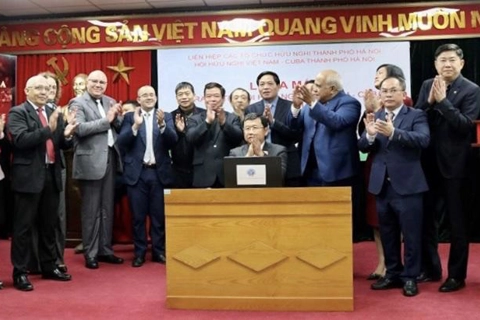
Today these relations are consolidated and cover the partisan, governmental, parliamentary, defense and security, judicial, labor organizations, women’s, youth and solidarity spheres.
According to Hernández, the political dialogue at the highest level between Cuba and Vietnam is systematic and distinguished by mutual trust, the wide coincidences in approaches to issues on the international agenda and the permanent willingness to exchange experiences of Doi Moi in Vietnam and the socio-economic model in Cuba.
In terms of economic ties, they share promising projects in the tourism, renewable energy, and agriculture sectors while identifying potential in biotechnology. Other areas of traditional cooperation include ybersecurity, medical services, education, and science and technology.
Leaders of both sides affirmed that they work for a higher horizon of economic-commercial relations to overcome all difficulties on the way to this goal.
| Cuban children sing a Vietnamese song at the Cuban parliament. Photo: Quochoi |