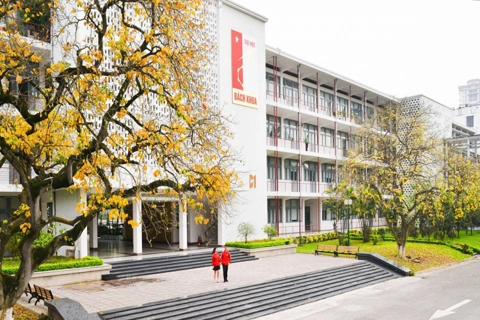
Vietnam National University moved to Hanoi's outskirt
The Vietnam National University's Hoa Lac campus is ready with all facilities and equipment for educational and research activities.
The Vietnam National University (VNU)’s headquarter has been relocated to its newly built campus in Hoa Lac on Hanoi's outskirt this week.
The campus is expected to be the most modern and advanced university town in Southeast Asia.
Planned to cover about 1,113.7 hectares, the campus includes the Polytechnic School, a research center, and offices of the management board.
Built with a total investment of VND22 trillion (nearly US$950 million), the college town consisting of nine member universities, eight institutes, 13 research centers, and four specialized high schools will provide training for more than 41,000 students.
A bird's eye view of the Center for Library Information and Digital Knowledge in the VNU-Hanoi campus in Hoa Lac. Photo: VNU |
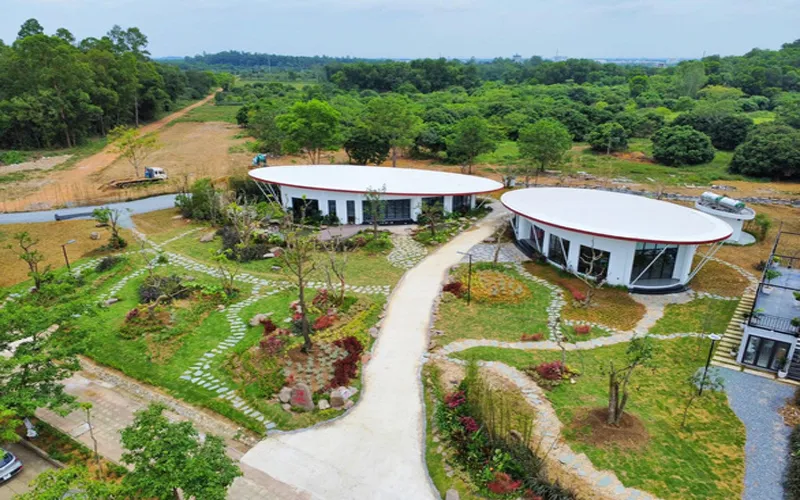
Currently, the VNU-Hanoi student population on the Hoa Lac campus has numbered 15,000.
Prof. Le Quan, president of the VNU-Hanoi said the Executive House, home to the management board of VNU-Hanoi, will become operational on June 1, marking its transformation towards a new development period in terms of facilities, academic life, and university administration.
“In the coming period, I hope that the lecturers will maintain their effort and promote solidarity to jointly build the university as expected by the Party, the State, and many generations of leaders, teachers, and students,” Quan stressed.
He added that the VNU’s Hoa Lac campus is ready with all facilities and equipment for educational and research activities.
Approved by the Government in 2003, the Hoa Lac campus project is part of a drive to make Hoa Lac a college town able to house around 60,000 students and lecturers who will be resettled from Hanoi's downtown.
Nguyen Thi Hue, head of the Land Management Department of the university's Development Center in Hoa Lac, said that the project has been executed for more than 17 years.
The lack of funding and outdated land clearance policy is blamed for the slow progress of the project, Hue added.
In 2009, the Vietnamese government approved the plan to relocate universities and colleges out of Hanoi’s downtown by 2025 to avoid the concentration of students in the city's metropolitan areas.
Accordingly, from 2010 to 2021, around 23 educational institutions, including 12 universities and colleges and 11 other higher education institutions will have to be relocated. However, only the Public Health University has been moved out of Hanoi's downtown since then.
University relocation is no less urgent than removing polluted industrial facilities in Hanoi away from residential areas, said urban experts.
Slow university relocation away from Hanoi's inner city is worsening traffic congestion and environmental pollution, and adds pressure on the city's infrastructure, they said.