Vietnam’s next 5 years mark turning point toward new growth model
For the first time, Vietnam establishes four core values namely nation, culture, family and human as the spiritual foundation of the new development phase, defining happiness and citizen satisfaction as key measures of state success.
THE HANOI TIMES — The 2026–2030 period will mark a turning point in Vietnam’s development, as the country moves toward a new growth model built on flexible institutions, a green economy and creative people, forming the foundation for a resilient and self-reliant nation.
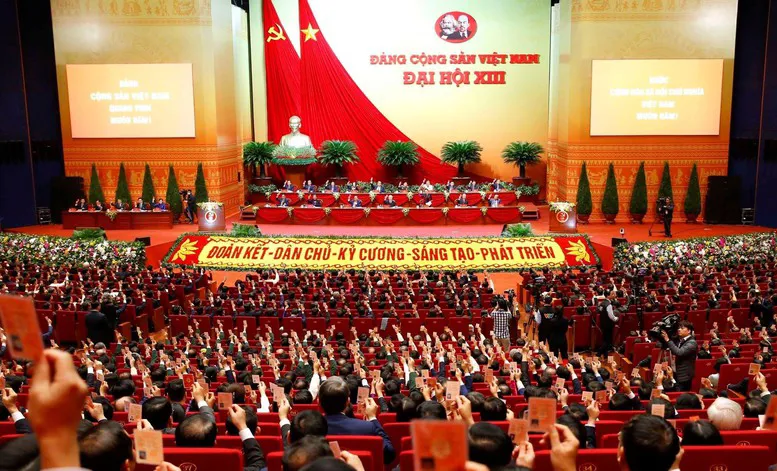
Overview of the 13th Party Congress in 2021. Photo: VNA
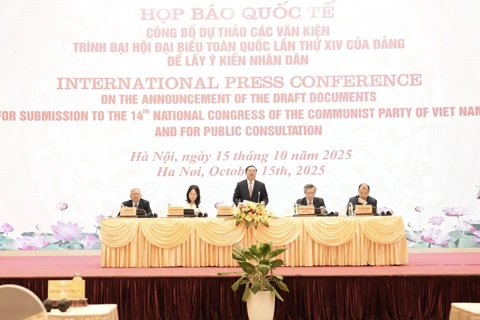
This content is part of the full draft documents submitted to the 14th National Party Congress for public consultation, recently released by the Party Central Committee. The Political Report has been developed in a new format that integrates the contents of the Socioeconomic Report and the Party-Building Summary Report.
For the first time in the Party Congress's history, the national development orientations, from political guidelines and socioeconomic strategies to Party building, are presented in a single document.
The merger reflects the goal of linking three pillars, namely institutions, the economy and people, helping to overcome the long-standing separation between political direction, development planning and policy implementation.
The draft reviews 40 years of reform, noting that Vietnam has achieved “remarkable, comprehensive and breakthrough” progress.
Between 2021 and 2025, GDP grew by an average of 6.3% per year, with the economy reaching over US$510 billion and per capita income around $5,000, placing Vietnam among upper-middle-income countries.
Infrastructure, industry, services, living standards, national defense and foreign relations all saw significant advances.
However, the draft also points out persistent challenges such as overlapping institutions, growth below potential, weak technological capacity, limited innovation and growing social inequality.
It therefore identifies 2026–2030 as the pivotal period for Vietnam to transition to a new growth model centered on flexible institutions, a green economy and creative people as the foundation for a self-reliant and resilient society.
Three pillars
Merging the three reports, the Political Report, Socioeconomic Report and Party-Building Report, marks a milestone in strategic governance thinking as these areas are now viewed as an integrated whole in which political direction provides guidance, the economy serves as the driver and people remain both the center and the goal.
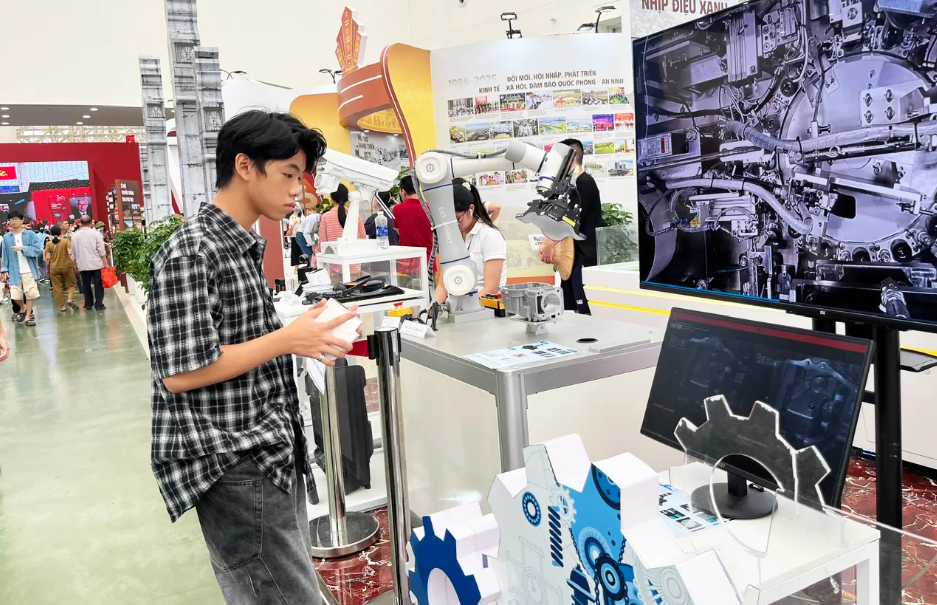
Hanoi's pioneering technology space at the national exhibition “80 Years of Independence, Freedom, and Happiness” celebrating the 80th National Day anniversary. Photo: Duy Khanh/The Hanoi Times
The document outlines three development phases, in which Vietnam aims to become a modern industrialized country with upper-middle income by 2030; a developed and high-income nation by 2045; and a prosperous, civilized and happy society by 2050.
The targets are ambitious: average annual GDP growth of 10% in 2026–2030, labor productivity growth of 8.5%, total factor productivity contributing over 55%, the digital economy accounting for 30% of GDP, urbanization exceeding 50% and greenhouse gas emissions reduced by 8%–9%.
The three strategic breakthroughs have been restructured to ensure a more holistic approach, with the first aiming to improve institutions to create a foundation for rapid and sustainable development.
At the same time, Vietnam will focus on developing a high-quality workforce linked with science and technology, considered key to national competitiveness. The third breakthrough is comprehensive investment in socioeconomic infrastructure, prioritizing digital, energy, strategic transport and green urban systems.
The draft also proposes a comprehensive revision of the 2013 Constitution to perfect the socialist rule-of-law state, promote decentralization and delegation and build a more flexible and efficient governance mechanism.
The goal is to establish a seamless institutional environment that unleashes national development potential.
These directions reflect a renewed leadership mindset that sees institutions as the foundation, science and technology as the driving force, people as the center and culture as the root of development.
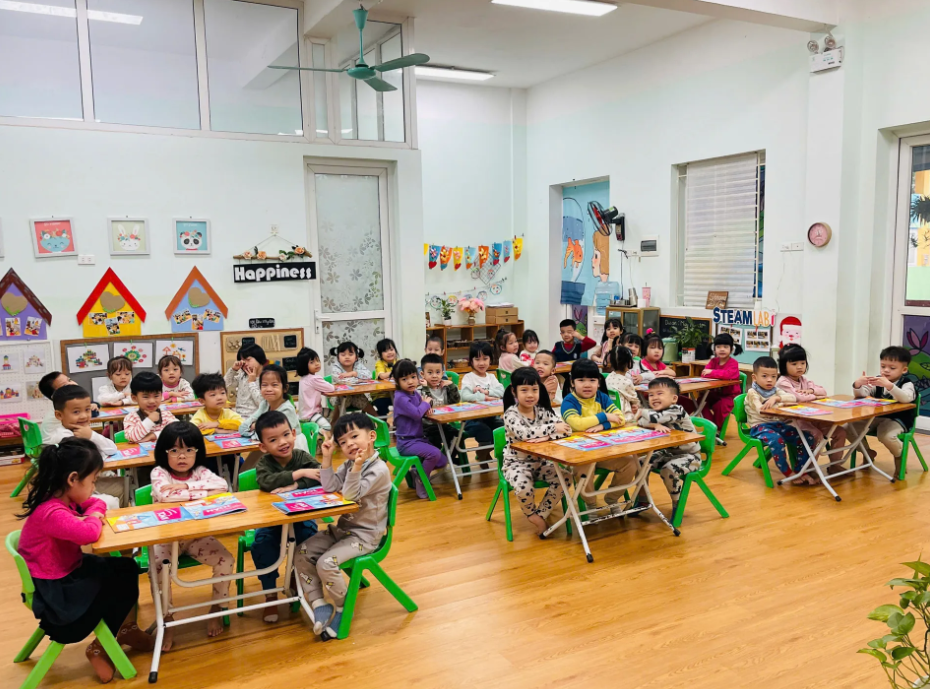
Class time at Thanh Xuan Kindergarten, Hanoi. Photo: Thanh Hai/The Hanoi Times
Sci-tech drives new growth
For the first time, science, technology and innovation are placed at the heart of the growth model. The document emphasizes that “developing science and technology is a breakthrough mission and a condition for Vietnam to enter the knowledge economy.”
It calls for outstanding mechanisms and policies to promote research, development and application, ensuring autonomy and global competitiveness.
Priority areas include artificial intelligence, semiconductors, biotechnology, new materials, clean energy, quantum technology, space science and peaceful use of nuclear energy.
Vietnam will build a national data center, foster the chip industry, create a global innovation network and encourage overseas Vietnamese experts and private enterprises to invest in emerging technologies.
Alongside these efforts is a comprehensive transition to a digital, green and circular economy, targeted to contribute 30% of GDP by 2030.
The document also introduces the concept of “technological sovereignty,” expressing the aspiration for strategic autonomy by mastering core technologies as a source of national strength.
The integration of science, technology and the economy marks a shift from technology application to technology creation. Previously seen as a production tool, technology is now regarded as the foundation for shaping a new growth model, where knowledge and innovation generate the highest added value.
People-centered development
Within this structure, people are placed at the center, serving both as the purpose and the driving force of all policies. For the first time, Vietnam establishes four core values: nation, culture, family and human, as the spiritual foundation of the new development phase, defining happiness and citizen satisfaction as key measures of state success.
Education is defined as the nation’s top priority, shaping its future. The report envisions a modern, equitable and globally integrated national education system, implementing a national program for education modernization, with public education as the pillar and private education as a vital component.
Vietnam will integrate digital skills and artificial intelligence into the school curriculum, gradually introduce English as a second language and develop research-oriented universities into regional innovation hubs. Special incentive policies for teachers, scientists and education managers will be implemented.
In parallel, a strategy for developing high-quality human resources will be carried out. Vietnam aims to integrate internationally in education, attract talent and experts at home and abroad, and build a lifelong learning society that values knowledge as the most important national asset.
In healthcare, the goal is a fair, efficient and sustainable system where every citizen receives regular checkups, with basic hospital services becoming free and universal health insurance coverage achieved. A multi-layered social security system will ensure no one is left behind. By 2030, Vietnam aims to eliminate extreme poverty, raise life expectancy to 75.5 years, and ensure 68 healthy years of life.
Culture and society are reaffirmed as the moral foundation of development. For the first time, the Political Report introduces the concept of “national, cultural, family and human values” into a Party Congress document, signaling a conceptual breakthrough that development means not only growth but also human elevation. Culture is no longer a supplementary factor but an intrinsic driver of progress. Vietnam will advance its cultural industries, preserve heritage, promote artistic creativity, ensure gender equality and protect freedom of belief and cultural diversity.
At a broader level, the document emphasizes strengthening national defense and security, while pursuing a foreign policy of independence, peace, and cooperation. The defense industry will be modernized with dual-use capabilities, and the armed forces will remain professional, disciplined and close to the people. Vietnam will continue to play an active role in regional mechanisms, expanding technological, environmental and people-to-people diplomacy.
Party building is reaffirmed as "the key of all keys". The cadre system will operate under the principle of “entry and exit, promotion and rotation,” protecting those who dare to think, act and take responsibility while strengthening mechanisms that prevent corruption. This political foundation underpins every development breakthrough.
The integration of the three major reports, the restructuring of strategic breakthroughs, and the placement of science and technology at the center with people as the core together define Vietnam’s long-term vision: a modern, innovative, humane, resilient and happy nation.