Vietnam seeks climate finance from G7
The partnership with the world’s advanced economies will help Vietnam address financial problems to pursue the low-carbon strategy.
Vietnam is seeking a partnership with G7 countries including Canada, France, Germany, Italy, Japan, the UK, and the US, in energy transition amid efforts to achieve net-zero transmissions by 2050.
The country has requested the United Nations Development Program (UNDP) to support it in establishing an agreement with the organization of the world’s largest so-called “advanced” economies to seek their financial support.
| Vietnam's Prime Minister Pham Minh Chinh (L) and UNDP Administrator Achim Steiner in New York on May 16. Photos: VGP |
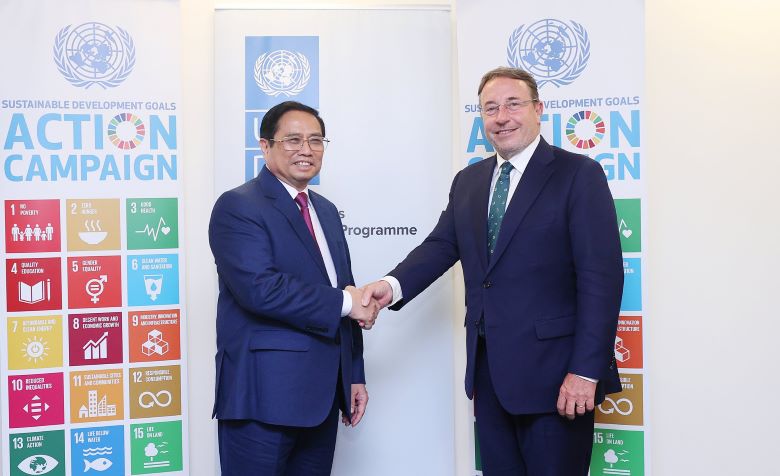
Prime Minister Pham Minh Chinh expressed his hope at the meeting with UNDP Administrator Achim Steiner in New York on May 16.
Vietnam also needs UNDP assistance in building a strategy to mobilize climate finance from development partners for the low-carbon journey from now until 2050, which is estimated at US$350-$400 billion.
In the latest move, G7 Foreign Ministers have committed to supporting emerging and developing countries in their endeavor to transition towards climate neutrality. The G7 would engage in “new climate partnerships“ by “matching high ambition with the necessary means to accelerate this transition”, said its final communiqué released on May 16 after a meeting under the German G7 presidency.
Chinh said to fulfill its commitments made at the 2021 United Nations Climate Change Conference (COP26), Vietnam continues to take drastic and comprehensive measures to reduce greenhouse gas emissions in energy-consuming industries, change agriculture and forestry land use, better manage wastes, and draw financial resources and green technologies to improve its adaptive capacity.
PM Chinh welcomed the UN-Energy Plan of Action towards 2025 co-chaired by Achim Steiner, which seeks to realize the global roadmap to accelerate action on Sustainable Development Goal 7 (SDG 7) [one of 17 SDGs established by the UN General Assembly in 2015, ensuring access to affordable, reliable, sustainable and modern energy].
He highly appreciated UNDP’s Country Program for Vietnam in 2022-26, which puts a focal point on green and sustainable socio-economic development, noting that he will ask Vietnamese related agencies to closely coordinate with UNDP in implementing the joint programs and consulting UNDP in the fields where Vietnam is working on to switch to the low-carbon economy and promote post-pandemic recovery towards green growth.
The overall objective of the new country program is that by 2026, all Vietnamese people will contribute to and benefit from a more sustainable, inclusive, and gender-responsive economic transformation; a safer and cleaner environment; and a more just, safe, and inclusive society.
Chinh expressed his hope that the UNDP support in sustainable development would be effective as Vietnam has approved the Socio-economic Development Strategy 2021-2030 and is deploying the Socio-economic Development Plan 2021-2025 with a focus on the energy transition.
The Vietnamese PM also expected UNDP's further assistance in settling explosive remnants of war (ERW) through funding, technical support, and improvement of awareness and capacity.
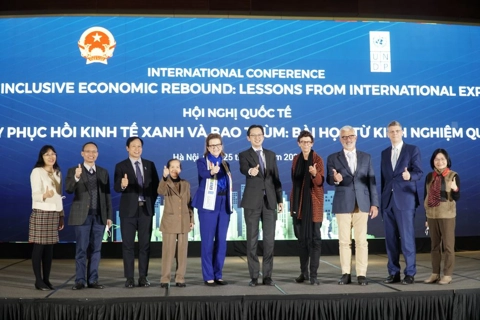
Achim Steiner said he was especially impressed by Vietnam’s strong leadership in green recovery, climate change response through breakthroughs in institutional reform, human resources, and infrastructure, adding that UNDP stands ready to advise on policymaking and mobilize resources for Vietnam to improve its adaptive capacity and promote the equitable energy transition.
He hoped that Vietnam would be an Asia-Pacific model in biodiversity and environmental protection and drawing investment in energy while saying the Southeast Asian country is a model in socio-economic development and implementing the SDGs.
| PM Chinh speaks at COP26, showing Vietnam's net-zero commitments. Photo: VNA |
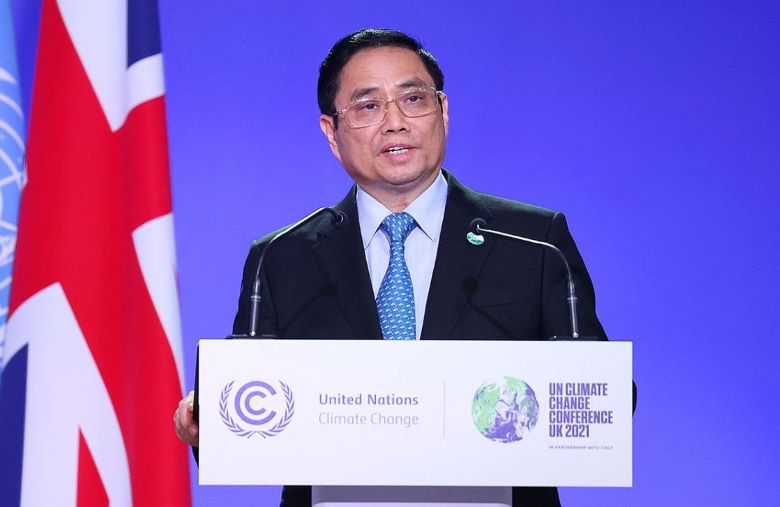
The UN is providing technical support to four key national policy frameworks to guide the transition in Vietnam, including the National Climate Change Strategy (NCCS) for the period to 2030 with outlook to 2050, the Power Development Plan 8, Vietnam’s Nationally Determined Contribution (NDC), and the National Adaptation Plan.
UNDP commends Vietnam for its leadership in advocating people-centered, inclusive and sustainable growth in both regional and global settings.
Vietnam has agreed to support a number of important statements and initiatives on protecting forests, shifting to clean energy, supporting adaptation for local communities, and methane reduction. All of these statements further strengthen Vietnam’s commitment to tackling climate change.
According to UNDP Vietnam, the country needs to simplify regulations to enable the business sector to contribute fully to a green economic rebound with people at its center in pursuing a whole-of-government and whole-of-society approach for realizing the new climate ambitions.