Vietnam sets 10% average GDP growth target for 2026–2030: Party chief
Vietnam is entering a new stage of development with the legacy of decades of achievements and lessons, anchored by national unity and a firm public mandate.
THE HANOI TIMES — Vietnam has launched an ambitious push into a new development phase, with its top leader setting targets of at least 10% annual GDP growth and per capita income of around US$8,500 by 2030, signaling a drive for faster reforms and stronger national capacity over the next decade.
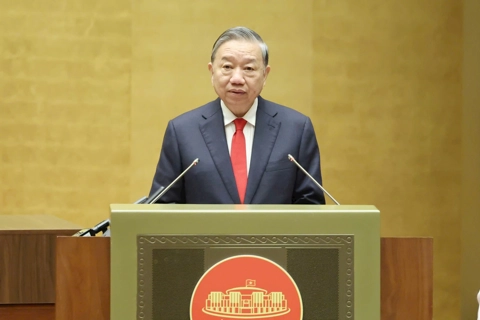
Speaking at the opening of the 14th National Party Congress on January 20, General Secretary To Lam said the country aims to sustain average growth of at least 10% a year in the 2026–2030 period as it accelerates structural reforms and long-term development.
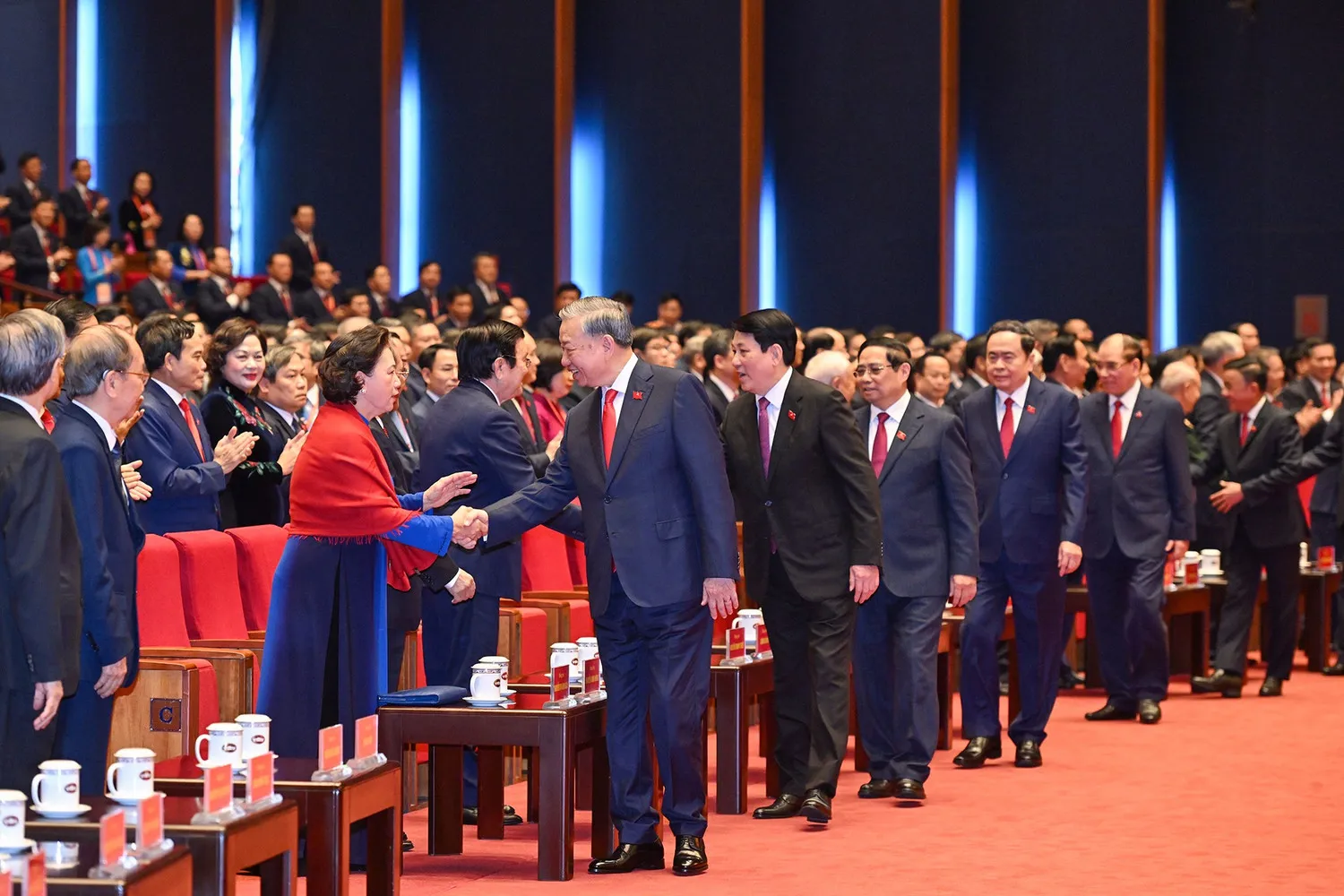
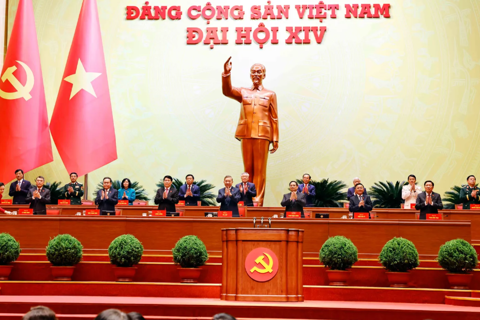
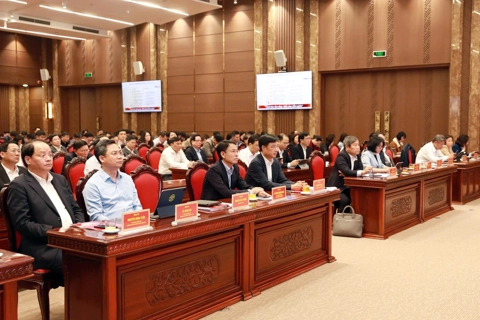
Senior leaders and former leaders of the Party and the State attend the opening session of the 14th National Party Congress taking place on January 20. Photos: 14th National Party Congress Information Portal
Presenting the report on draft documents submitted to the congress, Lam framed the growth target as part of a broader push to open a new development chapter for the country under changing domestic and global conditions.
“The Party Congress is a particularly important political event for the entire Party, the entire people and the entire army,” he said.
Lam described it as a milestone that “opens a new development journey” and reflects Vietnam’s ambition to strengthen strategic autonomy, self-reliance and national confidence.
He said the congress is being held at a moment of historical significance as Vietnam approaches two major milestones, the centenary of the Communist Party of Vietnam in 2030 and the centenary of the modern Vietnamese state in 2045. "Those milestones heighten the need to face realities directly, assess conditions accurately and accelerate reforms that improve governance and strengthen national capacity."
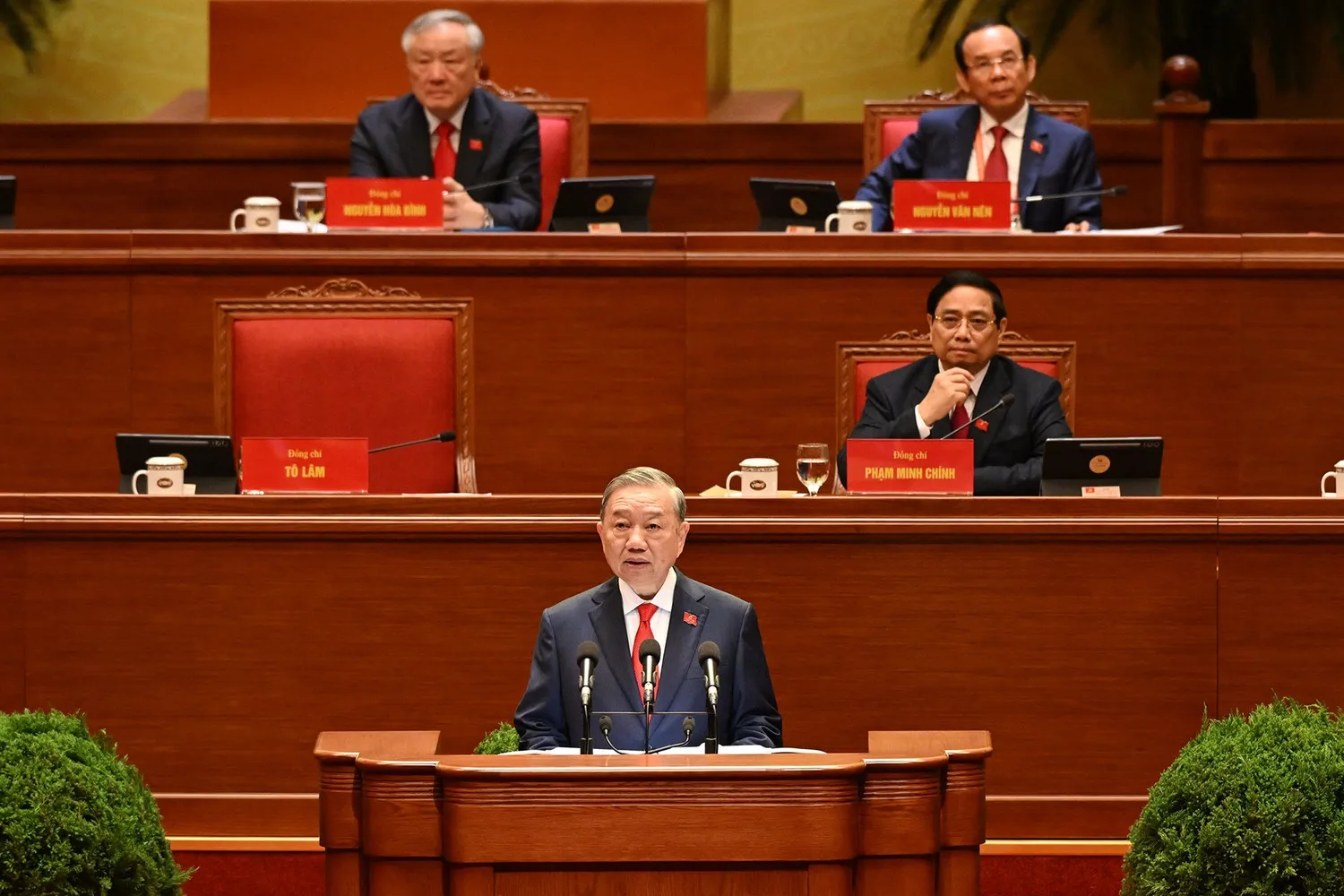
Party General Secretary To Lam presents the report at the 14th National Party Congress.
“We must look straight at the truth and evaluate the situation correctly,” he said, calling for renewed thinking, stronger institutions and decisive action to deliver results that people can see and feel.
Lam said Vietnam’s key objectives for 2026-2030 include maintaining a peaceful and stable environment, pursuing faster and more sustainable growth and improving inclusive living standards.
He reiterated Vietnam’s long-term development path, aiming to become a developing country with modern industry and upper middle income status by 2030 and to move toward high income status by 2045.
Growth model on productivity, innovation
The political report sets out 12 major policy directions, six priority tasks and three strategic breakthroughs to guide the next phase of development. An action program has been designed to translate key tasks into measures that can be implemented without delay.
The first breakthrough is institutional reform, with a strong focus on implementation and measurable impact on citizens and businesses.
“Resolutely abolish the ‘ask and give’ mechanism and reduce administrative procedures to the maximum,” he said, stressing that the time and cost borne by citizens and businesses should be the key measure of reform quality.
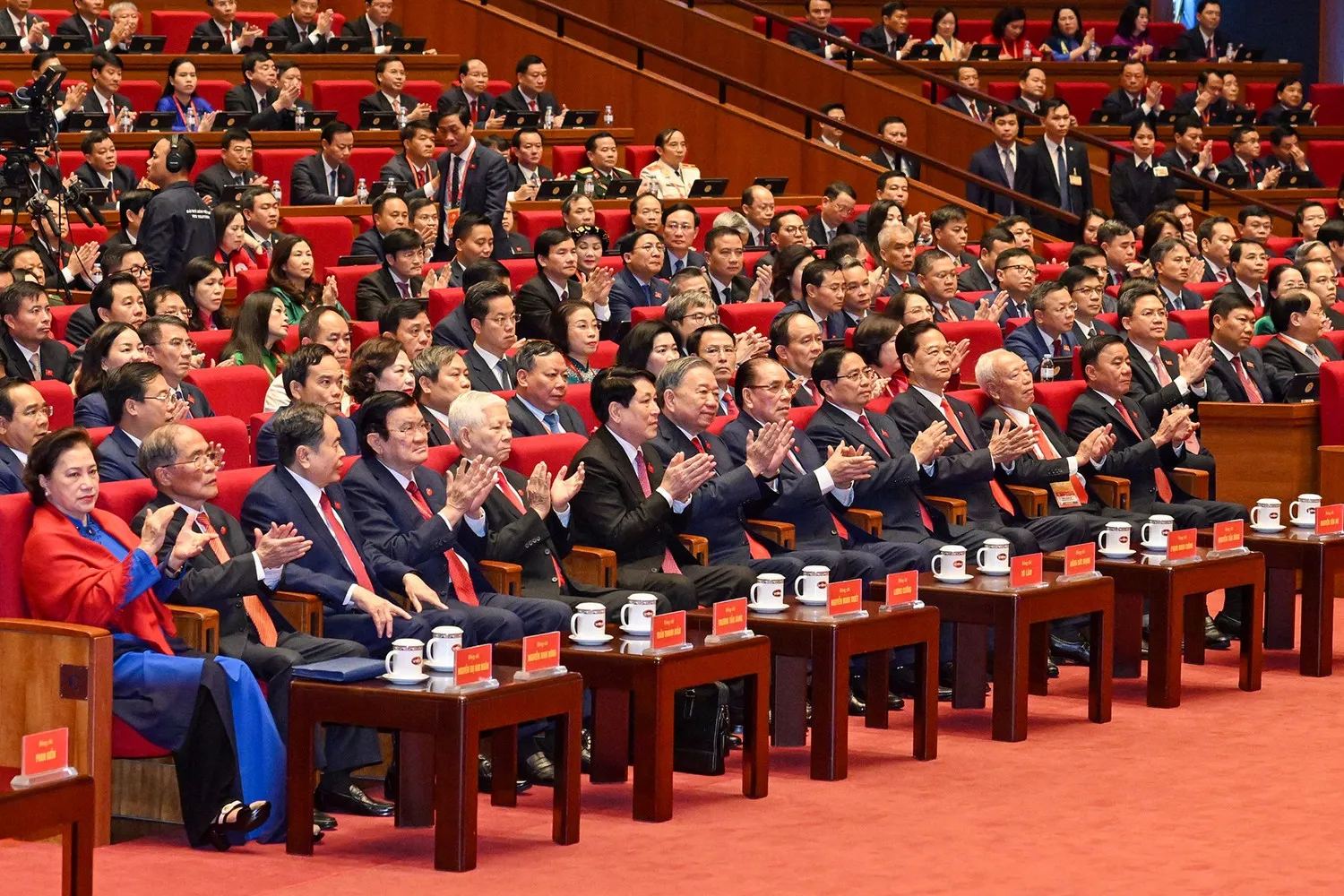
Delegates at the event.
Alongside streamlining, Lam called for stronger discipline in law enforcement and policy execution, warning against gaps between decisions at the top and outcomes at the local level.
He pointed to persistent problems that undermine confidence and waste resources, including situations where laws exist but are difficult to apply and policies are approved but implemented slowly.
"Vietnam will pursue a new growth model centered on the knowledge economy, the digital economy, the green economy and the circular economy," the Party chief said.
Growth must rely mainly on productivity, quality, efficiency and innovation,” he said, adding that Vietnam should gradually reduce dependence on resource extraction and cheap labor.
The Party chief also outlined the intended role of different economic sectors. The state sector will remain the main stabilizer for macroeconomic conditions and strategic direction, while the private sector is expected to remain a central driver of growth.
He described the private sector as “one of the most important drivers of the economy” and called for a more supportive business environment that protects property rights and the freedom to do business.
Vietnam should encourage stronger domestic firms that can compete internationally and participate more deeply in global value chains. He also stressed the role of knowledge and technology in upgrading production and business activity.
Science, technology, innovation and digital transformation were identified as key engines for the next development stage.
“If we want a breakthrough in technology, we must start with people and mechanisms. We cannot be subjective or driven by will alone.”
He called for policies that attract and reward talent, product-based evaluation of research outcomes and flexible financing mechanisms that support innovation. He also highlighted the importance of public-private cooperation and commissioning research linked to practical development needs.
“Science and technology must enter daily life, serve the people, raise labor productivity, reduce social costs and promote economic growth,” he said.
Lam also stressed the importance of culture and people as the spiritual foundation of society and as an internal strength that supports national development, saying that defense, security and diplomacy play a vital role in preserving peace so the country can focus on development.
People-centered development a focus
The general secretary stressed Party building and political system modernization, calling for a more effective state apparatus and sustained efforts against corruption, waste and other negative practices.
He underlined the need to build a cadre contingent with strong ethics, capacity and credibility, especially at the strategic level, urging leaders to put the right person in the right job and evaluate officials by results, effectiveness and public trust.
He backed a more dynamic staffing approach, with promotion or demotion based on performance and accountability, while pairing strict discipline with mechanisms to protect officials who dare to think, act and take responsibility for the common good.
At the same time, he warned against opportunism and illicit position trading that erode institutions and public trust.
Returning to a people-centered development principle, he said it runs consistently through the congress documents, emphasizing that the people are the foundation and national unity is the source of strength.
He said public trust is built by concrete results and fairness in governance, not rhetoric, reflected in official integrity, an effective state apparatus and timely resolution of legitimate concerns from citizens and businesses.
Lam urged delegates and Party members to assess policies through a simple test of public benefit: whether they strengthen trust and improve people’s lives.
The Party chief described the 14th National Party Congress as one of belief and aspiration, breakthrough and action, discipline and creativity, unity and development, noting that Vietnam’s aspirations are closer than ever even as challenges and competitive pressures intensify.
Entering a new development stage, Vietnam builds on decades of achievements and lessons, grounded in national unity and a strong public mandate.
Calling for collective action, he urged Party members to uphold responsibility, promote intelligence and ignite aspiration so that the people see, trust, support, accompany and benefit, echoing his call to join hands under the Party’s flag to turn faith into action and results.
|
As of January 19, 2026, the 14th National Party Congress had received 559 congratulatory messages from 109 political parties, six international and regional organizations, 16 individuals, 122 mass organizations and 306 overseas Vietnamese associations. Among the senders were ruling communist parties and governing parties in neighboring and traditional partner countries, including the Lao People’s Revolutionary Party, the Communist Party of China, the Cambodian People’s Party, the Communist Party of Cuba and the Workers’ Party of Korea. The congress also received 31 messages from countries in Asia and Oceania, 26 from Europe, 27 from the Americas and 20 from the Middle East and Africa, along with six messages from international and regional organizations. |