Vietnam urged to reshape economic strategy for 2026-2030 breakthrough
A new growth model built on total factor productivity, investment efficiency, scientific progress and innovation is expected to drive the country forward.
THE HANOI TIMES — Vietnam needs to reposition its economy amid a shifting global landscape, while creating breakthroughs in mobilizing and using resources more effectively to support growth in the 2026–2030 period.

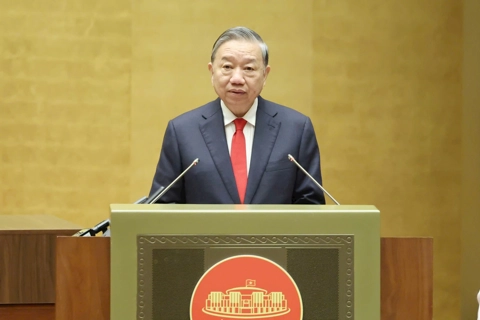
Deputy Finance Minister Do Thanh Trung at the event. Photos: The Hanoi Times
Deputy Finance Minister Do Thanh Trung shared the view at the Vietnam Economic and Financial Forum 2025 held today [December 5].
Trung said the global economic and political environment has continued to shift sharply, especially since April 2025 as tariff tensions, geopolitical conflicts and security flashpoints have escalated.
“These developments have added uncertainty to the global landscape and created complex impacts on Vietnam’s economy,” he added.
At home, the 2024 to 2025 period has seen a series of strategic directions and major policy breakthroughs issued by the Party and the Government, creating a foundation for fast and sustainable growth, he continued.
Since July 2025 the country has continued to streamline its administrative apparatus and reorganize territorial space, opening new room for development.
Vietnam faces an urgent development mandate. By 2030 the country aims to become a developing economy with a modern industry and upper-middle-income. By 2045, it targets high-income status.
“This requires Vietnam to reposition itself in a shifting environment and create breakthroughs in mobilizing resources, renewing the growth model and expanding development space along a sustainable path,” the deputy minister said.

UNOPS Deputy Regional Director for Asia Pacific Nicholas George.
In this context, Trung said Vietnam needs to establish a new growth model grounded in total factor productivity, investment efficiency, scientific and technological advances and innovation.
The model calls for a balanced combination of traditional growth drivers such as investment, exports and labor with new drivers that include the digital economy, the green economy, the knowledge economy and the circular economy.
Establishing this model requires strong linkages among all economic actors. The state will play a shaping and guiding role by focusing on strategic infrastructure and a transparent legal framework. The private sector will drive creativity and innovation and lead key sectors such as the digital economy, manufacturing and high-quality services.
FDI will serve as a selective and well-targeted source of capital that supports technology transfer and alignment with international standards, including ESG.
At the same time, Vietnam must tap new growth areas across regions and localities and strengthen the role of major economic hubs.
“This is not only about renewing the growth model but also about setting a strategic direction for Vietnam to achieve its goals for 2030 and 2045,” Trung said.
Speaking at the forum, Nicholas George, UNOPS Deputy Regional Director for Asia Pacific, said Vietnam’s ambitious goals reflect confidence in the country’s path toward a high-quality, innovation-driven economy supported by digital transformation, science and technology, strategic infrastructure and the green transition.

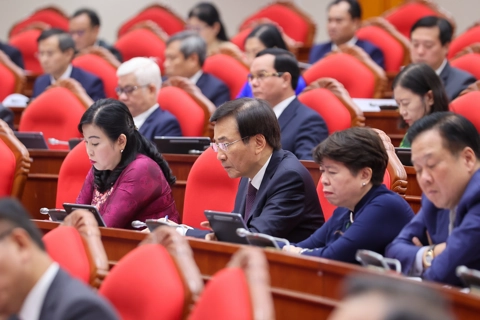
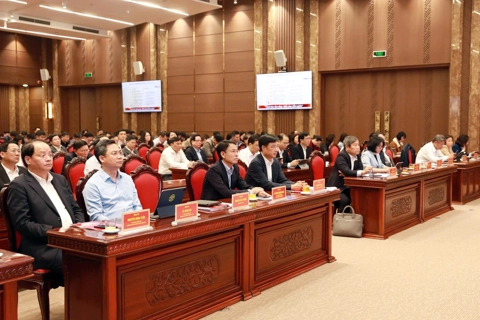
Delegates at the event.
These priorities match the rapid global shifts now underway, he said.
George said that climate pressures, supply chain realignments and fast-moving scientific and technological advances are reshaping growth trajectories worldwide.
“Vietnam has an opportunity to position itself to capture new possibilities in this transition and move toward low-emission development,” he stressed.
The transition requires a new growth model with cleaner industries, more efficient energy systems and digital public services, supported by investment from both the public and private sectors.
Practical solutions will be essential for achieving Vietnam’s ambitious development goals, he suggested.
Sascha Hocke, Deputy Country Director of GIZ Vietnam, agreed and said this is a pivotal moment for Vietnam to shape its next phase of development, especially in the economic and financial spheres, as the country responds to emerging challenges.
He said Vietnam has shown strong resilience but must accelerate reforms and embrace new global trends.
He noted that climate pressures could affect growth quality and sustainable development goals. In this context, closer coordination and stronger capacity building are essential.
Forecasts show Vietnam’s GDP may reach US$510 billion in 2025, placing the country 30th worldwide and fourth in ASEAN, with labor productivity up 46%.
Vietnam aims to achieve high-income status by 2045, a goal that requires bolder strategic reforms from institutions to private sector development to green growth, green investment and green finance.
Hocke said Vietnam’s future economic foundation will rest on sustainable growth, new technology, a stronger private sector and greater investment in human capital.