Vietnam weathers tariff pressures better than anticipated: HSBC
While most regional economies significantly restrained exports to the US, Vietnam maintained strong growth.
THE HANOI TIMES — Vietnam has weathered recent tariff pressures better than initially expected, with the impact on its economy proving milder than feared, according to HSBC.
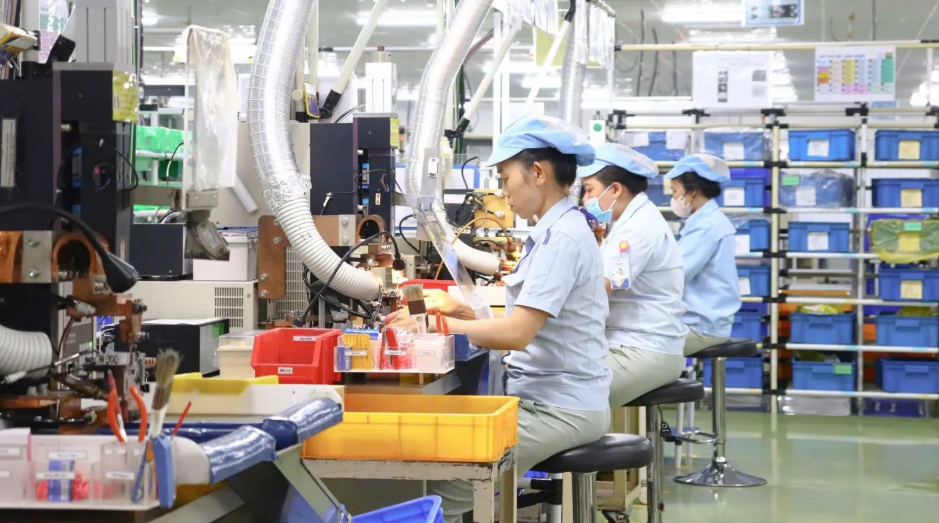
Electronics production at a Panasonic plant in Vietnam. Photo: The Hanoi Times
In a recent analysis, the UK-based bank said tariff shocks have not undermined Vietnam’s export momentum in 2025, as exports have continued to record growth, although uncertainties and risks ahead remain difficult to predict.
Data from the General Statistics Office show merchandise exports in the first 11 months exceeded US$430 billion, up 16.1% from the same period in 2024. HSBC attributed part of the growth to frontloading of orders, particularly in the second quarter.
Meanwhile, customs data show exports to the US reached more than $138.6 billion in the first 11 months, up over 27% year on year. The bank said while most regional economies significantly restrained exports to the US, Vietnam maintained strong growth.
Overall, the impact of tariffs on Vietnam’s economy appears less severe than initially expected, the HSBC analysis team said, citing two main reasons. Vietnam proactively engaged with the administration of US President Donald Trump even before he officially took office. After reports of a 46% reciprocal tariff rate, Vietnam intensified negotiations and is now grouped with other ASEAN countries at around 19%–20%.
Strong export growth to the US has also been driven by changes in the export structure. In 2013, about 60% of shipments consisted of light industrial goods such as garments, footwear and toys.
Over the past decade, electronics have expanded rapidly and become the main export category this year. In the first 11 months, the US spent nearly $50 billion on imports from Vietnam, including computers, phones, cameras, video equipment and electronic products and components.
HSBC said this shift reflects Vietnam’s progress in the technology value chain and its rising role in the final assembly of consumer electronics. Long-term investment by Samsung since 2007 has played a significant role.
At higher value-added levels, Vietnam’s position in integrated circuit production has also increased, supported by investment from Intel.
With exports remaining strong, HSBC and other international institutions, including Singaporean bank UOB, have recently raised their growth forecasts for Vietnam. This year, the government is targeting GDP growth of at least 8%.
This view is supported by S&P Global’s Purchasing Managers’ Index for November, which showed expansion at 53.8 points and recorded a second consecutive month of growth in new export orders.
However, Vietnam’s export outlook for 2026 remains uncertain. HSBC said the PMI signals positive momentum but remains difficult to read for 2026. The report noted that potential trade risks persist and it is still too early to fully assess their impact.
Two issues that require clarification are the proposed 40% transshipment tax and sector-specific tariffs on semiconductors. Analysts said both could have significant implications for Vietnam’s trade and growth.
At the global level, the OECD forecasts world trade growth to slow to 2.3% in 2026 from 4.2% in 2025. OECD Secretary-General Mathias Cormann said the impact of tariff policies under President Donald Trump has so far been relatively mild and not yet fully felt.
The full effects will become clearer from early next year when corporate inventories are depleted, he said. As weaker external demand weighs on exports, the OECD projects Vietnam’s growth to slow to 6.2% in 2026.
Both the OECD and HSBC also warned that Vietnam’s high exposure to the US market poses vulnerabilities, with exports to the US accounting for nearly 30% of total shipments.
Vietnam has expanded trade with the US but has also increased its reliance on the country as a final consumption market, HSBC said. These developments underscore the urgency of diversifying export markets and making fuller use of trade agreements such as the EVFTA and CPTPP.