Vietnamese citizens increasingly concerned about corruption: Survey
Surveyed people indicate the government's anti-corruption efforts are increasingly effective.
Although the experience of corruption is declining and the Vietnamese government has rolled out an unprecedented drive against graft, Vietnamese people are increasingly concerned about corruption and demand stakeholders to take more steps to deal with this issue, a survey has shown.
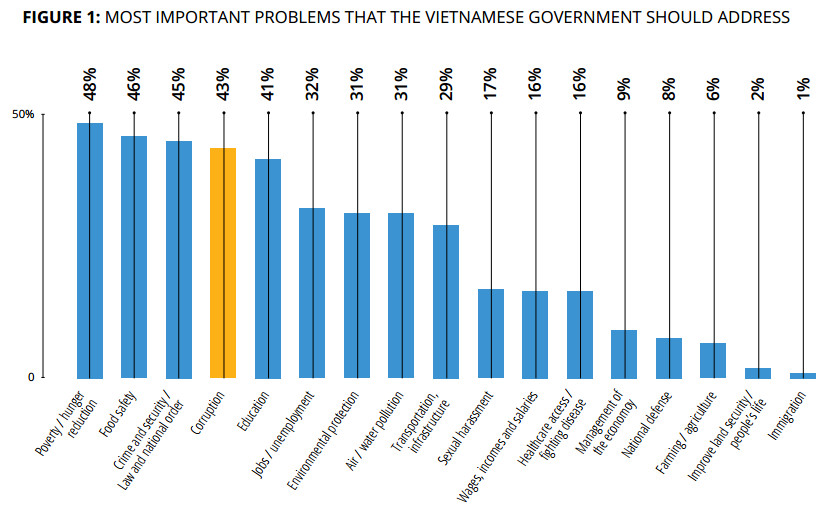
From the seventh place on issues of public concern in 2016, corruption has become the fourth largest concern for Vietnamese citizens in 2019, after poverty reduction, food hygiene, and crime/safety, according to the key findings of the Vietnam Corruption Barometer (VCB-2019) announced by Towards Transparency Tuesday in Hanoi.
| Source: VCB-2019, Towards Transparency |
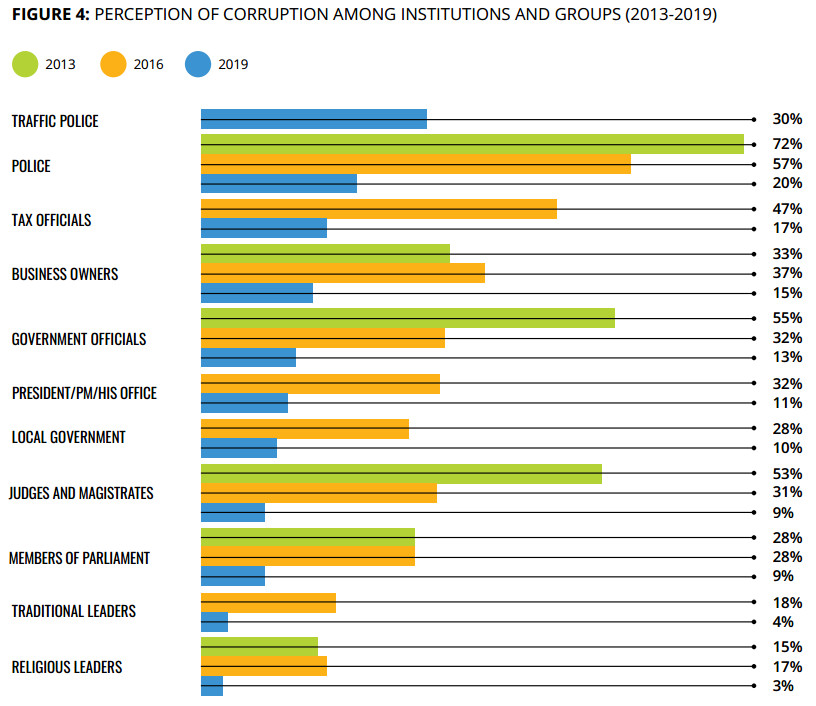
Vietnamese citizens perceive five types of actors as to be the most corrupt in Vietnam: Traffic police (30%), police (20%), tax officials (17%), business owners (15%), and other government officials (13%). Importantly, these percentages decreased steeply over the course of six years.
| Source: VCB-2019, Towards Transparency |
The survey finds that Vietnamese people believe that corruption is declining. About 18% of respondents who had contact with one or more of the seven surveyed public services said they had paid bribes in the preceding year, much lower than 65% indicated by a comparable survey, the Global Corruption Barometer, in 2017. Notably, this report marks for the first time since 2011 a decrease in bribery in public services.
When asked about the seriousness of corruption in the public sector, defined to include all departments and services that are owned, managed, and operated by the State, 73% of respondents said that corruption is either “a problem” or “a serious problem.” This rate remains stable compared with the 2017 edition of the survey (72%).
Significant differences in how the perception of corruption has evolved over the past 12 months were also found among regions (see Figure 3). Most noticeably, a significantly smaller number of citizens in Ho Chi Minh City (13%) believe that corruption has decreased in comparison to respondents in Hanoi (35%).
The surveyed people indicate the government's anti-corruption efforts are increasingly effective. According to the report, in addition to improving and completing the legal framework on anti-corruption, the government has been taking many measures and actions to prevent and fight corruption, bringing to light an unprecedented number of large-scale corruption cases. As a result, one in two citizens believes that the State action against corruption is effective (more than twice the ratio in 2016).
According to officials reports, 427 individuals corruption cases were investigated, and 200 cases were prosecuted in 2018. During the first nine months of 2019, 435 corruption cases were investigated, and 279 corruption cases were brought to court.
Thanks to a large-scale anti-corruption campaign led by CPV General Secreary Nguyen Phu Trong, a large number of high-ranking officials have been put on trial for corruption, including a member of the Politburo, as well as ministers, various generals of the Ministry of National Defense and Ministry of Public Security, provincial leaders, and hundreds of public officials nationwide.
The report also shows the number of people who believe they can make a difference in the fight against corruption increased significantly, from 55% in 2016 to 71% in 2019.
While believing that they have a role to play in the fight against corruption and are willing to denounce it, people rarely do so in practice. 49% of the surveyed citizens think that reporting corruption does not work and are afraid of its consequences. Notably, a majority of the respondents believe that interest groups influence government polices and decisions in their own favor.
"The citizens’ concern that large companies and interest groups are manipulating State policies and decisions is very worrying," said Pham Chi Lan, senior economist, and member of the Advisory Board of Towards Transparency. "The State needs to come up with measures soon, like regulations on lobbying for businesses to restore and strengthen public trust."
The VCB-2019 report provides recommendations to the Party, the State, businesses, citizens and other stakeholders to enhance both prevention and control of corruption. Improving integrity of government officials and employees, as well as imposing strict penalties on corrupt officials are the two top recommendations suggested by Vietnamese citizens.
| Nguyen Thi Kieu Vien, executive director of Towards Transparency, speaks at the launching workshop on Jan. 7. Photo: Minh Tuan |

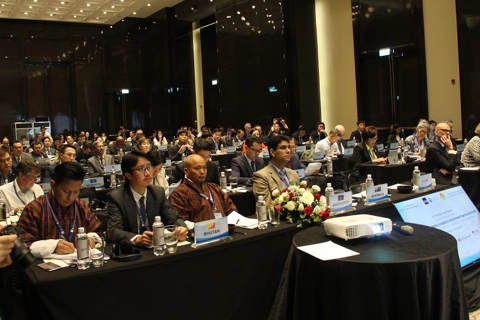
“Vietnamese citizens believe they can make a difference in the fight against corruption. Therefore, the Party and the State at all levels should create more space and provide more tools for people to participate in the fight against corruption,” Nguyen Thi Kieu Vien, executive director of Towards Transparency, stressed at the ceremony to announce the findings of the report.
Vietnam Corruption Barometer 2019 collects data on citizens’ perceptions and experiences of corruption, their views on government's anti-corruption efforts and effectiveness of anti-corruption measures. Data were collected in July and August 2019 through direct interviews with 1,085 people in 19 representative provinces and cities across the country. Qualitative interviews were also conducted in November 2019 to better understand people's views and experiences.