Vietnamese-Dutch couple completes first ward-level marriage under Hanoi’s new two-tier system
For the first time, the commune-level government in Hanoi processed an interracial marriage instead of the Department of Justice after the capital operated under the two-tier government model.
THE HANOI TIMES — For Dutch national Casper Bessel Roelof Steenbergen, July 14, 2025, marked the start of a new chapter as he married his Vietnamese bride, Nguyen Thi Anh Van, in a heartfelt cross-cultural wedding that celebrated love without borders.

Dutch citizen Steenbergen Casper Bessel Roelof and his spouse Nguyen Thi Anh Van receive marriage certificate at the Vinh Hung Ward People's Committee. Photo: Kinh Te & Do Thi Newspaper
Once the couple received their marriage certificate from the Vinh Hung Ward People’s Committee, it became a special day not only for the couple but also a historic moment for the capital.
For the first time, a foreign national was able to complete the marriage registration process at the local level without needing to visit the Hanoi Department of Justice.
Steenbergen expressed his love for Vietnam, especially Hanoi, and extended his heartfelt thanks to the Vinh Hung Ward staff and leaders for their careful, professional, and thoughtful support throughout the registration process.
Pham Hai Binh, Chairman of the Vinh Hung Ward People’s Committee, said that under the two-tier administrative system, ward-level authorities now have the authority to handle marriage registrations involving foreign nationals.
“From now on, residents no longer need to travel far or wait long at city-level offices. All steps, from reception to verification, will be handled locally, which will reduce pressure on the Hanoi Department of Justice and improve local administrative services,” he said.
Better services at local level
In addition to providing legal and administrative support, the two-tier administration is effective in helping citizens access social services.
Recently, Van Dinh Commune launched a large-scale campaign to help 800 elderly residents complete the paperwork necessary to receive pensions under new national policies.
Nguyen Danh Thinh, a 70-year-old wounded war veteran, said he was pleased the new procedure was performed expeditiously and conveniently.
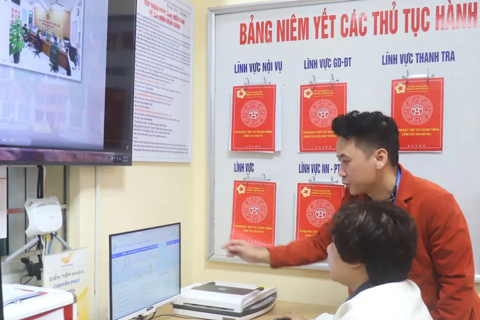
In Phuc Loi Ward, the administrative process has been redesigned to be open, transparent, and efficient.
Resident Nguyen Thi My said it took her just 10 minutes to authorize her son to collect her pension. "The ward officials were friendly and helpful," she said.
In Nam Phu Commune, Phan Hac Ho said that he used to submit documents manually and often encountered unfriendly public servants and delays.
Now, he can submit applications online and receive decisions with ease.
Even in Minh Chau Island Commune, where the workspace is cramped, a sizeable room is reserved for the public administrative service center.
In Kim Lien Ward, Nguyen Van Tinh expressed satisfaction with the electronic administrative system.
"The procedures are faster now. Everything is clearly explained. In the past, I had to file paper forms and wait for officials to review them," he said.
"Now, I can submit everything online, track the progress of processing, and choose to receive the results online or in person. It saves time for both sides,” Tinh added.
In Soc Son Commune, Ngo Van Tuan recalled that, in the past, he had to wait for the commune council to meet before receiving any official verification.
“Now, I can go straight to the commune office, and the staff will handle it immediately. Everything is faster and clearer, and we don’t have to travel back and forth,” he said.
Wards as the new urban cells of the capital
On July 1, 2025, Hanoi adopted the two-tier local administration system, eliminating the district-level government and reducing the number of commune-level units from 526 to 126, including 51 wards and 75 communes.
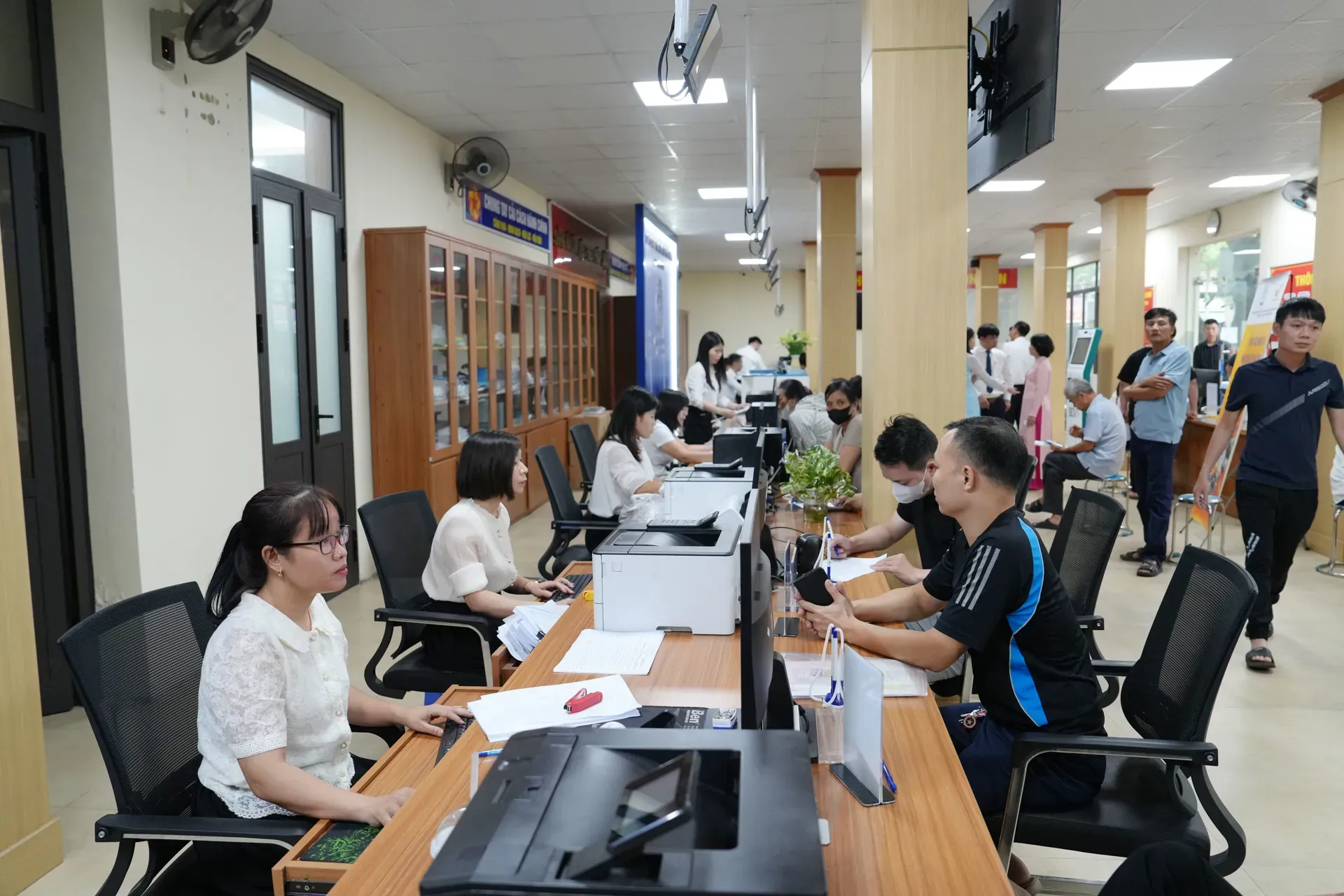
The public administrative service center in Dan Phuong Commune, Hanoi. Photo: Kinh Te & Do Thi Newspaper
Since the switch to the new local government system two weeks ago, it has functioned smoothly.
One of the new model's standout successes has been the processing of administrative procedures with even greater efficiency, with a strong emphasis on citizen- and business-centered services.
The city has maintained administrative service points in the former local units while expanding services to the 126 new wards and communes.
The Hanoi Public Administrative Service Center ensured no service disruptions during the transition.
In urban wards such as Dong Da, O Cho Dua, Hoan Kiem, Cua Nam, Cau Giay, Tay Ho, and Long Bien, as well as in rural communes such as Nam Phu, O Dien, and Minh Chau, local administrations have been reorganized and working facilities are mostly complete.
According to Vu Van Hoat, Chairman of the Vinh Tuy Ward People’s Committee, decisions are no longer fragmented across many levels under the two-tier model. Now, they are more unified and focused.
Bui Tu Anh, a civil registrar in Lien Minh Commune, said the administrative service center receives many visitors daily.
"The workload is heavy, but we do our best to process applications quickly and efficiently," she said. “Seeing citizens satisfied and smiling helps ease our pressure.”
Nguyen Thi Thu Huong, Chairwoman of the Son Tay Ward People’s Committee, said that all public service employees must improve the quality of their services and ensure the convenience of every transaction.
She added that citizen satisfaction is a key performance indicator for evaluating local staff performance.
According to Nguyen Thi Thanh Hang, Chairwoman of the Phuc Loi Ward People’s Committee, local leaders have intensified oversight and performance evaluations of civil servants.
Linking it to discipline and professional development helps ensure that job positions align with training and skills, optimizing performance, she added.
On July 14, General Secretary To Lam said that the removal of district-level governments is a shift in mindset and governance. "It gives more authority to communes and wards, making them more responsive and accountable in improving urban quality of life."
He said communes and wards are the 'urban cells' — the first level of contact between the government and the people.
Elevating the role of communes and wards is not merely an administrative requirement but also a strategic move to transform Hanoi into a capital of civilization, creativity, and happiness.