Work starts on US$612 million elderly healthcare complex in Hanoi
The complex project is designed as a multi-functional center with high-quality medical services, education and clinical training, scientific research and comprehensive elderly care.
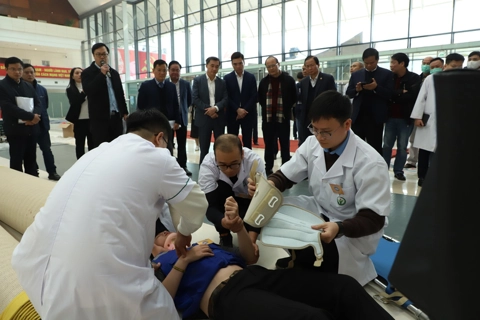
THE HANOI TIMES — The groundbreaking ceremony for Hanoi’s elderly healthcare complex at Hanoi Medical University Hospital took place this week as part of activities marking the 14th National Party Congress.

Party General Secretary To Lam (fourth, right), Hanoi Party Secretary Nguyen Duy Ngoc (fifth, right) and delegates attend the groundbreaking ceremony. Photos: The Ministry of Health
Attending the ceremony, Party General Secretary To Lam underlined the significance of the project for Hanoi and the national strategy on improving public health, particularly for the elderly, when the country enters a phase of rapid population aging.
"For older people, healthcare is a profound humanitarian issue, reflecting the responsibility of the Party, the State, society and families toward those who have contributed their lives to the nation and the community," said the Party chief.
He reaffirmed that people are both the goal and the driving force of development, with public healthcare regarded as a central and enduring political task.
Given increasing life expectancy, Vietnam's healthcare and social security systems would come under heavy pressure without a new policy response.

Party General Secretary To Lam delivers speech at the ceremony.
He added that the Party and State have issued a number of major policies to proactively respond to population ageing, seeing public healthcare as a pillar of sustainable development.
Lam expressed his belief that the project would become a symbol of academic, humane and modern health care in the new era.
"The Hanoi government should coordinate closely with the Ministry of Health and relevant agencies to make favorable conditions for the project in accordance with legal regulations, as well as ensure quality and investment efficiency," said Lam.
The project has a total estimated investment of VND16 trillion (US$612 million), with phase one scheduled for completion in 2028 and full completion targeted for 2030.
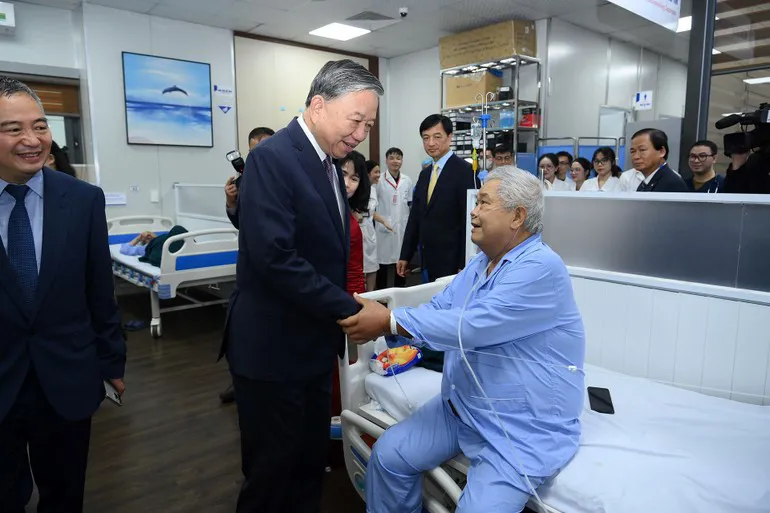
Party General Secretary To Lam visits and presents gifts to patients at the Hanoi Medical University Hospital.
It will be developed as a smart, green hospital applying advanced technologies and artificial intelligence in diagnosis, treatment and management, while serving as a technological nucleus for Hanoi’s healthcare digital transformation.
The project will continue with the construction of specialized surgical and oncology centers, research institutes, dormitories and lecture halls, with full completion by 2030.
The Hanoi Medical University and participating healthcare institutions were urged to uphold professional standards and medical ethics, place the quality of care and the interests of older people at the center, and work toward building a reputable center for geriatric training and research.

Vietnamese elderly people participate in a mass exercise program, spreading the spirit of "living healthy, living youthful". Photo: VNA
Vietnam is seeking to turn its rapidly growing elderly population into a new source of economic growth, as policymakers warn that the country is entering one of the fastest aging phases in Asia.
At a national forum on the silver economy in Vietnam recently, Nguyen Xuan Thang, Politburo member and Director of the Ho Chi Minh National Academy of Politics, said Vietnam’s demographic structure is changing rapidly as people aged 60 and over account for over 14% of the population in 2025.
“The country should move away from treating aging as a welfare burden and instead recognize older people as an economic asset,” said Thang.
He proposed integrating eldercare into community services and policy, laying a foundation for a sustainable silver economy, which refers to the economic activities, products and services designed to meet the needs of an aging population, typically people aged 50 or 60 and above.