ASEAN, China urged to speed up COC negotiations
The framework aims to guide conduct, prevent incidents and help manage tensions in the South China Sea - a vital maritime region central to regional security, trade and international shipping.
THE HANOI TIMES — ASEAN member states and China agreed on the need to step up efforts to accelerate negotiations on the Code of Conduct in the South China Sea (referred to as the East Sea in Vietnamese), with increasing the frequency of meetings, to reach a substantive agreement in line with international law, particularly the 1982 United Nations Convention on the Law of the Sea (UNCLOS).
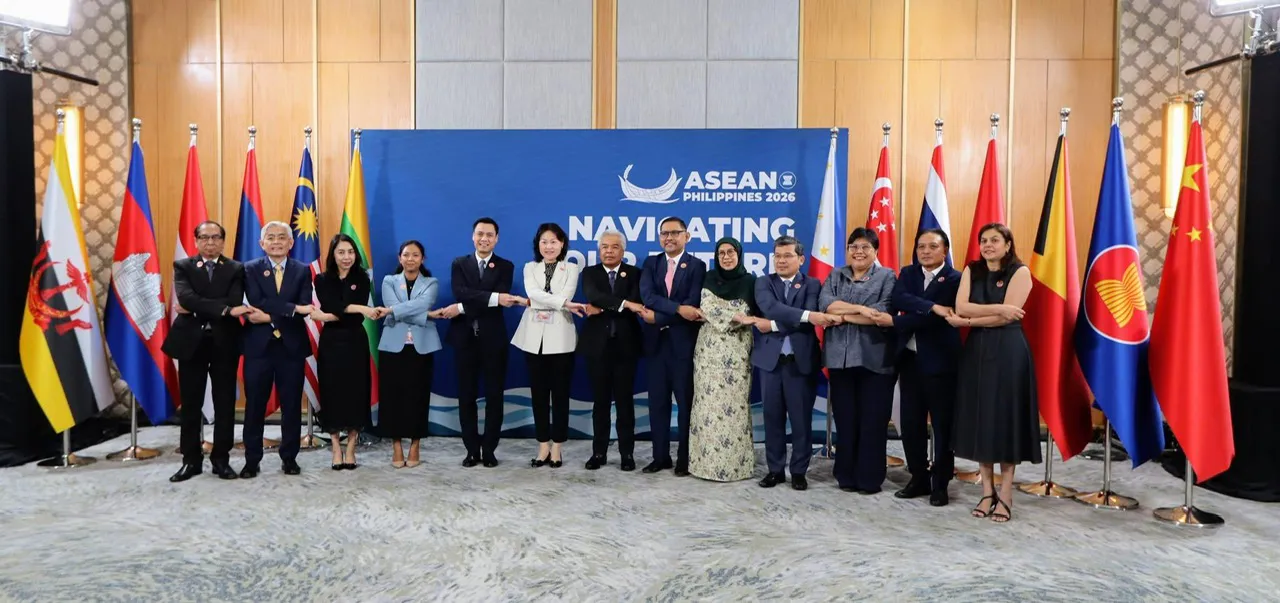
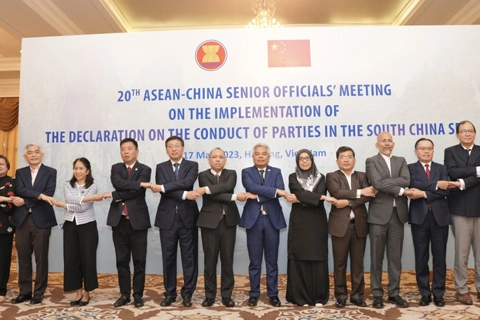
Representatives of ASEAN member states and China at the SOM-DOC 25 in Cebu, the Philippines on January 30. Photo: MOFA
The consensus was reached at the 25th ASEAN-China Senior Officials’ Meeting (SOM) on the Implementation of the Declaration on the Conduct of Parties in the South China Sea (SOM-DOC 25), held on January 30 in Cebu, the Philippines.
The meeting was co-chaired by Malaysia, in its capacity as ASEAN-China dialogue relations coordinator and China, and attended by deputy foreign ministers and senior officials from ASEAN countries and China.
The Vietnamese delegation was led by Deputy Minister of Foreign Affairs Dang Hoang Giang, Head of the SOM ASEAN-Vietnam.
Participants exchanged views on developments in the sea, reviewed the implementation of the Declaration on the Conduct of Parties (DOC) and discussed progress in COC negotiations.
They underscored the importance of maintaining peace, stability, security, safety and freedom of navigation and overflight in the South China Sea based on international law, including UNCLOS 1982, while reaffirming their commitment to building the waters into a sea of peace, cooperation, and prosperity.
The meeting also welcomed Cambodia’s official ratification of UNCLOS.
The delegates reaffirmed the DOC as a key foundation of ASEAN-China relations and noted progress in its implementation, including practical cooperation activities that have helped build trust and advance cooperation in addressing common challenges.
On that basis, participants agreed to continue ensuring the full and effective implementation of all DOC provisions, contributing to peace and stability in the East Sea and creating favourable conditions for COC negotiations.
The meeting also acknowledged progress in the COC talks and agreed that further efforts were needed to conclude the document at an early date, ensuring that it is effective, substantive and consistent with international law, including UNCLOS 1982.
Addressing the meeting, Deputy Minister Dang Hoang Giang welcomed the outcomes achieved in implementing the DOC and advancing COC negotiations.
He stressed that maintaining peace, stability, and cooperation in the East Sea serves the common interests of all countries and reflects the shared understanding reached by ASEAN and Chinese leaders at recent summits.
Regarding recent complex developments in the East Sea, he expressed concern and called on all parties to comply with international law, fulfil their international obligations, refrain from the use or threat of force, and resolve disputes by peaceful means in accordance with international law, particularly UNCLOS 1982.
Giang reiterated the DOC as one of the cornerstone documents of ASEAN-China relations, urging all parties to make their utmost efforts to fully and effectively implement its commitments, thereby contributing to peace and stability in the East Sea and the wider region and facilitating COC negotiations.
Concerning the COC, Deputy Minister Dang Hoang Giang reaffirmed Vietnam’s commitment to continued active, responsible, and constructive participation, working with other parties to accelerate negotiations toward an effective and substantive COC consistent with international law, including UNCLOS 1982, which would make a meaningful contribution to maintaining peace and promoting cooperation in the East Sea.
On the sidelines of the meeting, he held bilateral contacts with the head of the Chinese delegation and representatives of several ASEAN countries.
|
The Code of Conduct in the South China Sea (COC) is a framework currently under negotiation between ASEAN and China, intended to guide conduct, prevent incidents, and help manage tensions in the South China Sea. Negotiations on the COC are being carried out on the basis of the 2002 Declaration on the Conduct of Parties in the South China Sea (DOC), which constitutes a political commitment rather than a legally binding instrument. ASEAN and China have agreed that the COC should build upon the DOC and contribute to the maintenance of peace and stability in the region. ASEAN and China have repeatedly affirmed that the COC should be effective and substantive, and consistent with international law, including the 1982 United Nations Convention on the Law of the Sea (UNCLOS). Discussions on the COC cover principles and norms of behavior, measures to prevent and manage incidents at sea, and mechanisms to enhance trust and cooperation. Matters such as geographic scope, implementation arrangements, and the legal character of the COC continue to be addressed in the course of negotiations. ASEAN and China have also reiterated that the COC is intended to complement, rather than replace, international law, and that UNCLOS 1982 remains the legal framework governing maritime rights and obligations in the South China Sea. |