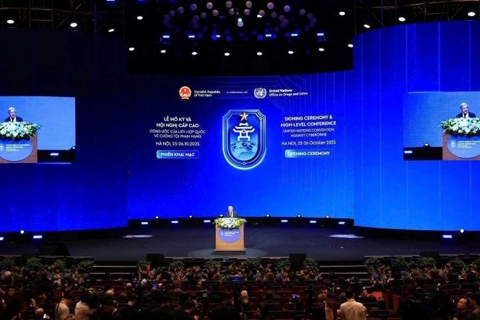
Fighting online scams becomes top ASEAN priority in digital age
The Hanoi Declaration marks a shift in ASEAN digital integration from infrastructure connectivity to connected intelligence, positioning AI as essential smart infrastructure rather than just a tool.
THE HANOI TIMES — ASEAN has elevated the fight against online scams to a top, long-term priority of regional digital cooperation, committing to build a safe and trusted digital space as the foundation of its digital economy and artificial intelligence development.

The 6th ASEAN Digital Ministers Meeting (ADGMIN) held in Hanoi on January 12-16. Photos: Vietnam's Ministry of Science and Technology
That political message was formalized in the Hanoi Declaration on Digital Cooperation, adopted at the 6th ASEAN Digital Ministers Meeting (ADGMIN) in Hanoi from January 12-16, 20266, amid mounting losses from online scams that cost Southeast Asia tens of billions of US dollars each year.
Ministers agreed that without digital trust, efforts to promote AI, data-driven innovation and digital transformation could stall or even backfire, as cybercrime and cross-border scam networks grow in scale and sophistication.
The rapid expansion of the digital economy and artificial intelligence (AI) is opening unprecedented opportunities for ASEAN while creating increasingly complex risks in cyberspace, especially cross-border online scams.
According to the ASEAN Secretariat, fraud networks are increasingly exploiting AI, big data and digital platforms, making scams harder to detect and dismantle.
These losses go beyond financial damage but undermine digital trust, which is the most critical foundation of the digital economy and digital society.
This reality explains why the Hanoi Declaration highlighted cybersecurity and cooperation against online scams from its opening sections.
ASEAN Digital Ministers agreed that without effective control of scams and cybercrime, efforts to promote AI, data and innovation could lose momentum or even backfire.
Speaking at the closing meeting on January 16, Vietnam’s Minister of Science and Technology, Nguyen Manh Hung, stressed that digital trust is a prerequisite for people and businesses to fully participate in digital transformation.
He said combating online scams is a development issue directly linked to the sustainability of the ASEAN digital economy.
For that reason, ASEAN’s decision to elevate anti scam efforts to a shared priority reflects a shift from reactive thinking to a more proactive and preventive approach.
Under the Hanoi Declaration, ministers agreed to strengthen the role of the ASEAN Regional Computer Emergency Response Team. Information sharing, early warning systems and coordinated responses to cross border scam cases will be intensified.
The ASEAN Working Group on Anti Online Scams was identified as a key coordinating mechanism to include policy alignment, harmonize procedures and promote regional best practices.
The bloc will also promote cross-border data flows to support the digital economy, while ensuring data security, privacy protection and compliance with national laws.
Meanwhile, ASEAN experts note that personal data is often the main input exploited by scam networks, making effective data governance the first line of defense.
Lim Wei Cheng, a cybersecurity expert from the ASEAN digital safety working group, said online scams are no longer an isolated national issue. Only when ASEAN acts as a unified digital space, with shared data and coordinated enforcement, can high tech criminal networks be weakened.
Digital transformation, AI and cybersecurity moving together

ASEAN states join hands to combat online scams.
Regional ministers argued that placing anti scam efforts at the center does not slow down innovation, but it creates a foundation for safer and more sustainable digital transformation.
The Hanoi Declaration signals a new phase of ASEAN digital integration, shifting from infrastructure connectivity to intelligence connectivity. In this context, AI is viewed not just as a tool, but as an essential form of smart infrastructure.
The 6th ADGMIN meeting themed “Adaptive ASEAN: From Connectivity to Connected Intelligence” held on January 12-16, 2026 took place as AI, big data, cloud computing and the Internet of Things are reshaping global growth models.
ASEAN estimates that the digital economy could contribute more than one trillion US dollars to regional GDP by 2030, if developed safely and responsibly.
However, ministers acknowledged that AI is increasingly being abused to create sophisticated scams, including voice and image impersonation and large scale automated fraud campaigns.
As a result, ASEAN agreed to strengthen AI governance and ethics alongside AI deployment to treat responsible AI as an integral part of the regional digital safety strategy.
The ASEAN Working Group on Artificial Intelligence has issued the ASEAN Guidelines on AI Governance and Ethics to emphasize transparency, accountability, and a human centered approach.
The establishment of the ASEAN AI Safe Network, endorsed at the 47th ASEAN Summit, reinforces efforts to prevent technological risks, including the misuse of AI for scams and cybercrime.
In addition, the meeting approved the ASEAN Digital Masterplan 2030, which builds on the achievements of the ASEAN Digital Masterplan 2025. During the 2021 to 2025 period, ASEAN implemented and completed 82 digital cooperation initiatives, laying a solid foundation for the next phase.
Meanwhile, the ASEAN Digital Masterplan 2026-2030 (ADM 2030) aims to build an inclusive, safe, trusted and innovative digital ASEAN, in line with the ASEAN Community Vision 2045 and the ASEAN Economic Community Strategic Plan 2026 to 2030.
Notably, among the 17 priority initiatives to be implemented in 2026, cybersecurity and the fight against online scams remain among the core focus areas.
Digital inclusion, infrastructure and political commitment

ASEAN Digital Masterplan 2030 (ADM 2030) promised to open sustainable digital development.
The Hanoi Declaration also makes clear that combating online scams cannot be separated from digital inclusion.
Expanding affordable connectivity, improving digital skills and protecting vulnerable groups such as the elderly, women, youth and rural communities are seen as fundamental measures to reduce exposure to scams.
ASEAN statistics show that internet penetration in the region has exceeded 75%. However, significant gaps in digital skills remain, leaving parts of the population vulnerable to increasingly sophisticated fraud schemes.
In this regard, ASEAN considers digital workforce development and public awareness as a social defense layer, alongside technical solutions.
The meeting also noted positive progress in 5G deployment across member states, recognizing it as a key foundation for digital transformation. At the same time, ministers stressed the need to better protect telecommunications infrastructure and submarine cables, which form the backbone of the regional digital space.
Vietnam was commended for its role in chairing the ASEAN Conference on 5G for several consecutive years, contributing to more harmonized and sustainable infrastructure development.
Vietnamese Minister Nguyen Manh Hung said the adoption of ADM 2030 and the Hanoi Declaration represents a political commitment and a promise of action by ASEAN to protect people and businesses in the digital space.
He emphasized that only by effectively controlling online scams and cybersecurity risks can ASEAN fully unlock the potential of AI and the digital economy.
Brunei will host the 7th ASEAN Digital Ministers Meeting in Bandar Seri Begawan on January 28 and 29, 2027, continuing the regional digital cooperation agenda.
Through the Hanoi Declaration, ASEAN has sent a clear policy signal that sustainable growth and innovation in the digital age must be anchored in safety and trust, making the fight against online scams a strategic imperative for the long-term resilience of the ASEAN Community.