Capital Law acts as catalyst for Hanoi’s sustainable urban future
The 2024 Capital Law creates a robust legal foundation for Hanoi's future environmental policies.
THE HANOI TIMES — Hanoi, the only city in Vietnam with its own dedicated law, is using the 2024 Capital Law as a legal springboard to roll out stronger environmental policies, aiming to improve air quality and protect public health.

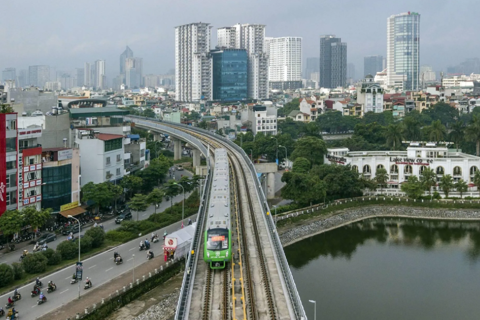
Hanoi from above. Photo: Tuan Anh/The Hanoi Times
Foundation for green transition
The new law marks a turning point, granting Hanoi unprecedented mechanisms, policies, and authority to manage urban development and environmental protection. According to environmental experts, the legislation not only sets out principles for sustainable development, a circular economy, and climate resilience, but also delegates the authority to the Hanoi People’s Council to craft flexible, context-specific policies tailored to the city’s needs.
One of the most notable provisions of the Capital Law is its push for cleaner transportation. It introduces breakthrough measures to support individuals and businesses in transitioning from fossil fuel vehicles to those powered by clean energy.
Strict regulations on emissions and the designation of low-emission zones, as well as areas prioritized for air quality control, demonstrate the city’s determination to improve air quality in Vietnam’s largest urban center.
Associate Professor Dr. Vu Thanh Ca, an environmental expert at the Hanoi University of Natural Resources and Environment, told The Hanoi Times that the law lays out comprehensive enforcement mechanisms, budget allocation provisions, and clearly defined responsibilities across government agencies.
This creates a robust legal foundation for future environmental policies, Ca said. “Rather than broad and vague guidelines, the law delivers direct and specific mandates, empowering Hanoi to implement bold but necessary actions in pursuit of a more sustainable future.”
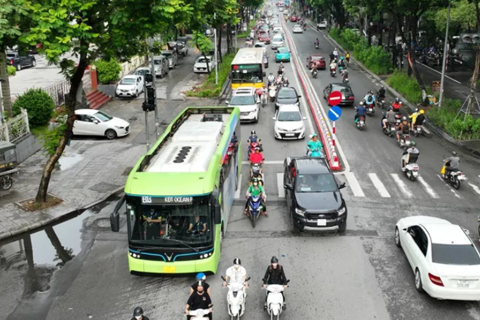
Transitioning to greener transportation has been identified as a top priority in Hanoi’s environmental agenda. City authorities have rolled out a range of support programs, including subsidies and fee reductions for individuals and businesses investing in electric or clean-fuel vehicles. Efforts are also underway to build a widespread network of charging stations and to modernize public transport through electric buses and taxis, gradually replacing gasoline-powered vehicles.
A key provision of the Capital Law grants the Hanoi People’s Council the authority to establish low-emission zones.
Starting January 1, 2025, Hanoi will pilot these zones in central areas such as Hoan Kiem and Ba Dinh. Restrictions will apply to high-emission fossil-fueled vehicles, giving priority to clean vehicles and public transport. These zones are expected not only to significantly improve air quality in densely populated areas, but also to pave the way for citywide expansion after 2030.
The proposed phase-out of gasoline-powered motorbikes is not a sudden idea, but rather a calculated move aligned with the core spirit of the Capital Law. In essence, it is a necessary step toward realizing low-emission zones, an approach already successfully adopted in cities like London, Paris, and Singapore. The policy aims to achieve two goals at once: sharply cutting air pollution and restructuring urban transport, easing congestion while encouraging a shift to clean and modern public transport.
To make the motorbike phase-out feasible, Hanoi is accelerating the development of green transport infrastructure. By the end of 2026, the city aims to equip at least 10% of parking spaces in existing buildings and 30% in new developments with EV charging stations. Expansion of electric bus and metro systems is also being prioritized, with plans to cover all main routes and densely populated areas by 2030.

Electrical bus on Hanoi street. Photo: Thanh Hai/The Hanoi Times
Sustainable solutions
While these efforts reflect a strategic vision, implementation faces significant challenges. Infrastructure for both public transport and EV charging remains limited, particularly in older apartment complexes and crowded residential zones.
Nguyen Dai Hoang, an active member of the Otofun automotive forum, raised a common concern: “How can you charge an EV when many old apartment blocks don’t have space for charging stations?” Indeed, many buildings constructed before 2000 lack the space for modern upgrades, making EV adoption difficult.
Another looming challenge is the disposal of used EV batteries. With an estimated 450,000 electric vehicles expected to replace gasoline-powered motorbikes within Ring Road 1, improper disposal of batteries after 5–7 years of use could pose a serious environmental threat. Experts warn that without an effective system for collection and recycling, EVs might end up shifting pollution from air to land.
Changing public habits also remains a major hurdle. For many, motorbikes are not just a mode of transport but a livelihood. From informal workers to small vendors, many people, especially those with lower incomes, worry about the costs and convenience of switching to alternative vehicles.
To overcome these barriers, Ca said Hanoi must adopt a comprehensive, long-term approach.
He noted that investment in public transport infrastructure is essential, particularly the extension of electric buses and metro lines to suburban areas. Mobile charging stations should also be explored, especially for dense residential neighborhoods and older apartment blocks.
On battery waste, Hanoi should partner with EV manufacturers to establish internationally compliant collection and recycling systems. Clear regulations requiring producers to take responsibility for used batteries should be introduced.
“Hanoi could look to Japan’s model, where EV producers are required to post a deposit to cover future recycling costs, easing pressure on public budgets,” Ca noted.
At the same time, the city must enforce clear regulations on low-emission zones, vehicle emissions standards, and penalties for non-compliance.
“Only with a realistic roadmap, adequate support measures, and strong public and business engagement can Hanoi meet its green transition goals, cutting air pollution and improving urban living standards in a sustainable way,” he said.