Government to fialize draft resolution accelerating Vietnam’s long-term social housing development
The government wants faster, simpler social housing development with online registration, better access to capital and strong oversight to meet Vietnam’s goal of one million affordable homes by 2030.
THE HANOI TIMES — Prime Minister Pham Minh Chinh has ordered the Ministry of Construction to finalize a new social housing resolution that simplifies procedures, shortens project timelines to two or three years and ensures real benefits for citizens.
At a meeting of the Central Steering Committee for Housing and Real Estate Market Policies with ministries and 17 provinces and cities on October 24, the prime minister asked the ministry to complete the draft resolution and submit it to the government within five days.

Prime Minister leads an online conference on October 24 connecting 17 provinces and cities with high demand for social housing. Photo: VGP
The upcoming resolution, set to take effect nationwide for the long term, aims to attract capable developers that meet financial, technical and operational standards while empowering localities with more responsibility in project implementation.
Prime Minister Chinh suggested that the resolution define specific conditions, standards and procedures for selecting developers in a transparent and decentralized manner, giving localities greater responsibility in implementation.
As Head of the Central Steering Committee, the prime minister said that the resolution must ensure fairness, transparency and equal access for homebuyers while preventing misuse of incentives.
He urged ministries, tax authorities and credit institutions to quickly remove obstacles, especially in capital access for developers and low-income households.
Social housing must include complete infrastructure such as transport, utilities, healthcare, education and cultural facilities to create equal living conditions and support sustainable urban growth, Chinh said.
The prime minister praised ministries and provinces for effectively carrying out the plan to build one million social housing units for low-income earners and industrial workers during 2021–2030.
He proposed expanding eligibility to include residents affected by administrative restructuring and diversifying funding sources beyond bank loans, including establishing a Social Housing Fund.
“We must cut at least half of all administrative procedures, classify social housing projects as priority projects for fast-track approval, and prepare clean land through flexible methods,” he said.
He also called for diversifying capital sources through credit, state funding via the Vietnam Bank for Social Policies, housing development funds and bond issuance.
Regarding eligibility and screening, he tasked provincial and municipal authorities to strengthen post-verification using integrated national databases to ensure transparency and accurate information about housing demand and ownership.
Deputy Minister of Construction Nguyen Van Sinh reported that about 9,830 hectares across 1,420 sites are available for social housing projects, but demand remains high, with residents still queuing to register for affordable homes due to limited supply.
Vietnam targets to complete one million social homes for low-income earners by 2030. Until now, nearly 700 projects nationwide are underway, totaling 637,000 units.
Of these, 165 projects with 116,000 units have been completed, 151 projects with 132,000 units are under construction and 380 projects with 388,000 units have received investment approval.
Between January and September, more than 50,000 units were completed, with another 38,000 expected by year-end, bringing the total to nearly 89,000 homes. Vietnam aims to complete 100,000 affordable homes in 2025.
Digital access and streamlined process
Deputy Minister of Finance Do Thanh Trung proposed an online registration platform for social housing purchases managed by a single agency that connects data with other ministries to shorten approval times and improve accessibility.
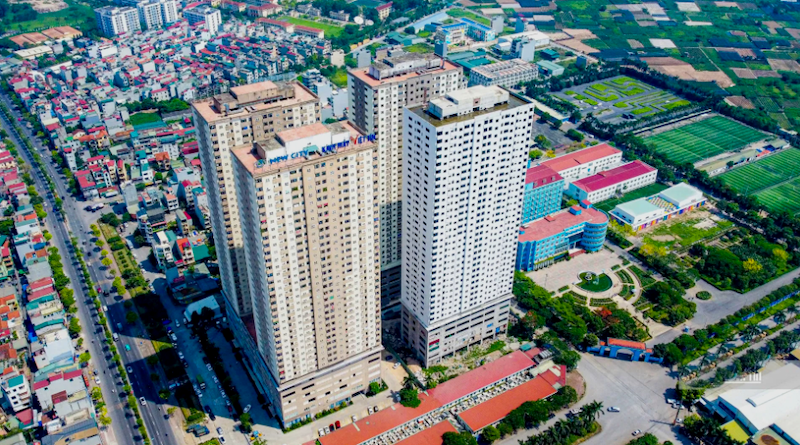
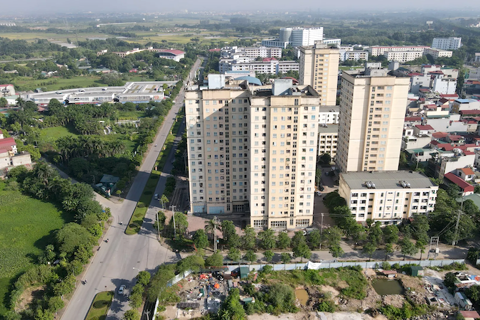
AZ Thang Long Social Housing Complex in Hoai Duc, Hanoi. Photo: Hai Linh/The Hanoi Times
He said the integrated database would replace time-consuming manual verification, a frequent cause of system overload during registration periods.
Former Deputy Minister of Construction Le Quang Hung, a member of the Government’s Policy Advisory Council, suggested simplifying the permitting process to two main steps, including investment approval and either feasibility appraisal or construction permit, removing redundant procedures.
He also recommended that the ministry’s list of 21 recommended investors serve only as a reference, not an exclusive group, and that selection criteria prioritize political commitment, financial capacity, project progress and pricing compliance.
Hung warned that the current draft focuses heavily on middle-income buyers, while low-income workers, especially in industrial zones, still lack affordable rental options. He proposed linking housing policy with industrial park enterprises, many of which could use welfare funds to build worker housing.
At the meeting, some businesses proposed faster project implementation by including land clearance and compensation costs in the selling price.
Minister of Construction Tran Hong Minh said that the idea would be inappropriate as it distorts the purpose of social housing.
“If we include land clearance costs, prices will rise and projects will turn into commercial housing,” he said. “Social housing prices on clean land provided by localities should only include construction and infrastructure costs to offer the most affordable rates for eligible buyers.”