Hanoi aims for urban reslience against climate change by 2030
The goal is to build and refine the urban governance model, thereby improving the efficiency of city management and the quality of urban life.
Hanoi aims to build a cohesive, modern urban infrastructure network that is resilient to climate change by 2030 in the city's action plan to implement the Politburo’s resolution No.06 on sustainable management of Vietnam's cities by 2030, with a vision to 2045.
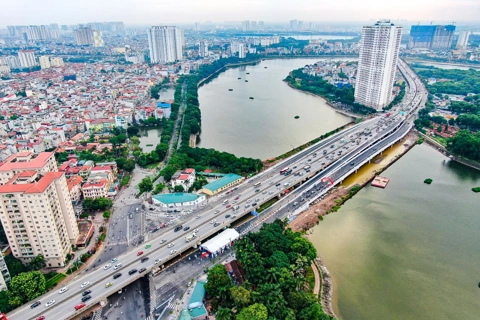
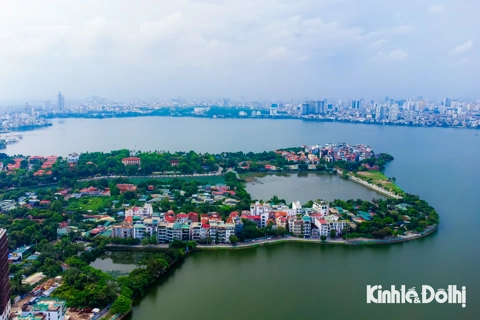
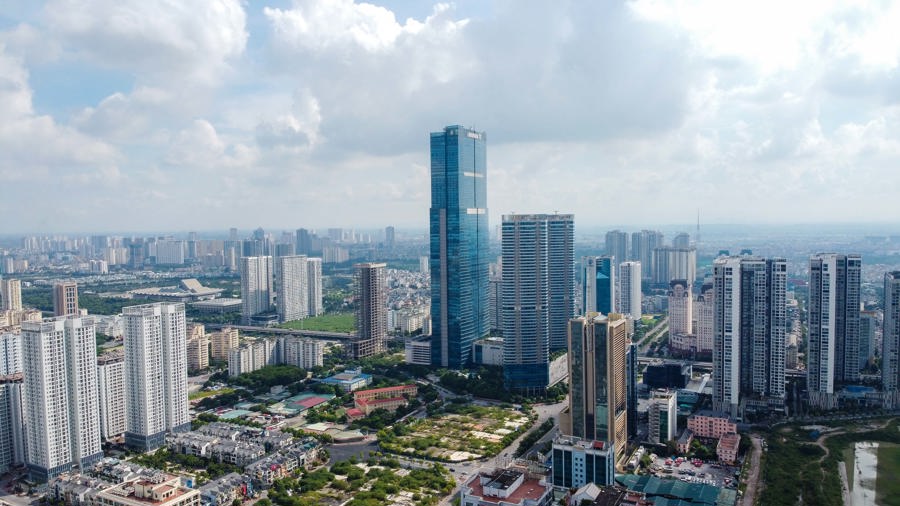
| Hanoi from above. Photo: Hai Linh/The Hanoi Times |
Other key targets include an urbanization rate of about 60-62% by 2025 and a further increase of 65-75% by 2030. In addition, the ratio of urban construction land to total natural land area should be about 30% by 2025 and 33-36% by 2030.
The capital's socio-economic goals by 2025 include completing 100% of district construction plans, satellite urban zoning plans, functional area construction zoning plans, detailed plans for revitalized areas, renovation programs for old apartment buildings, and urban rejuvenation and development initiatives.
At the same time, efforts will be made to establish a comprehensive system of planning and architectural management regulations and to make adjustments to the master plan to ensure the development conditions of various districts.
In terms of urban transportation and infrastructure, the city aims to achieve a ratio of urban transportation land (including static traffic) to urban construction land of 12% to 15% by 2025, and further increase it to 15% to 20% by 2030.
Similarly, the city aims to have about 30-35% of the city's commuters carried by public transport by 2025 and about 45-50% by 2030. The average green tree cover per urban resident should reach about 7.8-8.1 square meters per person by 2025 and about 12-14 square meters per person by 2030.
In addition, the average residential floor area per capita in urban areas is targeted to reach 31 square meters per person by 2025 and 33 square meters per person by 2030.
Hanoi also plans to renovate and upgrade existing medical facilities while investing in the construction of new hospitals. The priority is to quickly complete four large general hospitals at the city's entrances and reach the target of 30-35 beds per 10,000 people by 2025. The total number of hospital beds in medical facilities is expected to total around 21,880 beds by 2025 and approximately 24,380 beds by 2030.
It also aims to achieve a ratio of 2.8 to 3.2 hospital beds in city medical facilities per 1,000 residents and at least 15 doctors per 10,000 residents by 2025.
The city also sets a target to achieve a higher average gross regional domestic product (GRDP) growth rate than the national average during 2021-2025. In addition, it projects a GRDP expansion of 8-8.5% per year from 2026-2030. The goal is to achieve a per capita GRDP in the range of US$12,000 to US$13,000.
Specific industrial targets include a 17% share of processing and manufacturing in GRDP by 2025, rising to 20% by 2030.
The city aims to increase the share of the digital economy in the GRDP to 25-30% by 2025 and to 35-40% by 2030. In addition, the contribution of the cultural industry to the GRDP is projected to be 5% by 2025 and 8% by 2030.
Emphasis will be placed on increasing the share of high technology in the value of agricultural production to 70% by 2025 and 80% by 2030. Finally, it is planned to complete Ring Road No.4 by 2027 and prepare for the investment and construction of Ring Road No. 5 by 2030.
The municipal People's Committee has assigned various departments and sectors to orchestrate and implement comprehensive public awareness campaigns, educational initiatives, and extensive public engagement across society to emphasize the importance of planning, construction, management, and sustainable urban development.
These efforts are aimed at translating guiding principles and solutions into concrete actions, leveraging the strength of the political system to implement the proposed strategies effectively. The achievement of these goals would mark another milestone in Hanoi's development, following its administrative boundary expansion 15 years ago.
The city is committed to refining its regulations and policies to streamline the urbanization process and promote systematic and sustainable urban development. The focus will be on advancing urban governance and development, promoting housing initiatives, and building a cohesive, modern urban infrastructure network that is resilient to climate change.
At the same time, it aims to build and refine the urban governance model, thereby improving the efficiency of urban management and the quality of urban life. This includes ensuring social security and welfare and maintaining urban safety and order.