Hanoi commits to environmental protection in craft village development
The city will expedite investments in constructing and enhancing environmental infrastructure specifically designed for craft villages.
Over the years, Hanoi has devoted significant resources to tackling pollution in craft villages, primarily by constructing numerous wastewater treatment plants. The city is actively promoting social investment to help manage waste in craft villages.
| Making water puppets in Dao Thuc Village, Dong Anh District, Hanoi. Photo: The Hanoi Times |

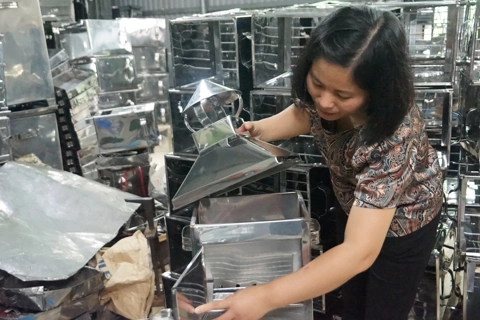
Statistical data from the Hanoi Department of Natural Resources and Environment show that there are currently 1,350 handicraft villages in the city, accounting for about 56% of all rural villages. Undoubtedly, craft villages have played a vital role in restructuring the agricultural and rural economy, creating jobs, and improving farmers' living standards and incomes.
However, the development of some craft villages has revealed inherent shortcomings, especially environmental pollution. As village commerce flourishes, pollution increases, seriously affecting the ecological environment and the well-being of its residents. Many artisan villages collect waste and dump it directly into the environment without solid waste disposal systems or proper wastewater treatment and exhaust gas management.
Experts attribute this problem to the production characteristics of these villages, where the main interest is in investing in product development. In many cases, insufficient attention is paid to the protection of the environment and the well-being of workers.
Limited investment capital hinders production and business expansion, resulting in rudimentary equipment and outdated processing technologies. In addition, only a small fraction of production and business facilities in artisan villages have adopted modern production lines.
These facilities are often fragmented, small, and scattered and lack proper waste management technology. Meanwhile, the people working in these industries lack awareness and voluntary compliance with legal requirements for waste collection, treatment, management and environmental protection.
To effectively combat environmental pollution and fully utilize the potential of craft villages, local authorities have taken proactive measures in planning and developing industrial zones, clusters, and areas in craft villages.
Nguyen Xuan Minh, Chairman of the People's Committee of Thuong Tin District, noted that the locality has been working on the planning and constructing industrial clusters specifically tailored to craft villages.
According to Minh, these localities have designated areas for waste collection in communes and townships, developed landfills, set up construction waste treatment facilities, and built sewerage systems.
"The district has also mandated vocational communes to implement comprehensive environmental protection plans and facilitated production and business establishments to sign environmental protection commitments," Minh said.
The district of Phu Xuyen has recently placed great emphasis on addressing environmental concerns in its handicraft villages. With more than 900 active production and business units in 42 villages, Phu Xuyen has recognized the importance of ecological criteria in developing new rural areas and improving existing ones.
Vu Van Huu, head of Phu Xuyen's Natural Resources and Environment Department, said the department has prioritized protecting and improving environmental quality. As a result, many villages have been gradually revitalized, improving living conditions for those living there.
Ensuring full compliance with environmental protection
Hanoi has introduced a comprehensive plan, roadmap, and strategy to address environmental pollution in craft villages by 2025, with a vision for 2030. The Hanoi People's Committee has set an ambitious goal to ensure that all recognized handicraft villages in the capital city meet environmental protection requirements by 2025.
The plan includes the achievement of specific milestones by the end of 2025 and the assessment and classification of all recognized handicraft villages according to existing regulations.
The ultimate goal is 100% compliance with environmental protection requirements in Hanoi's recognized craft villages. Looking ahead to 2030, the city aims to ensure that all craft villages meet comprehensive environmental protection criteria, effectively addressing the persistent problem of environmental pollution in these areas.
To achieve these goals, Hanoi has established an implementation roadmap. This includes the preparation, evaluation and approval of environmental protection plans for craft villages, ensuring strict compliance with environmental protection laws.
The city will accelerate investments in environmental infrastructure designed for craft villages following the environmental criteria outlined in the Law on Environmental Protection.
Regular assessments of environmental pollution levels will be conducted, and appropriate measures will be taken to mitigate and prevent environmental degradation and pollution risks.
Meanwhile, the city would strengthen inspection and monitoring efforts, ensuring that production households in handicraft villages comply with regulations and requirements for environmental protection.
By 2030, the Hanoi People's Committee aims to successfully relocate production facilities from craft villages to concentrated industrial zones, clusters, and designated production sites as outlined in the approved master plan. Investments will be made in the necessary infrastructure to support the operation and development of industrial clusters, including those specifically designated for craft villages in the approved plans. Priority will be given to ensuring these clusters meet the environmental protection requirements in the Law on Environmental Protection.