Hanoi focuses on investment in green energy
To encourage the use of clean energy, the city is renovating electrical systems in urban areas, public spaces, and gas stations.
Hanoi is taking steps to promote investment in green and clean energy to aid sustainable socio-economic development.
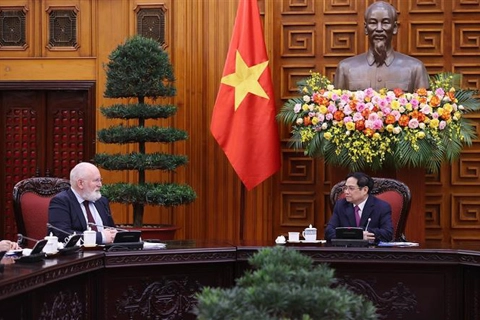
| Overview of the meeting. |

Deputy Chairman of Hanoi People's Committee Nguyen Manh Quyen made the remarks on March 13 at a meeting with representatives of the National Assembly's Standing Committee on Energy Development.
According to Quyen, the city is currently prioritizing clean-energy buses, which is in line with the roadmap to increase the proportion of electric and clean-energy vehicles by 2030.
Quyen noted that Hanoi's goal is to replace all gasoline or diesel taxis with electric or green energy vehicles by 2030 and to invest in new technologies to support this change.
In addition, the city is renovating electrical systems in urban areas, public spaces, and gas stations to support the use of clean energy, he added.
Commenting on Hanoi's power supply capacity, Nguyen Dinh Thang, deputy director of the city's Department of Industry and Trade, said the city's power grid includes three transformer stations, 285 km of 500 kV power grid, 13 substations, 775.86 km of 220 kV power grid, 63 substations, 1,052 km of 110 kV power grid, over 22,694 distribution stations, and 47,000 km of medium and low voltage lines.
The power grid is also connected to substations in neighboring areas to provide electricity to about 2.8 million customers in the city, supporting socio-economic development, he added.
In terms of power sources, the city has invested in 2,102 rooftop solar power systems with a capacity of 33.82 MWp, the Nam Son waste power plant with a capacity of 1.93 MW (already operational), and two power source projects: the Soc Son waste power plant project with a capacity of 75 MW (with 2/3 of power generation units already operational with a capacity of 60 MW) and the Seraphin waste power plant project with a capacity of 37 MW (construction started on March 30, 2022).
Hanoi has an average monthly demand of 146,500 m3. At present, the city has three gasoline depots with a capacity of more than 5,000 m3 and two gasoline depots with a capacity of less than 5,000 m3, as well as 493 gasoline stations, of which 32 are temporarily closed for various reasons.
Based on the current energy development situation in the capital, Thang suggested studying and implementing specific mechanisms to promote and support the development of rooftop solar power, as well as issuing mechanisms for buying and selling electricity in the area.
He also recommended that relevant agencies prioritize planning and allocating land funds for energy development to serve the socio-economic needs, and invest in building petrol and transformer stations in the city area.
At the meeting, National Assembly deputy Ta Dinh Thi highlighted the omission of specific references to solar power, roof power, biomass power, and smart grids in the energy monitoring report, stressing the necessity to address policy and legal issues related to energy development in the city.
The management and administration of petroleum prices in the capital is a topic of interest for many National Assembly deputies, given the strategic importance of the city. National Assembly delegate Vu Tien Loc stressed the importance of reporting and assessing responsibilities in the event of a disruption in the petroleum supply chain in the city.
National Assembly deputy Nguyen Phuong Thuy emphasized the need for a comprehensive strategy for planning petrol distribution stations and transformer stations. Additionally, delegates noted the lack of attention given to public charging stations for electric vehicles and called for specific policies to address the growing trend of "green" vehicles.
On these issues, Deputy Chairman Nguyen Manh Quyen has affirmed that the city has achieved synchronized management and administration of the oil market, leading to a stable supply situation in recent years. However, he has acknowledged the challenges posed by the lack of regulations on oil management, especially in reserve building, and called for policies to remove obstacles and ensure more effective management of the oil market.